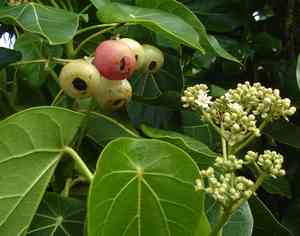
Hernandia (Hernandia) (Hernandia)
Also known as: Lantern Tree, Corkwood
Hernandia is a genus of flowering plants in the family Hernandiaceae, native to tropical regions of the Americas, the Caribbean, Africa, Madagascar, Southeast Asia, and Australasia. These plants are often trees or shrubs.
In This Article
Attributes of Hernandia (Hernandia)
Lifespan
Perennial
Plant Height
5-20 meters
Spread
5-10 meters
Leaf Color
Green
Flower Size
0.5-1 cm
Flower Color
White or pale yellow
Images of Hernandia (Hernandia)
Quickly Identify Hernandia (Hernandia)
1
Identifying Hernandia species involves examining the leaf shape and arrangement, flower structure, and fruit characteristics. Leaves are generally simple, alternate, and may be either entire or lobed. Flowers are typically small, clustered, and fragrant. Fruits are fleshy, often with a black or dark purple coloring when mature.
Scientific Classification of Hernandia (Hernandia)
Phylum
Magnoliophyta
Class
Magnoliopsida
Order
Laurales
Family
Hernandiaceae
Genus
Hernandia
Planting and Growing of Hernandia (Hernandia)
Care Difficulty
Moderate
Watering Schedule
Every 2 days
Sunlight Requirements
Partial sun
Sunshine Duration
6-10 hours
Ideal Temperature
68-77℉
Soil Type
Potting Mix, Peat Mix
Soil pH
6.5-7.5
Fertilizer Type
Balanced
Pruning Season
Spring, Summer
Pruning Area
Branches, Leaves
Pruning Frequency
2 times a year
Repotting Season
Spring
Pot Type
Plastic, Ceramic
 How to Water Hernandia (Hernandia)?
Hernandia plants prefer moderate watering. The key is to ensure that the top inch of soil is dry before re-watering, avoiding waterlogged conditions. The pot should allow excess water to drain freely to prevent root rot. Typically, water until the soil feels consistently moist but not overly saturated, about 500ml each time.
What are the symptoms of an underwatered Hernandia (Hernandia)?
›
What should I do if my Hernandia (Hernandia) is not getting enough water?
›
What are the symptoms of an overwatered Hernandia (Hernandia)?
›
How to save an overwatered Hernandia (Hernandia)?
›
 What Are the Sunlight Requirements for Hernandia (Hernandia)?
Placing Hernandia in partial sun ensures balanced growth, offering the benefits of controlled light exposure, which prevents stress and promotes leafy vigor and continuous development.
Optimal Duration
›
Preferred Environment
›
Location Strategy
›
 What Is the Ideal Temperature Range for Hernandia (Hernandia)?
For Hernandia, maintaining an ideal growth temperature between 68°F and 77°F is crucial. This range ensures that the plant can perform necessary metabolic processes efficiently, promoting healthy growth and development. Deviating from this range could lead to stress, affecting both growth rate and foliage health.
 What Soil is Best for Hernandia (Hernandia)?
Hernandia thrives in well-drained soils that effectively prevent waterlogging. This is crucial for root health and ensures the plant doesn't suffer from root rot due to excess moisture. The plant requires soil with moderate fertility, providing essential nutrients for healthy growth and vibrant foliage, which can be enhanced with periodic organic matter addition. Maintaining soil moisture is important for Hernandia's growth. Regular watering ensures the plant remains hydrated, especially in dry conditions, promoting robust development.
 How to Fertilize Hernandia (Hernandia)?
For Hernandia, it is crucial to provide just the right amount of fertilizer, neither too little nor too much. When using liquid fertilizer, dilute it to half the recommended strength on the packaging to ensure that the plant absorbs nutrients without any risk of root burn. A balanced, water-soluble fertilizer with an N-P-K ratio of 10-10-10 can be used; apply approximately 200ml per application for a medium-sized plant.
 How to Prune Hernandia (Hernandia)?
Always sterilize your tools before and after pruning to prevent the spread of disease. Use a mild bleach solution or rubbing alcohol for effective disinfection. Prune during mild weather, as extreme temperatures can stress the plant. Early morning or late afternoon is ideal, when the sun is less intense.
 How to Propagate Hernandia (Hernandia) plant?
1
Choose seeds from a reliable source or take cuttings from a healthy, disease-free plant. Ensure that seeds are not damaged and cuttings are taken from robust, non-flowering shoots to increase the chances of successful propagation.
2
Use a well-draining mix suitable for the specific propagation method. For cuttings, a mix of peat and perlite is often recommended as it provides a good balance of moisture retention and aeration.
3
After planting seeds or setting cuttings, place them in a location that receives indirect sunlight and maintains a stable temperature. Proper light and warmth are critical components for the propagation process.
 How to Repot Hernandia (Hernandia) plant?
1
Hernandia plants show signs of needing repotting when they exhibit slowed growth, roots emerging through drainage holes, or the soil dries out too quickly. It's ideal to repot during the growing seasons of spring or summer when the plant is more resilient.
2
Select a pot that is 1-2 inches larger in diameter than the current one. Ensure it has adequate drainage holes. A larger pot helps support root growth and prevents waterlogging, promoting healthier plant development.
3
Opt for a well-draining potting mix with a mix of peat, perlite, and a bit of sand. This ensures good aeration and prevents root rot by allowing excess water to drain easily, keeping the roots healthy and thriving.
Toxicity
Ingestion
WARNING
The judgment on toxicity and danger is for reference only. We DO NOT GUARANTEE any accuracy of such judgment. Therefore, you SHALL NOT rely on such judgment. It is IMPORTANT TO SEEK PROFESSIONAL ADVICE in advance when necessary.
Learn More About Hernandia (Hernandia) Diseases
Anthracnose
Bacterial Leaf Spot
Bacterial Soft Rot
Bacterial Wilt
Black Spot
Chemical Injury
Crown Gall
Cyst Nematode
Damping-off
Downy Mildew
Drought Stress
Fusarium Wilt
Gray Mold
Leaf Curl
Leaf Spot
Mosaic
Nutrient Deficiency
Nutrient Toxicity
Powdery Mildew
Root Rot
Root-knot Nematode
Rusts
Sooty Mold
Spider Mites
Temperature Stress
Thrips Damage
White Mold

