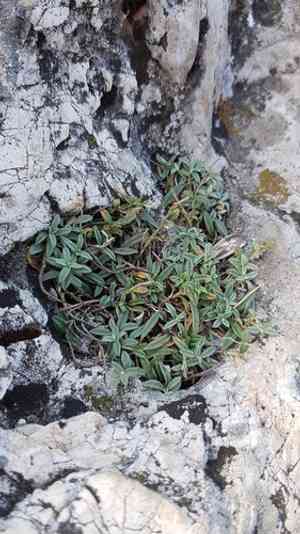
Hoary rock-rose (Helianthemum canum)
Also known as: Gray-leaved Rock Rose
Hoary rock-rose is a low-growing sub-shrub that grows on rocky grassland, cliff edges, and rock outcrops. Its unique feature is its ancient-looking, oval-shaped leaves that come in a lovely shade of grey-green. This foliage is what has given this plant the name "hoary rock-rose."
In This Article
Attributes of Hoary rock-rose
Lifespan
Perennial
Plant Type
Shrub
Plant Height
10-20 cm
Spread
30-60 cm
Leaf Color
Silver-gray
Flower Size
2-3 cm
Flower Color
Yellow
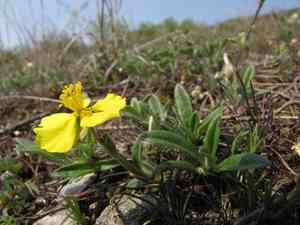
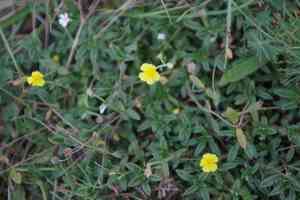
Images of Hoary rock-rose

Quickly Identify Hoary rock-rose
1
Identify Helianthemum canum by its dense, silvery-gray, oval to oblong leaves and small, five-petaled yellow flowers. The plant forms low, spreading mats and often grows in rocky or sandy soils.
Scientific Classification of Hoary rock-rose
Phylum
Vascular plants
Class
Dicotyledons
Order
Malvales
Family
Rock roses
Genus
frostweed
Species
Hoary rock-rose
Planting and Growing of Hoary rock-rose
Care Difficulty
Easy
Watering Schedule
Every 2 days
Sunlight Requirements
Full sun
Sunshine Duration
4-8 hours
Ideal Temperature
65-75℉
Soil Type
Potting Mix, Peat Mix
Soil pH
6.5-7.5
Fertilizer Type
Balanced
Pruning Season
Spring, Summer
Pruning Area
Branches, Leaves
Pruning Frequency
2 times a year
Repotting Season
Spring
Pot Type
Terracotta, Plastic
 How to Water Hoary rock-rose?
Helianthemum canum thrives on efficiency, requiring around 200 ml of water each time you water. This amount is sufficient to moisten the soil without causing water to stagnate at the roots. The key is to ensure the soil dries out between watering sessions to mimic its natural habitat.
What are the symptoms of an underwatered Hoary rock-rose?
›
What should I do if my Hoary rock-rose is not getting enough water?
›
What are the symptoms of an overwatered Hoary rock-rose?
›
How to save an overwatered Hoary rock-rose?
›
 What Are the Sunlight Requirements for Hoary rock-rose?
Helianthemum canum prefers full sun, which promotes abundant flowering and vigorous growth, resulting in a more aesthetically pleasing plant with enhanced vitality.
More About Sunlight Requirements Techniques→
What is the best placement for Helianthemum canum?
›
How can I ensure it gets enough light indoors?
›
Why is full sun important for its health?
›
 What Is the Ideal Temperature Range for Hoary rock-rose?
The ideal temperature range for growing Helianthemum canum is between 65°F and 75°F. This range facilitates optimal photosynthesis and nutrient uptake, promoting healthy foliage and robust flowering. Temperatures within this range also help prevent stress-related issues that might hinder the plant's development.
 What Soil is Best for Hoary rock-rose?
Helianthemum canum thrives in well-drained soil as it prevents waterlogging, which can cause root rot. This is particularly vital for rockrose due to its drought-tolerant nature, aiding in robust growth and vibrant flowering. This plant prefers nutrient-poor conditions, which is beneficial as it allows the plant to maintain its compact size and avoid leggy growth. Over-fertilizing can lead to excessive leaf growth with fewer blooms. A lean, low-organic matter soil suits Helianthemum canum. This type of soil mirrors its natural habitat, facilitating a stress-free adaptation for stronger plant resilience and lush blooms.
 How to Fertilize Hoary rock-rose?
Helianthemum canum, known for its delicate flowers, requires moderate fertilization. Apply liquid fertilizer at a rate of half the recommended strength to avoid overfeeding. Use a balanced 10-10-10 or similar ratio, ensuring no excess accumulates.
 How to Prune Hoary rock-rose?
Start by sterilizing your pruning shears to prevent disease spread. Identify any dead or damaged stems and cut them back to healthy tissue. Remove any crossed or congested stems to enhance airflow. For shaping, trim back into the foliage to maintain a rounded appearance and encourage dense growth. Perform this during the growing seasons of spring and summer.
More About Pruning Techniques→
 How to Propagate Hoary rock-rose plant?
1
Collect seeds from mature Helianthemum canum plants when the seed pods are dry and start to open. It is important to do this in dry weather to prevent mold.
2
Select healthy, non-flowering stems and cut them into lengths of 7-10 cm. Remove the leaves from the lower half to encourage root growth.
3
Dig up the plant and gently separate it into smaller sections, each with roots attached. Replant the divisions at the same depth as the original plant.
 How to Repot Hoary rock-rose plant?
1
Helianthemum canum signals its need for repotting when you notice the roots starting to protrude from the drainage holes or when growth seems stunted despite good care. The optimal time to address these signs is during early spring or late autumn, when the plant is experiencing less vigorous growth and can adapt more easily to changes.
2
The ideal pot for your Helianthemum canum should be only slightly larger than the current one, as this plant prefers a snug fit to enhance root development. A pot with ample drainage holes is crucial to prevent excess moisture, which can lead to root rot. Terracotta pots are often recommended due to their porous nature, which aids in moisture regulation.
3
Helianthemum canum thrives in a well-draining sandy soil mix that closely mimics its natural, rocky habitat. This soil ensures excellent aeration and prevents water retention, reducing the risk of root diseases. You can tailor the mix by combining regular potting soil with sand and perlite to achieve the desired texture and drainage properties.
Learn More About Hoary rock-rose Diseases
Anthracnose
Bacterial Leaf Spot
Bacterial Wilt
Crown Gall
Cyst Nematode
Damping-off
Downy Mildew
Drought Stress
Fusarium Wilt
Gray Mold
Leaf Curl
Leaf Spot
Mosaic
Nutrient Deficiency
Nutrient Toxicity
Powdery Mildew
Root Rot
Root-knot Nematode
Rusts
Sooty Mold
Spider Mites
Temperature Stress
Thrips Damage
White Mold



