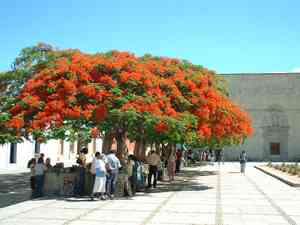
Honey locusts (Gleditsia)(Gleditsia)

Honey locusts (Gleditsia) (Gleditsia)

Also known as: Honey Locust, Thorny Locust

Honey locust trees (Gleditsia triacanthos) are appreciated for their versatility and aesthetic qualities. Known for their delicate, fern-like foliage and open canopy, they provide gentle shade and visual appeal in urban landscapes. Thornless varieties are particularly favored in city settings for safety and ease of maintenance.

These trees are highly adaptable, thriving in various soil types and tolerating urban pollution and harsh conditions. Their minimal maintenance needs and resistance to pests further enhance their suitability for urban environments.

Beyond their ornamental use, honey locusts can also contribute to soil enrichment through nitrogen fixation and serve in erosion control with their extensive root systems. Some species are even used for timber and animal fodder, adding to their practical value.

Attributes of Honey locusts (Gleditsia)

Lifespan
Perennial
Plant Height
20-30 meters
Spread
10-15 meters
Leaf Color
Green
Flower Size
1-1.5 cm
Flower Color
Greenish-yellow

ForwardPlant - Identify plants with a snap

Identify and diagnose plants, get toxicity alerts, and explore safety guides for all types of fungi.

Try for Free

Images of Honey locusts (Gleditsia)

Honey locusts (Gleditsia)(Gleditsia)

Quickly Identify Honey locusts (Gleditsia)

1
Gleditsia trees can be identified by their pinnate or bipinnate leaves, thorns on the trunk and branches, and their long, flat seed pods.

Scientific Classification of Honey locusts (Gleditsia)

Phylum
Tracheophyta
Class
Magnoliopsida
Order
Fabales
Family
Fabaceae
Genus
Gleditsia

Planting and Growing of Honey locusts (Gleditsia)

Care Difficulty
Moderate
Watering Schedule
Every 2 days
Sunlight Requirements
Full sun
Sunshine Duration
6-10 hours
Ideal Temperature
60-75℉
Soil Type
Potting Mix, Peat Mix
Soil pH
6.5-7.5
Fertilizer Type
Balanced
Pruning Season
Spring, Summer
Pruning Area
Branches, Leaves
Pruning Frequency
2 times a year
Repotting Season
Spring
Pot Type
Plastic, Terracotta

water icon How to Water Honey locusts (Gleditsia)?

For Gleditsia, the watering principle is to keep the soil moderately moist but not waterlogged. Water until the soil feels damp about 3 inches deep, ensuring that the plant's roots receive enough moisture without sitting in excess water.
What are the symptoms of an underwatered Honey locusts (Gleditsia)?
What should I do if my Honey locusts (Gleditsia) is not getting enough water?
What are the symptoms of an overwatered Honey locusts (Gleditsia)?
How to save an overwatered Honey locusts (Gleditsia)?

sunlight icon What Are the Sunlight Requirements for Honey locusts (Gleditsia)?

Sunlight Requirements: Full sun, Partial sun
Duration of light: 6-8 hours daily
Gleditsia thrives in environments with full sun or partial sun, benefiting from 6-8 hours of direct sunlight. Such conditions support vigorous growth and overall robust health, optimizing its ability to photosynthesize efficiently.
What is the best lighting condition for Gleditsia?
How can you achieve the ideal lighting condition?
What are the benefits of ideal lighting for Gleditsia?

temperature icon What Is the Ideal Temperature Range for Honey locusts (Gleditsia)?

Ideal Temperature: 60 ~ 75℉
The ideal temperature range for Gleditsia, or honey locust, is between 60°F and 75°F. Within this range, the plant can carry out photosynthesis efficiently and maintain healthy growth. Moderate temperatures also reduce the risk of stress-related diseases, ensuring the plant’s vitality and longevity.

soil icon What Soil is Best for Honey locusts (Gleditsia)?

Soil type: Loam, Sandy loam, Clay soil
Soil PH: 6.5 ~ 7.5
Gleditsia thrives in nutrient-rich soil that provides a steady supply of essential nutrients like nitrogen, phosphorus, and potassium. This rich soil foundation supports strong root development and vigorous growth, essential for maintaining the tree's lush foliage. Ensuring soil drainage is critical for Gleditsia. Well-drained soil prevents waterlogging, which can lead to root rot and other waterborne diseases. This drainage characteristic helps maintain plant health and improves its resistance to adverse conditions. Although Gleditsia can tolerate some drought, consistent soil moisture is beneficial, especially in young trees. Adequate moisture levels help with nutrient absorption and overall growth, enhancing the tree's resilience and productivity.

fertilize icon How to Fertilize Honey locusts (Gleditsia)?

Fertilizer type: Balanced
For Gleditsia, an appropriate amount of liquid fertilizer would be around 1 tablespoon mixed with a gallon of water. For slow-release granular fertilizers, scattering 1 pound per 100 square feet is effective. This balance provides necessary nutrients without overwhelming the plant's system.

prune icon How to Prune Honey locusts (Gleditsia)?

Pruning Time: Spring, Summer, Autumn, Winter
Begin by inspecting your Gleditsia for dead, broken, or diseased branches, removing these with a clean cut close to the main stem. Next, focus on branches that cross or rub against each other, trimming the less vigorous branch back to improve air circulation. Finally, shape the plant by cutting back any overly long branches to maintain a balanced and aesthetic form. While pruning can be done throughout the year, Gleditsia responds best during active growth periods in spring and summer. Avoid pruning during extreme temperatures of winter or late autumn to reduce stress and potential damage to the plant.

propagate icon How to Propagate Honey locusts (Gleditsia) plant?

Propagate Time: Spring,Early spring
1
Select healthy, disease-free branches and cut just below a node. Each cutting should be about 6 inches long. Strip the lower leaves, and optionally dip the end in root hormone powder before planting.
2
Plant the cuttings in a well-draining mix, such as sand or vermiculite. Insert the cutting into the soil halfway, ensuring no leaves touch the soil.
3
Choose a hardy rootstock and make a clean cut at the top. Prepare a grafting scion with a matching cut to fit perfectly onto the rootstock. Secure them together with grafting tape to hold in place as they heal and grow.

repot icon How to Repot Honey locusts (Gleditsia) plant?

Repotting frequency: Every 2-3 years
1
Look for signs such as roots growing out of the drainage holes, the plant becoming top-heavy, or the soil drying out quickly. These indicators suggest it's time for repotting. Ideally, do this during the growth season to minimize stress.
2
Choose a pot that is 2-4 inches larger in diameter than the current one. Ensure it has ample drainage holes to prevent waterlogging. A slightly larger pot promotes healthy root growth, reducing the risk of structural issues above ground.
3
Opt for a well-draining compost mix that allows water to flow through easily, preventing root rot. This type of soil promotes healthier growth by providing sufficient nutrition and maintaining optimal moisture levels around the roots.

ForwardPlant - Identify plants with a snap

Find the best spots for them to optimize their health, simply using your phone.

Try for Free
