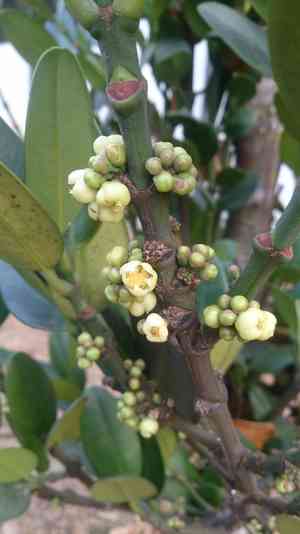
Common garcinia (Garcinia subelliptica)
Also known as: Happiness Tree, Fukugi Tree
The common garcinia tree (Garcinia subelliptica) thrives in coastal forests across regions such as Sri Lanka, Indonesia, the Philippines, and various island chains. Reaching heights of up to 20 meters, this tree serves multiple purposes: it is commonly planted as a windbreak and firebreak, and it adds aesthetic value as a decorative tree. On the Ryukyu Islands of Japan, the bark's pigment has historically been used to produce a yellow dye.
In This Article
Attributes of Common garcinia
Lifespan
Perennial
Plant Type
Tree
Plant Height
6 m to 20 m
Spread
1.1 m
Leaf Color
Green Red
Flower Size
1.5 cm
Flower Color
Yellow White Green
Images of Common garcinia
Quickly Identify Common garcinia
1
Garcinia subelliptica can be identified by its thick, leathery, and shiny dark green leaves, which are elliptical in shape. The tree often produces small yellow flowers followed by bright red to orange fruits.
Scientific Classification of Common garcinia
Phylum
Vascular plants
Class
Dicotyledons
Order
Nances, spurges, willows and allies
Family
Mangosteen
Genus
Saptrees
Species
Common garcinia
Planting and Growing of Common garcinia
Care Difficulty
Easy
Watering Schedule
Every 4 days
Sunlight Requirements
Full sun
Sunshine Duration
6-8 hours
Ideal Temperature
68-86℉
Soil Type
Potting Mix, Peat Mix
Soil pH
5.5-8
Fertilizer Type
Balanced
Pruning Season
Spring, Summer
Pruning Area
Branches, Leaves
Pruning Frequency
2 times a year
Repotting Season
Spring
Pot Type
Plastic, Ceramic
 How to Water Common garcinia?
For Garcinia subelliptica, aim to water until the soil is consistently moist but not waterlogged. Water with about 500 ml to ensure the water reaches the deeper roots without causing the soil to become soggy.
What are the symptoms of an underwatered Common garcinia?
›
What should I do if my Common garcinia is not getting enough water?
›
What are the symptoms of an overwatered Common garcinia?
›
How to save an overwatered Common garcinia?
›
 What Are the Sunlight Requirements for Common garcinia?
Garcinia subelliptica benefits from a range of full to partial sun, helping the plant maintain optimal photosynthetic activity, lush growth, and increased flowering capabilities.
More About Sunlight Requirements Techniques→
What is the best lighting condition for Garcinia subelliptica?
›
How can you achieve ideal lighting conditions indoors?
›
What benefits does Garcinia subelliptica gain from proper lighting?
›
 What Is the Ideal Temperature Range for Common garcinia?
The ideal temperature range for Garcinia subelliptica is between 68°F and 86°F. This range promotes optimal growth, ensuring the plant receives the warmth it thrives in. Growing Garcinia subelliptica in environments within this temperature bracket encourages healthy foliage and fruit development, contributing to robust plant health.
 What Soil is Best for Common garcinia?
Garcinia subelliptica thrives in nutrient-rich soils that support its robust growth and fruit production. Ensuring soil is amply furnished with organic matter can significantly enhance its vigor and resistance. Well-draining soil is crucial to prevent waterlogging that might lead to root rot. This characteristic ensures that the plant roots have ample oxygen, maintaining plant health and vitality. While drainage is crucial, the soil should retain adequate moisture to support the plant during arid times. This balance is vital for maintaining consistent growth and fruit-bearing.
 How to Fertilize Common garcinia?
For Garcinia subelliptica, use a balanced fertilizer with a nitrogen-phosphorus-potassium (N-P-K) ratio of 10-10-10. Apply liquid fertilizer at a dose of 1 gallon of water with 1 tablespoon of fertilizer for each plant during its active growing season. For slow-release granules, use about 1 to 2 pounds per plant, distributed evenly over the soil.
 How to Prune Common garcinia?
Start by inspecting the Garcinia subelliptica for any dead, diseased, or crossing branches. Use clean, sharp pruning shears to remove these unwanted parts, cutting at a 45-degree angle. Focus on achieving a balanced shape that allows light and air to penetrate through the foliage. This should be done quarterly for best results. Pruning for shape involves cutting back overly long branches and trimming to develop a rounded crown. Ensure you maintain the natural form of the tree. Gradually remove the tips of vigorous branches to retard quick growth while promoting lateral branch development. This not only enhances aesthetics but also supports a robust structure.
More About Pruning Techniques→
 How to Propagate Common garcinia plant?
1
Gather ripe seeds or healthy cuttings from Garcinia subelliptica. Ensure the cuttings are taken from non-flowering lateral branches to maximize rooting potential.
2
Use a well-draining potting mix for both seeds and cuttings. Mixing peat with perlite or sand helps maintain moisture while preventing water accumulation.
3
Place seeds on the soil surface and cover lightly. Insert cuttings so that they stand upright. Keep the medium moist, but avoid overwatering, which can lead to root rot.
 How to Repot Common garcinia plant?
1
Garcinia subelliptica shows it's time to repot when roots start circling inside the pot or growing out of drainage holes. Also, if the plant's growth is stunted and soil appears depleted, it's time for a change.
2
Select a pot that's 1-2 inches larger in diameter than the current one. Ensure it has drainage holes to prevent waterlogging. A slightly larger pot encourages steady growth and prevents rootbound conditions.
3
Opt for a well-draining potting mix enriched with organic matter. This ensures roots receive adequate air and moisture without retaining excess water, preventing root rot and promoting healthy growth.



