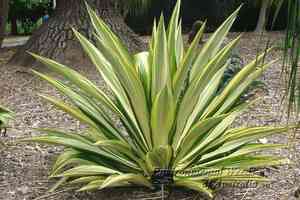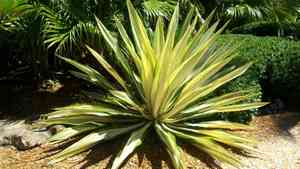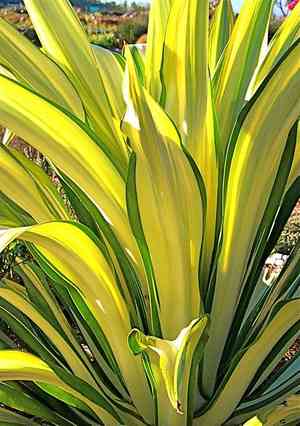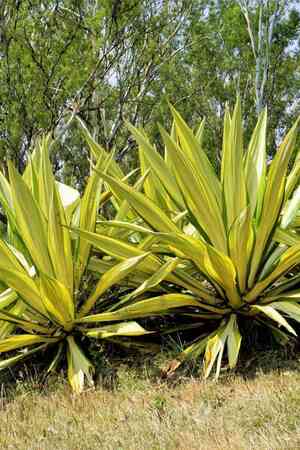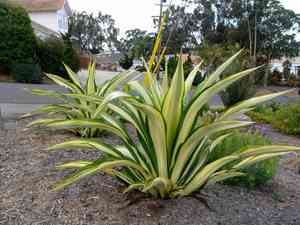
Giant Cabuya(Furcraea foetida)

Giant Cabuya (Furcraea foetida)

Also known as: Mauritius-Hemp

The Giant Cabuya (Furcraea foetida) is a robust, evergreen perennial known for its striking, variegated foliage. Here are its main attributes and growth preferences:

**Attributes:**
- **Size:** Typically grows to a height of 1.2 to 1.5 meters (4 to 5 feet).
- **Foliage:** Features long, sword-like leaves with wavy edges, creating a ribbon-like appearance.
- **Growth Form:** Forms a large, attractive rosette that resembles a fountain.
- **Propagation:** Often propagated through bulbils that develop on its tall flower stalks.

**Growth Preferences:**
- **Sun Exposure:** Thrives in full sun but can adapt to partial shade.
- **Soil Requirements:** Prefers well-drained soil and can tolerate poor, rocky conditions.
- **Watering Needs:** Drought-resistant; requires minimal watering once established.
- **Climate Tolerance:** Handles heat and humidity well, but is sensitive to frost.
- **Ideal Locations:** Often planted in sunny borders or as an ornamental in xeriscapes.

This plant is highly valued for its resilience and dramatic appearance, making it a popular choice for low-maintenance gardens.

Attributes of Giant Cabuya

Lifespan
Perennial
Plant Type
Herb, Shrub
Plant Height
1 m
Spread
1.2 m to 1.8 m
Leaf Color
Green Blue
Flower Size
4 cm to 5 cm
Flower Color
Green White Yellow

ForwardPlant - Identify plants with a snap

Identify and diagnose plants, get toxicity alerts, and explore safety guides for all types of fungi.

Try for Free

Images of Giant Cabuya

Giant Cabuya(Furcraea foetida)

Quickly Identify Giant Cabuya

1
Spiky sword-shaped leaves, 4-7 feet (1.2-2.1 meters) long, lacking spines.
2
Towering floral spike up to 25 feet (7.6 meters) with greenish-white blossoms.
3
Robust, succulent stature without trunk, reaching 5 feet (1.5 meters) tall.
4
Generates tiny plantlets on flower structure post-flowering.
5
Distinct fragrance attracting bees, prominent wavy leaf shape.

Scientific Classification of Giant Cabuya

Phylum
Vascular plants
Class
Monocotyledons
Order
Asparagus and allies
Family
Asparagus
Genus
furcraea
Species
Giant Cabuya

Planting and Growing of Giant Cabuya

Care Difficulty
Easy
Watering Schedule
Every 2 days
Sunlight Requirements
Full sun
Sunshine Duration
4-8 hours
Ideal Temperature
65-85℉
Soil Type
Potting Mix, Peat Mix
Soil pH
6.5-7.5
Fertilizer Type
Balanced
Pruning Season
Spring, Summer
Pruning Area
Branches, Leaves
Pruning Frequency
2 times a year
Repotting Season
Spring
Pot Type
Plastic, Terracotta

water icon How to Water Giant Cabuya?

Furcraea foetida thrives best with deep watering, allowing the water to soak deeply into the soil. Aim for approximately 500 ml of water per session, ensuring moisture reaches the root zone. This plant prefers its soil to dry out between waterings, thus simulating its natural arid habitat.
What are the symptoms of an underwatered Giant Cabuya?
What should I do if my Giant Cabuya is not getting enough water?
What are the symptoms of an overwatered Giant Cabuya?
How to save an overwatered Giant Cabuya?

sunlight icon What Are the Sunlight Requirements for Giant Cabuya?

Sunlight Requirements: Full sun, Partial sun
Duration of light: 6 to 8 hours
Furcraea foetida prefers a light range extending from full sun to partial shade. Ideal lighting fosters photosynthesis efficiency, enhancing growth and health.
Question 1: How much sunlight does Furcraea foetida need?
Question 2: What solutions ensure ideal lighting?
Question 3: How does ideal lighting benefit the plant?
More About Sunlight Requirements Techniques

temperature icon What Is the Ideal Temperature Range for Giant Cabuya?

Ideal Temperature: 65 ~ 85℉
Furcraea foetida thrives best in temperatures ranging from 65°F to 85°F. This range allows the plant to photosynthesize efficiently and maintain cellular processes essential for growth and health. Consistent temperatures within this range enable the plant to grow robustly with vibrant foliage and a strong root system.

soil icon What Soil is Best for Giant Cabuya?

Soil type: Loam, Sandy loam, Sand soil
Soil PH: 6.5 ~ 7.5
Furcraea foetida thrives in well-draining soils. This requirement ensures that the roots do not sit in water, preventing root rot and other fungal diseases. Such a condition encourages healthy root development and robust growth. Providing a soil mixture enriched with organic matter is ideal for Furcraea foetida. It allows the plant to access necessary nutrients, fostering lush foliage and strong structural development. While Furcraea foetida isn't overly demanding of soil fertility, a moderate nutrient profile supports optimal health and vitality. This balance ensures the plant receives what it needs to flourish without the risk of nutrient burn.

fertilize icon How to Fertilize Giant Cabuya?

Fertilizer type: Balanced
For Furcraea foetida, use a balanced liquid fertilizer with an N-P-K ratio of 10-10-10. Dilute the fertilizer to half-strength before applying to prevent root burn. Apply about 250 ml per plant per session.

prune icon How to Prune Giant Cabuya?

Pruning Time: Spring, Summer
Begin by examining the plant for any leaves that are brown or damaged. These should be removed first, as they can be a site for pests or disease. Trim back any excess or overly long leaves at their base. Cuts should be made cleanly and as close to the base as possible without damaging the main stem. After removing dead or damaged leaves, step back and look at the overall shape of the plant. Make minor adjustments by carefully trimming to maintain a balanced appearance. More About Pruning Techniques

propagate icon How to Propagate Giant Cabuya plant?

Propagate Time: Spring, Summer
1
Furcraea foetida seeds are collected from mature seed pods. Allow the pods to dry on the plant before collecting them. This ensures that the seeds are fully developed and have a higher germination rate.
2
Select healthy stems for cuttings that are about 6 inches long. Cut just below a node with a sterilized tool. Remove lower leaves to reduce moisture loss and enhance root formation.
3
Plant the seeds or cuttings in prepared pots with potting soil mix. Use a small stick to create holes for cuttings deep enough to support them upright. Lightly water the soil to settle the seeds or cuttings in place.
More About Propagating Techniques

repot icon How to Repot Giant Cabuya plant?

Repotting frequency: Every 2-3 years
1
For Furcraea foetida, repotting is needed when you notice roots coming out of the drainage holes or when the plant's growth has noticeably slowed. The best time to repot is during spring or summer when the plant is actively growing. Ensure the plant is healthy before proceeding, as stressed plants may not handle repotting well.
2
Select a pot that is slightly larger than the current one, with drainage holes to prevent waterlogging. A pot that is too large can retain excess moisture, which could lead to root rot. Terra cotta pots are often preferred as they are porous, allowing the soil to dry out more evenly.
3
Use a well-draining sandy soil mix for repotting Furcraea foetida. This type of soil mimics the plant's natural environment and prevents water from accumulating around the roots, thus reducing the risk of root rot. Adding some perlite or coarse sand can further enhance drainage capabilities.

ForwardPlant - Identify plants with a snap

Find the best spots for them to optimize their health, simply using your phone.

Try for Free