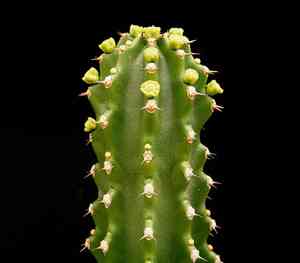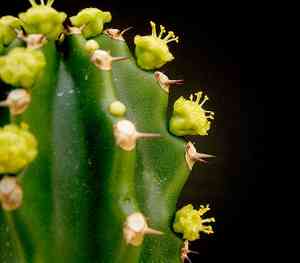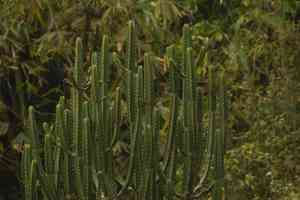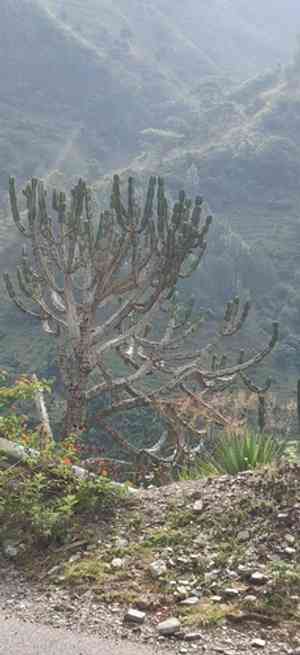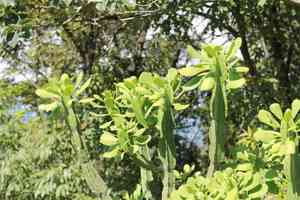
Sullu spurge(Euphorbia royleana)

Sullu spurge (Euphorbia royleana)

Also known as: Royle's spurge

Euphorbia royleana, commonly known as Sullu spurge, is a cactus-like, deciduous succulent. Its stems are adorned with spines and topped with leaves, which it sheds during extreme temperatures. This plant features small, greenish-yellow flowers and is mildly toxic.

Attributes of Sullu spurge

Lifespan
Perennial
Plant Type
Tree, Shrub
Plant Height
5 m to 7 m
Spread
4 cm to 7 cm
Leaf Color
Green Blue
Flower Size
2.5 cm
Flower Color
Yellow Green

PlantJoy - Identify plants with a snap

Identify and diagnose plants, get toxicity alerts, and explore safety guides for all types of fungi.

Try for Free

Images of Sullu spurge

Sullu spurge(Euphorbia royleana)

Quickly Identify Sullu spurge

1
Upright form reaching 20 feet (6 meters) with cactus-like branches and hairy trunk.
2
Distinctive greenish-yellow flowers in subterminal cymes with minimal stalks.
3
Fruit with three-lobed capsules containing brown, striated seeds lacking caruncle.
4
Succulent, apically clustered leaves with no petiole, falling off before blooming.
5
Ridged stem with paired downward-pointing spines, turning leafless based on seasons.

Scientific Classification of Sullu spurge

Phylum
Vascular plants
Class
Dicotyledons
Order
Nances, spurges, willows and allies
Family
Spurge
Genus
Spurges
Species
Sullu spurge

Planting and Growing of Sullu spurge

Care Difficulty
Easy
Watering Schedule
Every 2 days
Sunlight Requirements
Full sun
Sunshine Duration
4-8 hours
Ideal Temperature
65-77℉
Soil Type
Potting Mix, Peat Mix
Soil pH
6.5-7.5
Fertilizer Type
Balanced
Pruning Season
Spring, Summer
Pruning Area
Branches, Leaves
Pruning Frequency
2 times a year
Repotting Season
Spring
Pot Type
Plastic, Ceramic

water icon How to Water Sullu spurge?

Euphorbia royleana benefits from a consistent watering routine where the soil is allowed to slightly dry out between waterings. Water about 250 ml each time until the water drains out of the bottom of the pot. This ensures that the plant receives adequate moisture without becoming waterlogged, mimicking its natural environment's dry conditions.
What are the symptoms of an underwatered Sullu spurge?
What should I do if my Sullu spurge is not getting enough water?
What are the symptoms of an overwatered Sullu spurge?
How to save an overwatered Sullu spurge?

sunlight icon What Are the Sunlight Requirements for Sullu spurge?

Sunlight Requirements: Full sun, Partial sun
Duration of light: 6 to 8 hours
Euphorbia royleana prefers full sunlight but can adapt to partial sun. Consistent exposure to bright, indirect sunlight during hot parts of the year ensures firm, healthy growth while enhancing its natural succulence and ability to store water.
Where should Euphorbia royleana be placed?
How to achieve ideal lighting during cloudy seasons?
What is the benefit of ideal lighting conditions for this plant?
More About Sunlight Requirements Techniques

temperature icon What Is the Ideal Temperature Range for Sullu spurge?

Ideal Temperature: 65 ~ 77℉
The ideal temperature range for Euphorbia royleana is between 65°F and 77°F. These temperatures closely mimic the plant's natural habitat conditions, promoting optimal growth and vigor. Within this range, the plant's metabolism functions efficiently, leading to healthy development.

soil icon What Soil is Best for Sullu spurge?

Soil type: Sandy soil, Loam, Sandy loam
Soil PH: 6.5 ~ 7.5
Euphorbia royleana thrives best in well-drained soil. This ensures the roots do not suffer from rot due to excessive moisture retention, promoting vigorous growth and health. Although not overly demanding, this plant benefits from soil that is moderately rich in organic matter. This helps in providing essential nutrients needed for robust stem and leaf development. Given its drought-tolerant nature, the soil should accommodate periodic dryness to mimic its natural environment. This establishes the plant's resilience and facilitates low-maintenance care.

fertilize icon How to Fertilize Sullu spurge?

Fertilizer type: Balanced
For Euphorbia royleana, proper fertilization is crucial to maintain its growth and health. Given its natural habitat, it doesn't require heavy feeding. Use a balanced liquid fertilizer diluted to half-strength. Each monthly application should involve no more than 500 ml of this diluted mixture, ensuring nutrients are available without overwhelming the plant.

prune icon How to Prune Sullu spurge?

Pruning Time: Spring, Summer
Start by inspecting the overall shape of your Euphorbia royleana. Use sharp, sterilized scissors or pruning shears to trim any overly long or misshapen branches. Aim to maintain a balanced symmetrical shape that allows maximum light penetration and air circulation. Carefully identify and remove any dead, diseased, or damaged areas on the plant. This prevents the spread of disease and stimulates new growth with more vigor. Ensure you dispose of these parts away from your garden to avoid contamination. To promote a bushier appearance, selectively prune back the tips of some branches. By cutting just above a leaf node, you encourage new branches to sprout, resulting in a fuller and more compact plant.

propagate icon How to Propagate Sullu spurge plant?

Propagate Time: Spring,Early summer
1
Choose a healthy, mature stem from the Euphorbia royleana. Ensure it is disease-free and has several healthy leaves to improve propagation success.
2
Using clean pruning shears, cut a stem segment about 10-15 cm long. Remove leaves from the lower half to prevent rotting when planting.
3
Dip the cut end of the stem in rooting hormone and plant it into a well-draining potting mix. Water lightly and place it in a location with indirect sunlight.
More About Propagating Techniques

repot icon How to Repot Sullu spurge plant?

Repotting frequency: Once every 2-3 years
1
It's time to repot your Euphorbia royleana when you notice roots coming through the drainage holes, the plant becoming top-heavy, or soil that dries out more quickly than usual. These are signs that the plant has outgrown its current pot and needs more room to thrive.
2
Select a pot that is slightly larger than the current one, ideally 1-2 inches wider in diameter. It should have drainage holes to prevent waterlogging, which can cause root rot. A terra cotta or ceramic pot is ideal as they allow air exchange for the roots and enhance evaporation of excess water.
3
Use a well-draining cactus or succulent mix, ideally with a gritty texture composed of sand, perlite, or pumice. This type of soil mimics the natural arid habitat of Euphorbia royleana, reducing the risk of root rot by allowing excess water to drain quickly.
More About Repotting Techniques

PlantJoy - Identify plants with a snap

Find the best spots for them to optimize their health, simply using your phone.

Try for Free

Toxicity of Sullu spurge

Is Sullu spurge toxic to humans?

Sullu spurge is a plant with mild toxicity that can potentially lead to skin irritations, blisters, and swelling when touched. The plant's milky sap is the sole toxic component, containing harmful diterpene esters. All parts of the plant are toxic if consumed; however, accidental ingestion is rare due to its protective spines and the fact that it is not cultivated as a food crop. Common symptoms following ingestion typically involve nausea, vomiting, and diarrhea.

Identify toxic plants for your safety

Learn which plants are harmful to you and your pets, and make informed choices for a safer home!

Try for Free
WARNING
The judgment on toxicity and danger is for reference only. We DO NOT GUARANTEE any accuracy of such judgment. Therefore, you SHALL NOT rely on such judgment. It is IMPORTANT TO SEEK PROFESSIONAL ADVICE in advance when necessary.
More About Toxic Techniques