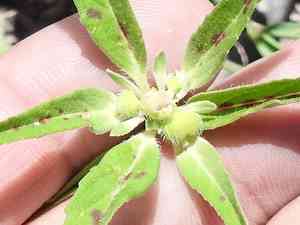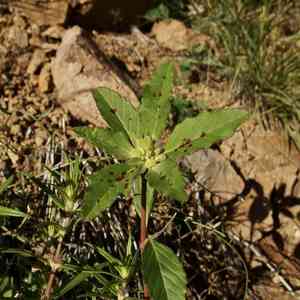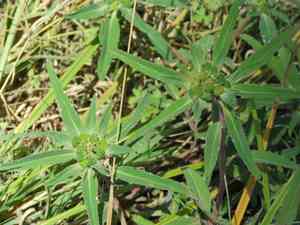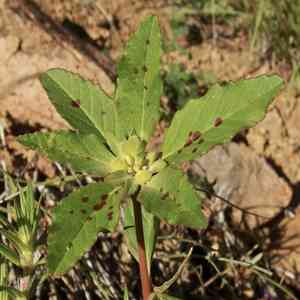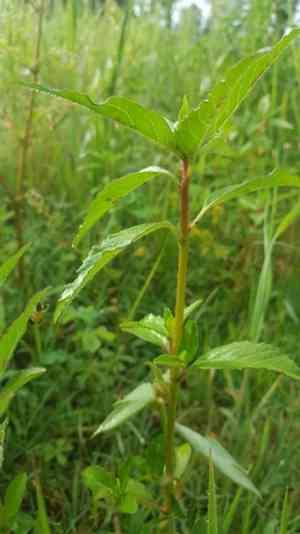
Hairy-fruit spurge(Euphorbia cuphosperma)

Hairy-fruit spurge (Euphorbia cuphosperma)

Also known as: Euphorbia, Spurges

The hairy-fruit spurge (Euphorbia villosa) is a unique perennial herb characterized by its fine-haired fruits and stems. Its key features include:

1. **Leaves**: Narrow, lance-shaped, and alternately arranged.
2. **Flowers**: Small, yellow-green, grouped in cyathia typical of the Euphorbia genus.
3. **Fruits**: Notable for their fine, hair-like coverings, which assist in seed dispersion.

Adaptations:
1. **Drought Resistance**: Equipped to thrive in dry, sandy soils through reduced leaf surface area and deep root systems.
2. **Sunlight**: Prefers and flourishes in full sun, making it common in open, sunny habitats.
3. **Soil**: Tolerates poor, nutrient-deficient soils, often found in meadows, grasslands, and along roadsides.

These traits enable the hairy-fruit spurge to survive and adapt to harsh environmental conditions.

Attributes of Hairy-fruit spurge

Lifespan
Perennial
Plant Type
Shrub, Succulent
Plant Height
Up to 1 meter
Spread
Up to 0.5 meters
Leaf Color
Green, sometimes with a bluish tint
Flower Size
Typically small, around 1-2 cm
Flower Color
Yellow-green

ForwardPlant - Identify plants with a snap

Identify and diagnose plants, get toxicity alerts, and explore safety guides for all types of fungi.

Try for Free

Images of Hairy-fruit spurge

Hairy-fruit spurge(Euphorbia cuphosperma)

Quickly Identify Hairy-fruit spurge

1
To identify Euphorbia cuphosperma, look for its unique milky latex sap, which is typical of many Euphorbia species. The plant often has succulent leaves and a characteristic inflorescence called a cyathium.

Scientific Classification of Hairy-fruit spurge

Phylum
Vascular plants
Class
Dicotyledons
Order
Malpighiales
Family
Spurge
Genus
Spurges
Species
Hairy-fruit spurge

Planting and Growing of Hairy-fruit spurge

Care Difficulty
Hard
Watering Schedule
Every 2 days
Sunlight Requirements
Partial sun
Sunshine Duration
6-10 hours
Ideal Temperature
60-75℉
Soil Type
Potting Mix, Peat Mix
Soil pH
6.5-7.5
Fertilizer Type
Balanced
Pruning Season
Spring, Summer
Pruning Area
Branches, Leaves
Pruning Frequency
2 times a year
Repotting Season
Spring
Pot Type
Plastic, Terracotta

water icon How to Water Hairy-fruit spurge?

Euphorbia cuphosperma is accustomed to arid climates and requires a modest amount of water. Watering should allow the soil to be moist but not waterlogged, ensuring excess water is draining away. The soil should dry out between each watering session to mimic its natural habitat.
What are the symptoms of an underwatered Hairy-fruit spurge?
What should I do if my Hairy-fruit spurge is not getting enough water?
What are the symptoms of an overwatered Hairy-fruit spurge?
How to save an overwatered Hairy-fruit spurge?

sunlight icon What Are the Sunlight Requirements for Hairy-fruit spurge?

Sunlight Requirements: Partial sun, Full sun
Duration of light: 6 to 8 hours daily
This plant flourishes in partial to full sun environments, enjoying 6 to 8 hours of sunlight daily, which supports its robust growth and vibrancy.
What is the ideal lighting for Euphorbia cuphosperma?
How can I achieve ideal lighting conditions for Euphorbia cuphosperma?
What are the benefits of achieving ideal lighting for this plant?

temperature icon What Is the Ideal Temperature Range for Hairy-fruit spurge?

Ideal Temperature: 60 ~ 75℉
Euphorbia cuphosperma thrives best in temperatures ranging from 60°F to 75°F. In this range, the plant can efficiently carry out photosynthesis and other metabolic activities, leading to vibrant growth and resilience against pests and diseases.

soil icon What Soil is Best for Hairy-fruit spurge?

Soil type: Sandy soil, Loam
Soil PH: 6.5 ~ 7.5
Euphorbia cuphosperma thrives in well-draining soil to prevent root rot, which can quickly damage the plant. A sandy or loamy composition helps ensure excess water easily drains away. While the plant isn't overly demanding, a soil that's moderately rich in nutrients supports healthy growth and vibrant foliage. Regular addition of organic matter, such as compost, can benefit the plant. Maintaining a soil pH between 6.5 and 7.5 ensures that the plant receives optimal nutrient absorption without suffering from nutrient lockout or toxicity from overly acidic or alkaline conditions.

fertilize icon How to Fertilize Hairy-fruit spurge?

Fertilizer type: Balanced
For Euphorbia cuphosperma, providing the right amount of nutrients is essential for healthy growth. Typically, for liquid fertilizers, a solution diluted to half the recommended strength is sufficient. For slow-release fertilizers, use approximately 3 to 5 grams per plant, depending on its size and maturity.

prune icon How to Prune Hairy-fruit spurge?

Pruning Time: Spring, Summer
To prune Euphorbia cuphosperma effectively, use sharp, clean pruning shears or scissors. This ensures a clean cut, reducing the risk of disease. Avoid using tools that have been used on diseased plants without proper sterilization. Start by removing any dead, damaged, or diseased stems. Trim back leggy growth to encourage a more compact habit. Always cut back to a node, which is where new growth will emerge, ensuring cuts are clean and at an angle to promote healing. More About Pruning Techniques

propagate icon How to Propagate Hairy-fruit spurge plant?

Propagate Time: Spring, Early spring, Late spring
1
Select healthy stems of about 4-6 inches in length and make clean cuts to prepare the cuttings. It's essential to remove the bottom leaves from the cuttings to prevent rot and encourage root development.
2
Use a well-draining soil mix, ideally consisting of perlite and peat, to accommodate both cuttings and seeds. This enhances root growth by ensuring excellent aeration and avoiding water retention.
3
Plant seeds just below the soil surface and cuttings a few inches deep. Maintain slight soil moisture—not too wet—as this reduces the risk of fungal infections and aids in successful propagation.
More About Propagating Techniques

repot icon How to Repot Hairy-fruit spurge plant?

Repotting frequency: Every 2-3 years
1
Look for signs such as roots protruding from drainage holes, soil dry out too quickly, or stunted growth, indicating it's time to repot your Euphorbia cuphosperma. As it grows, the roots need more space to expand and absorb nutrients, so ensure you repot in the growing seasons like spring or summer.
2
Opt for pots that are slightly larger than the current one with ample drainage holes. This ensures excess water escapes, preventing root rot. Materials like terracotta can also absorb moisture, supporting a balanced environment, which is essential for succulents like Euphorbia cuphosperma.
3
A well-draining cactus mix is essential. It typically contains sand and perlite, reducing compaction and allowing excess water to flow through. This composition mimics the natural arid habitat of Euphorbias, ensuring healthy root growth and preventing water-logging.

ForwardPlant - Identify plants with a snap

Find the best spots for them to optimize their health, simply using your phone.

Try for Free

Toxicity

ingestion, contact with sap

Identify toxic plants for your safety

Learn which plants are harmful to you and your pets, and make informed choices for a safer home!

Try for Free
WARNING
The judgment on toxicity and danger is for reference only. We DO NOT GUARANTEE any accuracy of such judgment. Therefore, you SHALL NOT rely on such judgment. It is IMPORTANT TO SEEK PROFESSIONAL ADVICE in advance when necessary.