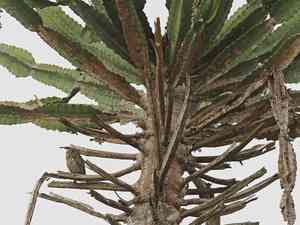
Candelabra tree (Euphorbia candelabrum)
Also known as: Sudanese tree-euphorbia
The candelabra tree (Euphorbia candelabrum) avoids being eaten by grazing animals through several effective adaptations. Its significant height, reaching up to 4.5 meters, places its branches out of reach for many herbivores. Additionally, the tree produces a toxic white latex sap that seeps out when the plant is damaged, deterring animals from consuming it. The tree’s structure, with numerous upward-growing branches, further helps it to stay safe from grazing pressures.
In This Article
Attributes of Candelabra tree
Lifespan
Perennial
Plant Type
Herb
Plant Height
10 m
Spread
5 m
Leaf Color
Green
Flower Size
Small, less than 1 cm
Flower Color
Yellow Green
Images of Candelabra tree
Quickly Identify Candelabra tree
1
Identify Euphorbia candelabrum by its tall, candelabra-like structure with multiple arms branching from a central trunk. The arms are covered in small, rounded spikes, and the plant produces a milky sap.
Scientific Classification of Candelabra tree
Phylum
Vascular plants
Class
Dicotyledons
Order
Malpighiales
Family
Spurge
Genus
Spurges
Species
Candelabra tree
Planting and Growing of Candelabra tree
Care Difficulty
Moderate
Watering Schedule
Every 2 days
Sunlight Requirements
Full sun
Sunshine Duration
4-8 hours
Ideal Temperature
65-75℉
Soil Type
Potting Mix, Peat Mix
Soil pH
6.5-7.5
Fertilizer Type
Balanced
Pruning Season
Spring, Summer
Pruning Area
Branches, Leaves
Pruning Frequency
Once a year
Repotting Season
Spring
Pot Type
Plastic, Ceramic
 How to Water Candelabra tree?
Euphorbia candelabrum, being a drought-tolerant succulent, thrives best when watered sparingly. Water deeply yet infrequently, allowing the soil to dry out completely between waterings. Pour approximately 250 ml of water directly at the base, ensuring that the water reaches the roots without causing waterlogging.
What are the symptoms of an underwatered Candelabra tree?
›
What should I do if my Candelabra tree is not getting enough water?
›
What are the symptoms of an overwatered Candelabra tree?
›
How to save an overwatered Candelabra tree?
›
 What Are the Sunlight Requirements for Candelabra tree?
This plant thrives in full to partial sun, ideally 8 to 12 hours of light. Proper lighting supports health, encouraging robust growth and effective photosynthesis.
More About Sunlight Requirements Techniques→
How much sunlight does Euphorbia candelabrum need?
›
What solutions ensure optimal light for Euphorbia candelabrum?
›
What are the benefits of optimal sunlight for Euphorbia candelabrum?
›
 What Is the Ideal Temperature Range for Candelabra tree?
The ideal temperature range for Euphorbia candelabrum is between 65°F and 75°F. Maintaining this temperature range ensures optimal growth and health. Within this range, the plant can efficiently perform photosynthesis, nutrient absorption, and respiration, promoting strong development.
 What Soil is Best for Candelabra tree?
Euphorbia candelabrum thrives best in well-drained soil, preventing waterlogging that could cause root rot. Well-drained soil ensures that excess water moves away from the roots, providing the plant with necessary air and nutrients for optimal growth. Having nutrients in the soil is vital for Euphorbia candelabrum, as it supports the plant's growth and development. A nutrient-rich substrate provides essential minerals and organic matter, resulting in healthy growth and vibrant greenery. The plant does not require overly rich soil but benefits from moderate fertility. This balance ensures that the Euphorbia candelabrum receives enough nutrition without the risk of fertilizer burn or excessive growth that could lead to structural weakness.
 How to Fertilize Candelabra tree?
Euphorbia candelabrum, like many succulents, requires a balanced approach to fertilization. A general guideline is to use half the recommended dose of a balanced liquid fertilizer, around 20-20-20 NPK, at the specified intervals. For ground-planted individuals and larger specimens, make sure to tailor the quantity in proportion to their size, avoiding any excess, which could stress the plant.
 How to Prune Candelabra tree?
Focus on removing dead, diseased, or damaged stems. Identify branches that cross each other and those that disrupt the natural form of the candelabra. This will enhance its structural integrity and aesthetic appeal. Start by making clean cuts above a leaf node or a branch junction. This encourages healthy new growth. Gradually shape the plant, ensuring balance and symmetry while avoiding taking off too much at once. After pruning, apply a fungicide to the cut areas to prevent infections. Ensure the plant is kept in a well-lit area with adequate water, but avoid waterlogging, to aid in its recovery and growth.
More About Pruning Techniques→
 How to Propagate Candelabra tree plant?
1
To propagate via seeds, first, allow the seed pods to dry on the plant. Once they start to open naturally, collect the seeds carefully. Ensure they are fully mature for better germination results.
2
Using a sterile knife, take segments from healthy, disease-free stems of the Euphorbia candelabrum. Allow the cut surfaces to dry and callous over for a few days before planting.
3
Sow the collected seeds in a seedling tray filled with a well-draining soil mix. Lightly cover them with soil and keep the tray in a warm, sunny spot. Water gently to keep the soil moist.
 How to Repot Candelabra tree plant?
1
Euphorbia candelabrum should be repotted when you notice the roots growing through the drainage holes or if the plant becomes top-heavy and wobbly. Another sign is when growth appears to slow down, indicating the roots need more space.
2
Choose a pot that is one to two inches larger in diameter than the current one. Opt for pots with drainage holes to ensure excess water can escape, preventing root rot and allowing air to circulate amongst the roots, ensuring a thriving plant.
3
Select a well-draining cactus mix to prevent water retention. The ideal soil should allow excess water to drain quickly, protecting the roots from rot and imitating the natural dry landscape this plant is accustomed to.
Toxicity
Ingestion or contact with sap
WARNING
The judgment on toxicity and danger is for reference only. We DO NOT GUARANTEE any accuracy of such judgment. Therefore, you SHALL NOT rely on such judgment. It is IMPORTANT TO SEEK PROFESSIONAL ADVICE in advance when necessary.



