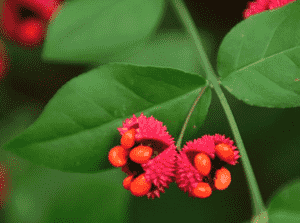
American Strawberry bush(Euonymus americanus)

American Strawberry bush (Euonymus americanus)

Also known as: Strawberry bush, Bursting-heart, Hearts-a-burstin

The American Strawberry Bush, scientifically known as *Euonymus americanus*, produces intriguing flowers that seem to burst open, showcasing its red fruit. Despite its appealing name, this plant, also called Bursting Heart or Hearts-a-bursting, is toxic and should not be consumed. It belongs to the bittersweet family and typically grows to a height of 1.8 to 3.5 meters.

Attributes of American Strawberry bush

Lifespan
Perennial
Plant Type
Shrub
Plant Height
2 m
Spread
1.8 m to 3.5 m
Leaf Color
Green Blue
Flower Size
2 mm to 3 mm
Flower Color
Green Yellow

PlantJoy - Identify plants with a snap

Identify and diagnose plants, get toxicity alerts, and explore safety guides for all types of fungi.

Try for Free

Images of American Strawberry bush

American Strawberry bush(Euonymus americanus)

Quickly Identify American Strawberry bush

1
Distinctive red-orange seeds within warty capsules in fall.
2
Star-like yellow-green flowers with purple stamens in clusters.
3
Bumpy red capsules with vivid red seeds splitting open in fall.
4
Smooth oval leaves with toothed margins turning vibrant red.
5
Slender green stem with square cross-section and reddish buds.

Scientific Classification of American Strawberry bush

Phylum
Vascular plants
Class
Dicotyledons
Order
Celastrales
Family
Bittersweet
Genus
Spindle trees
Species
American Strawberry bush

Planting and Growing of American Strawberry bush

Care Difficulty
Easy
Watering Schedule
Every 4 days
Sunlight Requirements
Partial sun
Sunshine Duration
6-10 hours
Ideal Temperature
65-75℉
Soil Type
Potting Mix, Peat Mix
Soil pH
5.5-7
Fertilizer Type
Balanced
Pruning Season
Spring, Summer
Pruning Area
Branches, Leaves
Pruning Frequency
2 times a year
Repotting Season
Spring
Pot Type
Plastic, Ceramic

water icon How to Water American Strawberry bush?

When watering Euonymus americanus, aim to saturate the soil with about 500 ml of water each time. The principle is to water thoroughly until the water begins to drain from the bottom of the pot or container. This ensures that the entire root system is adequately hydrated without leaving any dry pockets.
What are the symptoms of an underwatered American Strawberry bush?
What should I do if my American Strawberry bush is not getting enough water?
What are the symptoms of an overwatered American Strawberry bush?
How to save an overwatered American Strawberry bush?

sunlight icon What Are the Sunlight Requirements for American Strawberry bush?

Sunlight Requirements: Partial sun, Full shade
Duration of light: 3-6 hours daily
Euonymus americanus prefers partial to full shade, benefiting from 3-6 hours of indirect sunlight daily. Ideal light helps maintain vibrant foliage and supports flowering, ensuring the plant's health and aesthetic appeal.
What is the best light condition for Euonymus americanus?
How can I ensure my Euonymus americanus gets the ideal amount of light?
What benefits does Euonymus americanus gain from receiving ideal light?
More About Sunlight Requirements Techniques

temperature icon What Is the Ideal Temperature Range for American Strawberry bush?

Ideal Temperature: 65 ~ 75℉
The ideal temperature range for Euonymus americanus cultivation is between 65°F and 75°F. This range supports optimal physiological processes such as photosynthesis and respiration, ensuring healthy growth and vibrant foliage. Maintaining these temperatures aids in preventing heat and cold stress, thereby enhancing plant resilience.

soil icon What Soil is Best for American Strawberry bush?

Soil type: Loam, Sandy loam
Soil PH: 5.5 ~ 7
Euonymus americanus thrives in well-draining soil, which prevents waterlogging and root rot. This condition ensures healthy root growth and reduces the risk of disease. These plants prefer soils with moderate fertility. Adequate nutrients support lush foliage and vibrant growth without overwhelming the plant and promoting excessive leaf production over flowers. Enrichment with organic matter, like compost, improves soil structure and fertility, providing nutrients and aiding in moisture retention for Euonymus americanus.

fertilize icon How to Fertilize American Strawberry bush?

Fertilizer type: Balanced
For Euonymus americanus, it's critical to use a balanced fertilizer such as a 10-10-10 or 14-14-14 NPK ratio. When using liquid fertilizer, dilute at a half strength to avoid root burn. Generally, apply one to two cups for small to medium-sized shrubs. Over-fertilizing can deteriorate plant health, hence moderation is essential.

prune icon How to Prune American Strawberry bush?

Pruning Time: Spring, Summer
Start by observing the overall structure of the plant and plan which areas require pruning. This helps maintain a balanced form and prevents removing too much foliage at once. Cut off any dead, damaged, or diseased branches first. This not only enhances the appearance of the plant but also prevents the spread of diseases. Carefully thin out areas with overly dense growth by cutting back branches all the way to the main stem. This enhances air circulation, reducing the risk of fungal infections. Trim the plant to maintain the desired shape, making cuts at a slight angle above a healthy bud. This encourages new growth and maintains the ornamental appeal of Euonymus americanus. Once pruning is done, remove any fallen debris and dispose of it properly. Debris left at the base of the plant can harbor pests or diseases that may affect future growth. More About Pruning Techniques

propagate icon How to Propagate American Strawberry bush plant?

Propagate Time: Spring, Early spring, Autumn
1
Harvest the seeds from ripe fruit in the autumn. Clean them thoroughly to remove any pulp, which can promote fungal growth if left attached.
2
Choose healthy sections of the plant with at least two leaf nodes, and cut below the lower node. Dip the cut end into rooting hormone before planting.
3
Select healthy roots in spring, cut into 3-4 inch segments, and plant horizontally in soil. This process typically requires patience as root establishment can be slow.
More About Propagating Techniques

repot icon How to Repot American Strawberry bush plant?

Repotting frequency: Every 2-3 years
1
It's time to repot Euonymus americanus when you notice roots circling the bottom of the pot or growing out of the drainage holes. Additionally, if the plant's growth appears stunted, it signals the need for repotting. Choose early spring or summer when the plant is actively growing. These seasons ensure the roots quickly establish themselves in the new soil.
2
Select a pot that is one size larger than the current pot, with sufficient drainage holes to prevent waterlogging. A slightly larger pot allows for root expansion, giving your Euonymus americanus the room it needs to grow without overwhelming the roots with too much space, which could lead to root rot.
3
Opt for well-draining, loamy soil. This type of soil maintains moisture without becoming waterlogged, providing a balanced environment for root health. It ensures adequate aeration, which is vital for root development and plant stability, allowing the Euonymus americanus to thrive in its new environment.

PlantJoy - Identify plants with a snap

Find the best spots for them to optimize their health, simply using your phone.

Try for Free

Toxicity of American Strawberry bush

Is American Strawberry bush toxic to humans?

The American strawberry bush presents attractive and intriguing seed cases and fruits that may appear appetizing—this is a significant reason to keep them far from children. The bark, fruits, and seeds contain high levels of toxic glycosides, particularly in the fruits and seeds. These glycosides typically result in chills, nausea, diarrhea, vomiting, and colicky pain. If a substantial amount of the plant material is ingested, these symptoms can escalate to weakness, seizures, and could potentially lead to coma or even death. Given that children are the most likely individuals to consume these hazardous fruits, coupled with their smaller size and increased vulnerability to poisoning, they face the highest risk from this plant.

Is American Strawberry bush toxic to cat?

The American Strawberry bush is a plant species that is toxic to cats, presenting a significant health threat if consumed. If a cat accidentally ingests any portion of the American Strawberry bush, it could result in poisoning. Upon contact with this plant, cats may display a range of symptoms indicating physical distress or illness. It is essential to keep a close watch on your pet for any odd behaviors or signs of unease following potential ingestion and to promptly seek veterinary assistance at an animal hospital for appropriate treatment.

Is American Strawberry bush toxic to dog?

The American Strawberry bush is recognized as toxic to dogs. Canines may inadvertently consume various parts of this plant, which can result in potential poisoning. Every component of the American Strawberry bush is deemed poisonous and poses a threat if ingested by dogs. Following consumption, a dog may display symptoms such as vomiting, diarrhea, lethargy, or alterations in heart rate. It is vital for dog owners to vigilantly observe their pets and restrict their access to the American Strawberry bush. Should a dog ingest any part of the American Strawberry bush, seeking immediate veterinary care is essential to secure the best possible outcome for the affected animal.

Identify toxic plants for your safety

Learn which plants are harmful to you and your pets, and make informed choices for a safer home!

Try for Free
WARNING
The judgment on toxicity and danger is for reference only. We DO NOT GUARANTEE any accuracy of such judgment. Therefore, you SHALL NOT rely on such judgment. It is IMPORTANT TO SEEK PROFESSIONAL ADVICE in advance when necessary.
More About Toxic Techniques

