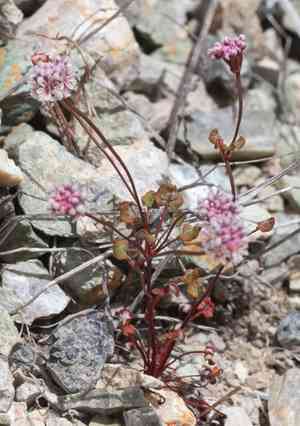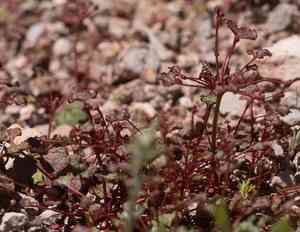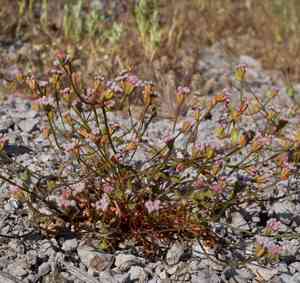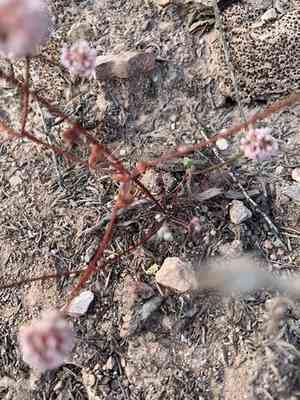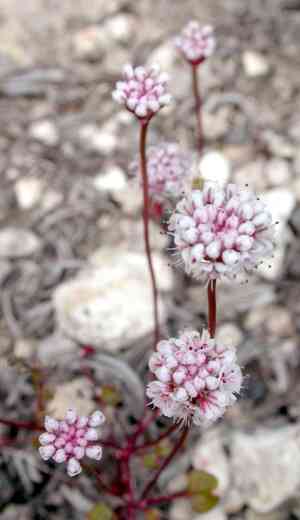
Pinnacles buckwheat(Eriogonum nortonii)

Pinnacles buckwheat (Eriogonum nortonii)

Also known as: Norton's Buckwheat

Pinnacles buckwheat (Eriogonum nortonii) is well-suited to rocky, arid habitats due to several distinctive features and adaptations:

1. **Basal Leaf Cluster**: It has a dense cluster of leaves at the base, which helps conserve moisture and protect the plant.

2. **Long, Slender Stem**: The stem supports clusters of small, star-shaped flowers that range in color from pink to white, arranged in spherical umbels.

3. **Extensive Root System**: This deep root network allows the plant to access water from deep within the soil, making it highly drought-resistant.

4. **Cushion-like Form**: This growth habit not only reduces exposure to extreme weather conditions but also aids in water retention.

These adaptations enable pinnacles buckwheat to effectively manage the challenges of its rocky, arid environment, ensuring its survival and reproduction.

Attributes of Pinnacles buckwheat

Lifespan
Perennial
Plant Type
Herb
Plant Height
10-30 cm
Spread
10-20 cm
Leaf Color
Green-grey
Flower Size
0.5-1 cm
Flower Color
White to pink

ForwardPlant - Identify plants with a snap

Identify and diagnose plants, get toxicity alerts, and explore safety guides for all types of fungi.

Try for Free

Images of Pinnacles buckwheat

Pinnacles buckwheat(Eriogonum nortonii)

Quickly Identify Pinnacles buckwheat

1
To identify Eriogonum nortonii, look for its small, oval-shaped leaves that are covered in a fine layer of hair. The flowers are typically small, clustered, and can range in color from white to pink.

Scientific Classification of Pinnacles buckwheat

Phylum
Vascular plants
Class
Dicotyledons
Order
Caryophyllales
Family
Buckwheat
Genus
Wild Buckwheat
Species
Pinnacles buckwheat

Planting and Growing of Pinnacles buckwheat

Care Difficulty
Moderate
Watering Schedule
Every day
Sunlight Requirements
Full sun
Sunshine Duration
6-10 hours
Ideal Temperature
60-75℉
Soil Type
Potting Mix, Peat Mix
Soil pH
6.5-7.5
Fertilizer Type
Balanced
Pruning Season
Spring, Summer
Pruning Area
Branches, Leaves
Pruning Frequency
Once a year
Repotting Season
Spring
Pot Type
Plastic, Ceramic

water icon How to Water Pinnacles buckwheat?

Eriogonum nortonii is native to dry, arid environments, which means it prefers a light touch when it comes to watering. Ensure the water penetrates the soil but doesn't pool on the surface. About 250 milliliters should suffice for each watering, allowing the soil to dry thoroughly between sessions.
What are the symptoms of an underwatered Pinnacles buckwheat?
What should I do if my Pinnacles buckwheat is not getting enough water?
What are the symptoms of an overwatered Pinnacles buckwheat?
How to save an overwatered Pinnacles buckwheat?

sunlight icon What Are the Sunlight Requirements for Pinnacles buckwheat?

Sunlight Requirements: Full sun
Duration of light: 6 to 8 hours
Full sun exposure is ideal for Eriogonum nortonii, ensuring optimal growth and flowering. Adequate sunlight not only bolsters photosynthesis but also enhances the plant's aesthetic and ecological value, making it a vibrant addition to the landscape.
What is the best lighting solution for Eriogonum nortonii?
How can one achieve the ideal lighting conditions for Eriogonum nortonii?
What benefits does Eriogonum nortonii receive from ideal lighting?

temperature icon What Is the Ideal Temperature Range for Pinnacles buckwheat?

Ideal Temperature: 60 ~ 75℉
For Eriogonum nortonii, the ideal temperature range for growth falls between 60°F and 75°F. This range ensures that the plant can thrive without experiencing stress from either cold or heat, making it ideal for most temperate climates.

soil icon What Soil is Best for Pinnacles buckwheat?

Soil type: Sand soil, Sandy loam
Soil PH: 6.5 ~ 7.5
Eriogonum nortonii thrives in well-drained soil which prevents root rot by allowing excess water to escape. This is crucial, as stagnant water can lead to fungal diseases affecting the health of the plant. This plant does well in nutrient-poor substrates, reducing competition from other plants. It is adapted to extract necessary nutrients from minimal sources, avoiding the need for frequent fertilization. A sandy composition supports proper aeration around the roots, which is essential for oxygen exchange and promoting robust root development, essential for the plant's stability and nutrient uptake.

fertilize icon How to Fertilize Pinnacles buckwheat?

Fertilizer type: Balanced
For Eriogonum nortonii, it's essential to provide a balanced amount of fertilizer to avoid either starvation or overfeeding. A general guideline is to use a dilute liquid fertilizer solution at half the recommended strength. When using slow-release granules, apply about a tablespoon per plant, being careful not to concentrate it around the base of the stem.

prune icon How to Prune Pinnacles buckwheat?

Pruning Time: Spring, Autumn
Always use sanitized and sharp pruning shears to prevent the spread of diseases and to ensure clean cuts. Dirty or dull tools can cause ragged cuts that take longer to heal, exposing the plant to infections. Be cautious not to remove more than one-third of the plant at a time. Over-pruning can stress the plant, reducing its vigor and ability to produce blooms or healthy foliage. More About Pruning Techniques

propagate icon How to Propagate Pinnacles buckwheat plant?

Propagate Time: Spring, Early spring, Late spring
1
When propagating Eriogonum nortonii from seeds, collect seeds from mature flowers in late summer. Ensure seeds are thoroughly dry before storage. Store them in a cool, dry place until ready to plant in early spring.
2
Take softwood cuttings during the growing season. Ensure each cutting is about 4-6 inches long, removed just below a node. Strip any excess leaves to reduce transpiration and place the cuttings in water or a moist medium immediately.
3
Spread seeds over a well-draining soil mix in a seed tray. Lightly cover them with a thin layer of sand or grit. Keep the soil moist but not waterlogged, providing a bright but indirect light source for optimum germination.
More About Propagating Techniques

repot icon How to Repot Pinnacles buckwheat plant?

Repotting frequency: Every 2-3 years
1
Eriogonum nortonii shows signs it needs repotting when its roots start protruding from the drainage holes or when growth appears stunted. This suggests the plant has outgrown its current pot or depleted nutrients and requires a fresh environment to thrive.
2
Select a pot that is one size up from the current one, ideally made of terra cotta for its breathability. It helps prevent root rot by allowing excess moisture to evaporate, maintaining a balanced moisture level for the plant's roots.
3
Opt for a well-draining sandy mix, incorporating materials such as perlite or coarse sand. This composition ensures excellent drainage and mimics its natural habitat, allowing roots to breathe and reducing the chances of root rot and other moisture-related issues.

ForwardPlant - Identify plants with a snap

Find the best spots for them to optimize their health, simply using your phone.

Try for Free