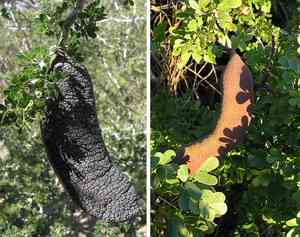
Dog poop bush (Ebenopsis confinis)
Also known as: Border Ebony, Confine's Ebenopsis
The dog poop bush, a hardy shrub commonly found in dry regions, exhibits several key adaptations for survival. It has deep roots that access underground water, and its leaves have a waxy coating to minimize water loss. The plant's small leaves further reduce transpiration. Additionally, the bush can enter dormancy during extreme droughts to conserve resources. These traits collectively enable the dog poop bush to thrive in arid and semi-arid environments.
In This Article
Attributes of Dog poop bush
Lifespan
Perennial
Plant Type
Tree
Plant Height
4-8 meters
Spread
3-6 meters
Leaf Color
Green
Flower Size
1-2 centimeters
Flower Color
Creamy white
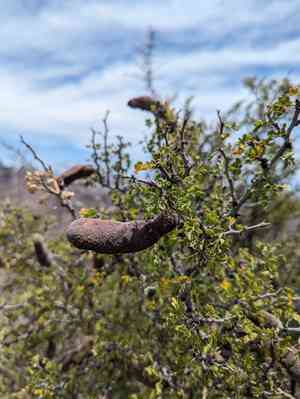
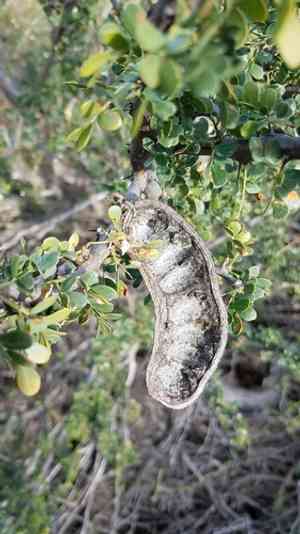
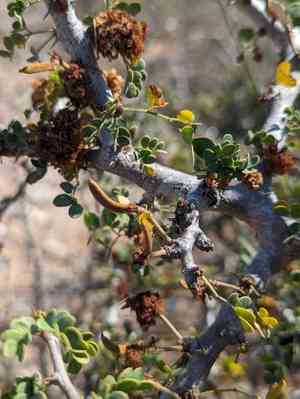
Images of Dog poop bush
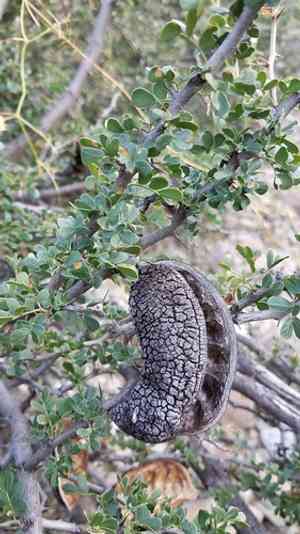
Quickly Identify Dog poop bush
1
To identify Ebenopsis confinis, look for its characteristic thick and thorny branches, small bipinnate leaves, and the rough dark bark. The flowers are creamy white and turn into brownish pods when mature.
Scientific Classification of Dog poop bush
Phylum
Vascular plants
Class
Dicotyledons
Order
Fabales
Family
Legume
Genus
Texas ebonies
Species
Dog poop bush
Planting and Growing of Dog poop bush
Care Difficulty
Moderate
Watering Schedule
Every 2 days
Sunlight Requirements
Full sun
Sunshine Duration
4-8 hours
Ideal Temperature
60-75℉
Soil Type
Potting Mix, Peat Mix
Soil pH
6.5-7.5
Fertilizer Type
Balanced
Pruning Season
Spring, Summer
Pruning Area
Branches, Leaves
Pruning Frequency
2 times a year
Repotting Season
Spring
Pot Type
Plastic, Ceramic
 How to Water Dog poop bush?
For Ebenopsis confinis, water it with about 500ml each time. The principle here is to thoroughly moisten the root zone without waterlogging the soil. Wait until the top few inches are dry before watering again, ensuring that the plant's roots have adequate oxygen and nutrient access.
What are the symptoms of an underwatered Dog poop bush?
›
What should I do if my Dog poop bush is not getting enough water?
›
What are the symptoms of an overwatered Dog poop bush?
›
How to save an overwatered Dog poop bush?
›
 What Are the Sunlight Requirements for Dog poop bush?
Ideally, Ebenopsis confinis should thrive in full sun to partial sun environments. Access to adequate light promotes healthy photosynthesis, which is vital for energy production, robust growth, and vibrant flowering.
Optimal Light Intensity
›
Maintaining Duration
›
Dealing with Shade
›
 What Is the Ideal Temperature Range for Dog poop bush?
Ebenopsis confinis thrives best in temperatures ranging from 60°F to 75°F. This range ensures optimal growth and flowering. Maintaining daytime temperatures within this range can contribute to the plant's health and productivity. Growth can slow if temperatures consistently fall below or rise above this range.
 What Soil is Best for Dog poop bush?
Ebenopsis confinis requires a nutrient-rich substrate to thrive. A soil rich in organic matter helps enhance root development and provides essential nutrients for growth. The plant thrives best in well-draining soils, which prevent waterlogging and root rot. Good drainage improves root oxygenation, crucial for healthy plant development. Ebenopsis confinis benefits from soil that retains moderate moisture, ensuring consistent water availability without being waterlogged, crucial for its xerophytic nature.
 How to Fertilize Dog poop bush?
For Ebenopsis confinis, use a balanced fertilizer with equal parts nitrogen, phosphorus, and potassium. A liquid fertilizer can be applied at a rate of 1 tablespoon per gallon of water during the growing season, while solid slow-release fertilizers should adhere to package instructions, typically around 1/4 cup per application.
 How to Prune Dog poop bush?
Start by identifying and removing any dead or diseased branches using sharp pruning shears. Cut these branches at a 45-degree angle close to the main stem. Thin out dense areas to improve air circulation and sunlight penetration by removing some of the older branches, cutting them back to their base. Finally, shape the plant by snipping off any errant branches to achieve the desired form.
More About Pruning Techniques→
 How to Propagate Dog poop bush plant?
1
Collect seeds from mature plants in the autumn. Clean and dry them properly before storage to prevent any fungal growth. Use the seeds in spring for sowing to ensure high germination rates.
2
Select healthy branches for cuttings. Cut at a 45-degree angle just below a node, ensuring that the cutting is at least 4-6 inches long. Remove the lower leaves to reduce water loss.
3
Place the seeds or cuttings in a well-drained potting mix. Water the soil thoroughly to keep it moist but not soggy. For cuttings, consider using a rooting hormone to enhance root development.
 How to Repot Dog poop bush plant?
1
Ebenopsis confinis typically requires repotting when its roots begin to protrude from drainage holes or when its growth considerably slows down. Another indicator is when water drains too quickly from the pot, suggesting root-bound issues. Spring and summer are ideal, as these seasons promote recovery and growth.
2
Select a pot that's one to two inches larger in diameter than the current one, offering ample space for root expansion. Ensure it has sufficient drainage holes to prevent waterlogging and root rot. A slightly heavy pot can also stabilize the plant, preventing it from toppling over as it grows.
3
Opt for a well-draining sandy soil mix, which mimics the plant's natural habitat. This type of soil prevents root rot by allowing excess water to escape easily, ensuring that roots stay oxygenated. Adding perlite or pumice can also enhance drainage.
Learn More About Dog poop bush Diseases
Anthracnose
Bacterial Leaf Spot
Bacterial Soft Rot
Black Spot
Chemical Injury
Crown Gall
Cyst Nematode
Damping-off
Downy Mildew
Drought Stress
Fusarium Wilt
Gray Mold
Leaf Curl
Leaf Spot
Mosaic
Nutrient Deficiency
Nutrient Toxicity
Powdery Mildew
Root Rot
Root-knot Nematode
Rusts
Sooty Mold
Spider Mites
Temperature Stress
Thrips Damage
White Mold



