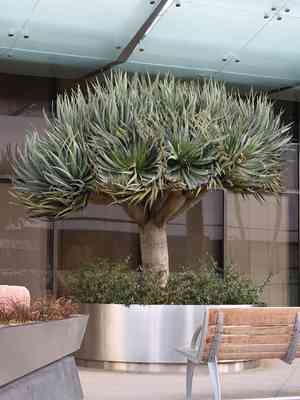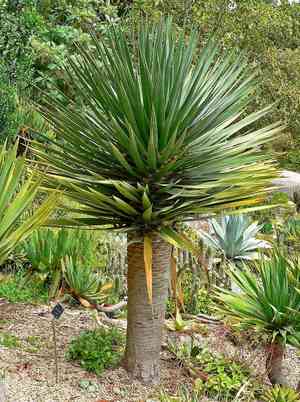
Dragon tree(Dracaena draco)

Dragon tree (Dracaena draco)

Also known as: Canary islands dragon tree

The national symbol of Tenerife is the dragon tree (Dracaena draco), a tropical tree native to the Canary Islands. This distinctive tree produces a unique resin known as dragon's blood, historically used as a dye and for various medicinal purposes.

Attributes of Dragon tree

Lifespan
Perennial
Plant Type
Shrub, Tree
Plant Height
20 m
Spread
4.5 m to 8 m
Leaf Color
Green Blue
Flower Size
Small, about 1-2 centimeters (0.4-0.8 inches)
Flower Color
White Green

ForwardPlant - Identify plants with a snap

Identify and diagnose plants, get toxicity alerts, and explore safety guides for all types of fungi.

Try for Free

Images of Dragon tree

Dragon tree(Dracaena draco)

Quickly Identify Dragon tree

1
Massive, broad stature reaching 25 feet (7.6 meters) tall and wide.
2
Unbranched growth until flowering; two dominant branches emerge.
3
Clusters of pliable, sword-shaped blue-green leaves up to 2 feet (60 cm) long.
4
Greenish-white flowers followed by orange berries.
5
Bark exudes reddish resin when wounded.

Scientific Classification of Dragon tree

Phylum
Vascular plants
Class
Monocotyledons
Order
Asparagus and allies
Family
Asparagus
Genus
Dracaena
Species
Dragon tree

Planting and Growing of Dragon tree

Care Difficulty
Easy
Watering Schedule
Every 2 days
Sunlight Requirements
Partial sun
Sunshine Duration
6-10 hours
Ideal Temperature
65-75℉
Soil Type
Potting Mix, Peat Mix
Soil pH
6.5-7.5
Fertilizer Type
Balanced
Pruning Season
Spring, Summer
Pruning Area
Branches, Leaves
Pruning Frequency
2 times a year
Repotting Season
Spring
Pot Type
Plastic, Ceramic

water icon How to Water Dragon tree?

When watering Dracaena draco, aim for approximately 500 ml each session. The key is to maintain a balance where the soil is evenly moist but not soggy. Check the top inch of soil; if it's dry, it's time to water. Avoid water accumulation in the saucer, as this could lead to root rot.
What are the symptoms of an underwatered Dragon tree?
What should I do if my Dragon tree is not getting enough water?
What are the symptoms of an overwatered Dragon tree?
How to save an overwatered Dragon tree?
More About Watering Techniques

sunlight icon What Are the Sunlight Requirements for Dragon tree?

Sunlight Requirements: Partial sun
Duration of light: 2-4 hours daily
Partial sun provides the ideal light range for Dracaena draco, ensuring it thrives with balanced growth and vibrant leaves, maximizing its photosynthetic capabilities while avoiding the risks of overexposure or lack of light.
What is the ideal location for Dracaena draco?
What practical measures can help achieve ideal lighting?
What benefits can Dracaena draco gain from ideal lighting?
More About Sunlight Requirements Techniques

temperature icon What Is the Ideal Temperature Range for Dragon tree?

Ideal Temperature: 65 ~ 75℉
The ideal temperature range for Dracaena draco, also known as the Dragon Tree, is between 65°F and 75°F. This range mimics its native environment in the Canary Islands, where mild and consistent temperatures dominate. Providing a stable environment in this range supports optimal growth and foliage health.

soil icon What Soil is Best for Dragon tree?

Soil type: Sandy soil, Loam
Soil PH: 6.5 ~ 7.5
Dragon tree demands well-draining soil to prevent root rot. This allows oxygen to reach roots and enhances growth by draining away excess water effectively. While resilient, Dracaena draco thrives in nutrient-rich loam which supports robust growth and lush foliage. The presence of organic matter not only sustains but also invigorates. Despite a preference for dry spells, the soil should hold moisture moderately to retain nutrients and support root development without continuous saturation. More About Soil

fertilize icon How to Fertilize Dragon tree?

Fertilizer type: Balanced
For Dracaena draco, moderation is key when it comes to fertilizing. The recommended amount of liquid fertilizer is about one tablespoon diluted in a gallon of water per application. For slow-release fertilizer, using a small scoop (such as a teaspoon) scattered around the base of the plant should suffice. Always ensure the fertilizer is appropriately diluted to prevent any root damage. More About Fertilizing Techniques

prune icon How to Prune Dragon tree?

Pruning Time: Spring, Summer
Begin by thoroughly inspecting your Dracaena draco for any dead or damaged leaves. These will often appear brown or yellow and might feel dry and brittle. Carefully remove them to redirect energy to healthier parts of the plant. Consider the overall shape you desire. Trim back any overgrown branches to maintain a uniform appearance. Cut just above the node where leaves emerge to ensure new growth forms healthily. For any large cuts or wounds that occur during pruning, apply a wound sealant to prevent disease. This is especially important in humid environments where pathogens can easily take hold. More About Pruning Techniques

propagate icon How to Propagate Dragon tree plant?

Propagate Time: Spring, Late spring
1
Collect the seeds from mature fruit of Dracaena draco. Ensure the seeds are fresh for better germination rates. Clean them thoroughly and allow them to dry for a day before planting.
2
Select a healthy stem from the Dracaena draco plant. Using sharp pruning shears, make a clean cut just below a node. Remove leaves from the lower part of the cutting to prevent rot.
3
Dip the cut end of the stem into rooting hormone and plant it in a well-draining potting mix. Keep the soil moist but not waterlogged to prevent rotting.
More About Propagating Techniques

repot icon How to Repot Dragon tree plant?

Repotting frequency: Every 2-3 years
1
Dracaena draco needs repotting when its roots start to circle the pot or grow from drainage holes. Another signal is soil drying out much faster than usual, indicating root-bound conditions. Early spring is ideal as the plant resumes active growth during this time.
2
Select a pot that is 1-2 inches larger in diameter than the current one. Ensure it has good drainage holes to prevent water accumulation. A slightly taller pot helps the long roots develop, promoting healthy growth.
3
A well-draining potting mix with added perlite or pumice is perfect for Dracaena draco. This ensures excess water drains quickly, preventing root rot and allowing air circulation needed for healthy root systems.
More About Repotting Techniques

ForwardPlant - Identify plants with a snap

Find the best spots for them to optimize their health, simply using your phone.

Try for Free

Toxicity of Dragon tree

Is Dragon tree toxic to cat?

The dragon tree is acknowledged as a harmful plant species for our feline friends. Cats are at risk of poisoning if they consume any part of the dragon tree, especially its seeds. Following consumption, cats may show symptoms of discomfort, which could develop into serious distress that requires urgent attention. While the precise toxic compounds remain unspecified, the danger they pose to the health of cats is clear, emphasizing the need for preventive actions to keep them away from dragon trees. If a cat ingests any part of the dragon tree, it is crucial to seek veterinary assistance immediately to safeguard their health and welfare.

Is Dragon tree toxic to dog?

The dragon tree presents a toxic hazard to dogs, especially when they mistakenly eat the seeds of the plant. Dogs consuming these seeds may show a range of symptoms that suggest poisoning. Therefore, it is vital for dog owners to remain alert and keep their pets away from dragon trees, as ingestion can result in harmful health consequences. In the event that a dog does ingest any portion of the dragon tree, particularly the seeds, it is imperative to obtain immediate veterinary assistance to secure the best possible prognosis for the animal.

Identify toxic plants for your safety

Learn which plants are harmful to you and your pets, and make informed choices for a safer home!

Try for Free
WARNING
The judgment on toxicity and danger is for reference only. We DO NOT GUARANTEE any accuracy of such judgment. Therefore, you SHALL NOT rely on such judgment. It is IMPORTANT TO SEEK PROFESSIONAL ADVICE in advance when necessary.
More About Toxic Techniques