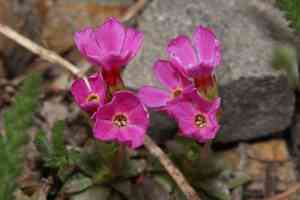
Cliff dwarf primrose (Douglasia laevigata)
Also known as: Douglas' Dustymaiden, Desert Douglasia
The cliff dwarf primrose excels in alpine terrains due to several key adaptations. Its glossy, smooth leaves and compact, cushion-like growth help it endure harsh weather and strong winds. This hardy perennial produces striking pink to purple flowers, which create a vivid contrast against the rocky, barren landscape. Its ability to thrive in such tough conditions highlights the remarkable adaptability and resilience of nature.
In This Article
Attributes of Cliff dwarf primrose
Lifespan
Perennial
Plant Type
Herb, Shrub
Plant Height
5 cm to 15 cm
Spread
Approximately 20 cm (8 inches)
Leaf Color
Green
Flower Size
1-2 cm (0.4-0.8 inches)
Flower Color
Pink
Images of Cliff dwarf primrose
Quickly Identify Cliff dwarf primrose
1
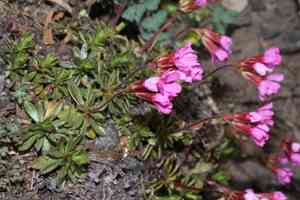
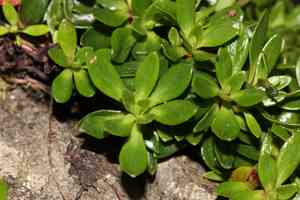
Douglasia laevigata can be identified by its small, dense clusters of bright pink to magenta flowers. The leaves are oblong and arranged in basal rosettes. The plant has a low-growing habit, typically forming cushion-like mats.
Scientific Classification of Cliff dwarf primrose
Phylum
Vascular plants
Class
Dicotyledons
Order
Ericales
Family
Primrose
Genus
Dwarf-primrose
Species
Cliff dwarf primrose
Planting and Growing of Cliff dwarf primrose
Care Difficulty
Easy
Watering Schedule
Every 2 days
Sunlight Requirements
Partial sun
Sunshine Duration
4-8 hours
Ideal Temperature
55-70℉
Soil Type
Potting Mix, Peat Mix
Soil pH
6.5-7.5
Fertilizer Type
Balanced
Pruning Season
Spring, Summer
Pruning Area
Branches, Leaves
Pruning Frequency
2 times a year
Repotting Season
Spring
Pot Type
Plastic, Ceramic
 How to Water Cliff dwarf primrose?
Douglasia laevigata prefers consistently moist soil without becoming waterlogged. The best approach is to water until the soil feels evenly damp to a depth of about 2-3 inches. This allows the root system to access adequate water, while preventing over-saturation which may lead to root rot.
What are the symptoms of an underwatered Cliff dwarf primrose?
›
What should I do if my Cliff dwarf primrose is not getting enough water?
›
What are the symptoms of an overwatered Cliff dwarf primrose?
›
How to save an overwatered Cliff dwarf primrose?
›
 What Are the Sunlight Requirements for Cliff dwarf primrose?
Partial sun ideally includes morning sun exposure followed by afternoon shade. This light range helps Douglasia laevigata maintain energetic growth and rich blossom output.
What is the best way to provide ideal light?
›
How do we set up a space to ensure ideal light levels?
›
What benefits result from providing ideal lighting?
›
 What Is the Ideal Temperature Range for Cliff dwarf primrose?
Douglasia laevigata thrives best in a temperature range of 55°F to 70°F. This range provides the optimal conditions for photosynthesis and growth. Maintaining these temperatures is crucial for this plant to develop vigorous foliage and display vibrant flowering.
 What Soil is Best for Cliff dwarf primrose?
Douglasia laevigata prefers well-drained soils that prevent waterlogging. This requirement ensures that the roots have access to necessary oxygen and prevents root rot, which can severely damage the plant. The plant thrives in soils with a pH between 6.5 and 7.5. Maintaining this pH range facilitates optimal nutrient availability and uptake, promoting healthy growth and vibrant blooms. Incorporating organic matter like compost can improve soil structure and fertility. This reinforces the soil's ability to retain moisture while providing essential nutrients that support robust growth.
 How to Fertilize Cliff dwarf primrose?
For Douglasia laevigata, use a balanced 10-10-10 liquid fertilizer at a rate of half a teaspoon per gallon of water. Use lightweight applications to avoid root burn caused by excess nutrients.
 How to Prune Cliff dwarf primrose?
Always use sharp, sterilized pruning shears to make clean cuts, minimizing damage and reducing the risk of infection. Clean the tools between each use to prevent any spread of disease, especially if you notice signs of plant stress or illness. Douglasia laevigata is a delicate plant, so avoid cutting more than a third of the plant at once. Over-pruning can stress the plant, leading to poor blooms or stunted growth. It's better to prune a little at a time and monitor the plant's response before proceeding further.
More About Pruning Techniques→
 How to Propagate Cliff dwarf primrose plant?
1
Collect seeds from mature Douglasia laevigata plants in late spring. Ensure that the seeds are fully developed and free from pests or diseases.
2
Select healthy, non-flowering stems for cuttings in spring. Cut the stem at an angle using sharp shears to maximize rooting surface area.
3
In early spring, carefully dig up the plant and gently separate the root clump into sections. Each section should have roots attached for successful division.
 How to Repot Cliff dwarf primrose plant?
1
Repot Douglasia laevigata when you notice its roots filling the pot or growing out of drainage holes. Spring and autumn are ideal times as the plant is not in extreme heat or dormancy, allowing for smoother adjustment to a new pot.
2
Select a pot that is one size larger than the current one, ensuring it has ample drainage holes to prevent waterlogging. Using a slightly bigger pot gives the roots room to grow without overwhelming them with too much space, which can lead to root rot.
3
Opt for a well-draining potting mix, ideally with a blend of sand, peat, and loam, to mimic its natural habitat. This mix ensures that the roots receive adequate moisture while preventing water from sitting, which is crucial to avoid fungal diseases.
Learn More About Cliff dwarf primrose Diseases
Anthracnose
Bacterial Leaf Spot
Bacterial Soft Rot
Crown Gall
Cyst Nematode
Damping-off
Downy Mildew
Drought Stress
Fusarium Wilt
Gray Mold
Leaf Spot
Mosaic
Nutrient Deficiency
Nutrient Toxicity
Powdery Mildew
Root Rot
Root-knot Nematode
Rusts
Sooty Mold
Spider Mites
Temperature Stress
Thrips Damage
White Mold
Chemical Injury



