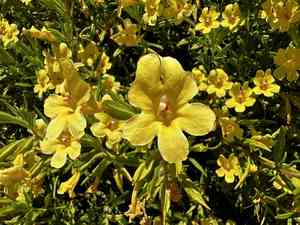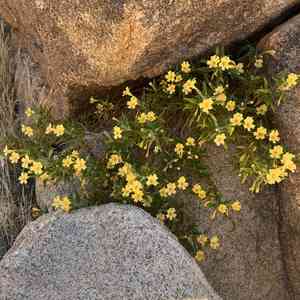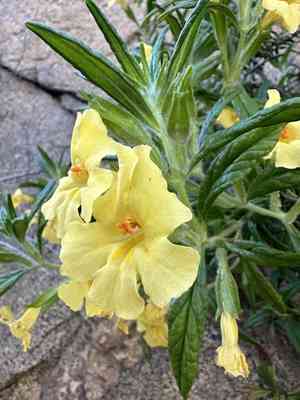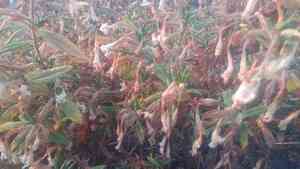
Kaweah river bush monkeyflower(Diplacus calycinus)

Kaweah river bush monkeyflower (Diplacus calycinus)

Also known as: Grant's Monnkeyflower, Mimulus calycinus

The Kaweah River bush monkeyflower (Erythranthe purpurea) is a perennial herb notable for its lush, green leaves and its preference for moist, rocky or sandy environments.

**Characteristics:**
- **Growth Form:** It exhibits a sprawling to upright growth habit.
- **Foliage:** The leaves are green, oppositely arranged, and can be slightly sticky.
- **Flowers:** The plant is distinguished by its striking, tubular flowers, which are typically purple with yellow throats, setting it apart from other species. These flowers are designed to attract pollinators such as bees and hummingbirds.
- **Height:** It usually reaches a height of 1 to 2 feet.

**Habitats:**
- **Location:** This species is commonly found along riverbanks, streams, and in moist, rocky locales.
- **Elevation:** It prospers at elevations between 500 and 2,000 feet.
- **Soil:** While it favors well-drained, sandy, or gravelly soils, it can adapt to a range of soil types.

The Kaweah River bush monkeyflower is well-suited to California's Mediterranean climate, flourishing through its wet winters and enduring dry summers.

Attributes of Kaweah river bush monkeyflower

Lifespan
Perennial
Plant Type
Shrub
Plant Height
10-30 cm
Spread
N/A
Leaf Color
Green
Flower Size
2-3 cm
Flower Color
Yellow

ForwardPlant - Identify plants with a snap

Identify and diagnose plants, get toxicity alerts, and explore safety guides for all types of fungi.

Try for Free

Images of Kaweah river bush monkeyflower

Kaweah river bush monkeyflower(Diplacus calycinus)

Quickly Identify Kaweah river bush monkeyflower

1
Identifiable by its bright yellow, tubular flowers with five lobes, ovate leaves that are covered in glandular hairs, and a sticky calyx. The plant often grows in sandy or rocky soils and dry habitats.

Scientific Classification of Kaweah river bush monkeyflower

Phylum
Vascular plants
Class
Dicotyledons
Order
Lamiales
Family
Lopseed
Genus
Bush monkeyflowers
Species
Kaweah river bush monkeyflower

Planting and Growing of Kaweah river bush monkeyflower

Care Difficulty
Moderate
Watering Schedule
Every 4 days
Sunlight Requirements
Full sun
Sunshine Duration
4-8 hours
Ideal Temperature
65-75℉
Soil Type
Potting Mix, Peat Mix
Soil pH
6.5-7.5
Fertilizer Type
Balanced
Pruning Season
Spring, Summer
Pruning Area
Branches, Leaves
Pruning Frequency
2 times a year
Repotting Season
Spring
Pot Type
Plastic, Ceramic

water icon How to Water Kaweah river bush monkeyflower?

When watering Diplacus calycinus, aim to provide around 250 ml of water. It's essential to ensure that the water reaches the root zone without causing waterlogging. Based on the plant's natural habitat, allow the soil to dry out slightly between waterings, mimicking the conditions of a dry climate, where periods of drought are common.
What are the symptoms of an underwatered Kaweah river bush monkeyflower?
What should I do if my Kaweah river bush monkeyflower is not getting enough water?
What are the symptoms of an overwatered Kaweah river bush monkeyflower?
How to save an overwatered Kaweah river bush monkeyflower?

sunlight icon What Are the Sunlight Requirements for Kaweah river bush monkeyflower?

Sunlight Requirements: Full sun, Partial sun
Duration of light: 6 to 8 hours daily
Diplacus calycinus enjoys full to partial sun, thriving in 6 to 8 hours of sunlight. This ideal light exposure encourages robust growth and maximizes flowering potential, attributable to photosynthesis and energy production.
How much sunlight does Diplacus calycinus need ideally?
What are some solutions to provide ideal light for Diplacus calycinus?
What are the benefits of obtaining ideal light for Diplacus calycinus?

temperature icon What Is the Ideal Temperature Range for Kaweah river bush monkeyflower?

Ideal Temperature: 65 ~ 75℉
For optimal growth, Diplacus calycinus thrives best within a temperature range of 65°F to 75°F. This range ensures that the plant experiences an environment that supports ideal metabolic activities, photosynthesis, nutrient uptake, and overall vibrancy. Keeping the temperatures within this range helps maintain the plant's growth rate and maximizes flowering potential.

soil icon What Soil is Best for Kaweah river bush monkeyflower?

Soil type: Sandy loam, Loam
Soil PH: 6.5 ~ 7.5
Diplacus calycinus thrives in well-draining soils, which help prevent root rot by allowing excess water to escape quickly. This is particularly important as it mimics the plant's natural habitat. This plant performs best in nutrient-rich soils that provide essential minerals for growth and flowering, promoting lush foliage and vibrant blooms. Soils that retain moderate moisture are ideal for Diplacus calycinus, ensuring consistent hydration without waterlogging. This balance supports healthy growth and reduces stress on the plant.

fertilize icon How to Fertilize Kaweah river bush monkeyflower?

Fertilizer type: Balanced
For Diplacus calycinus, it's important to moderate the amount of fertilizer used. A balanced 10-10-10 NPK liquid fertilizer should be diluted to half strength and applied twice a month during the growing season. For solid fertilizers, use a slow-release type, applying approximately one tablespoon per plant annually in the spring to ensure nutrients are steadily provided.

prune icon How to Prune Kaweah river bush monkeyflower?

Pruning Time: Spring, Summer, Autumn
Avoid pruning more than one-third of the plant at once. Over-pruning can stress Diplacus calycinus, leading to stunted growth or reduced flowering. It is essential to balance shaping the plant while leaving enough foliage for photosynthesis. Choose a dry day for pruning to reduce the risk of moisture-borne diseases. In wet conditions, cuts take longer to heal and are more susceptible to fungal infections, compromising plant health. More About Pruning Techniques

propagate icon How to Propagate Kaweah river bush monkeyflower plant?

Propagate Time: Early spring,Late spring,Early summer
1
For seed propagation, collect mature seeds from healthy Diplacus calycinus plants. Ensure the seeds are free from mold and are properly dried before storing them in a cool, dry place until sowing.
2
Select healthy, non-flowering stems for cuttings. Use pruning shears to cut a 4-6 inch section from the plant, ensuring the cut is clean and angled to maximize root growth potential.
3
Carefully dig up a mature plant and separate the root clumps into smaller sections. Each section should have a healthy root system to ensure successful propagation.
More About Propagating Techniques

repot icon How to Repot Kaweah river bush monkeyflower plant?

Repotting frequency: Every 1-2 years
1
Diplacus calycinus should be repotted when you notice roots growing through the drainage holes of its current pot or when its growth becomes noticeably stunted. Additionally, if the soil no longer retains moisture or your plant shows signs of stress despite normal care, it is time to consider repotting.
2
Select a pot that is 1-2 inches larger in diameter than the current one. Ensure it has proper drainage holes to prevent waterlogging, which can lead to root rot. A slightly bigger pot allows the plant roots to spread and grow, fostering healthier growth and blooming.
3
Opt for a well-draining sandy loam soil mix. This type of soil promotes excellent drainage and aeration, minimizing the risk of root rot and mimicking the plant's natural habitat. Adding organic matter like compost will also enhance the soil's fertility.

ForwardPlant - Identify plants with a snap

Find the best spots for them to optimize their health, simply using your phone.

Try for Free