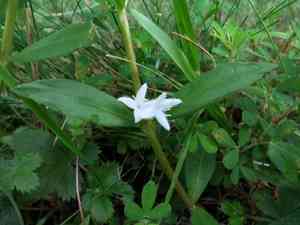
Virginia buttonweed (Diodia virginiana)
Also known as: Large buttonweed
Virginia buttonweed (Diodia virginiana) poses significant challenges for turfgrass management due to its deep root system and ability to spread via rhizomes. This weed thrives in moist, poorly-drained areas, making effective control difficult. Its resilience and growth habits necessitate persistent, targeted herbicide applications and improved lawn drainage practices.
In This Article
Attributes of Virginia buttonweed
Lifespan
Perennial, Annual
Plant Type
Herb
Plant Height
30 cm to 91 cm
Spread
15 cm to 45 cm
Leaf Color
Green
Flower Size
2.5 cm
Flower Color
White Purple
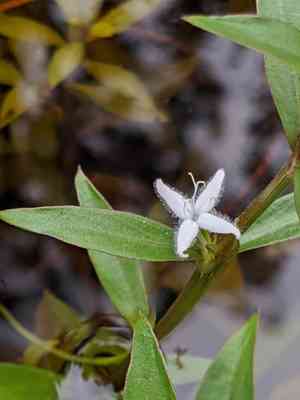
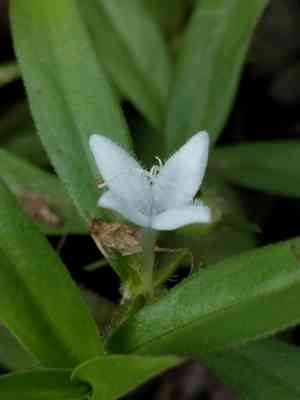
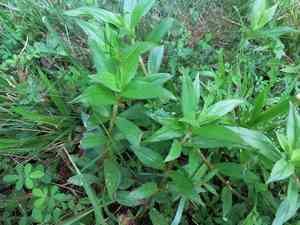
Images of Virginia buttonweed
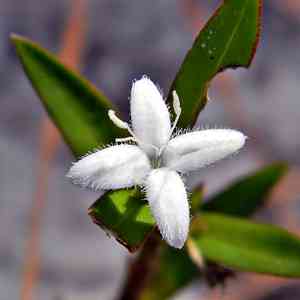
Quickly Identify Virginia buttonweed
1
Star-shaped white flowers in leaf axils with radial symmetry
2
Narrow, stiff leaves up to 3.5 inches (9 cm) with bristles at base
3
Oval to elliptic capsular fruit with leathery, hairy green exterior
4
Longitudinally ridged stem with branching patterns, up to 2 feet (60 cm) long
5
Sprawling growth habit, green foliage, profuse blooming up to 36 inches (91 cm) wide
Scientific Classification of Virginia buttonweed
Phylum
Vascular plants
Class
Dicotyledons
Order
Gentianales
Family
Madder
Genus
Buttonweeds
Species
Virginia buttonweed
Planting and Growing of Virginia buttonweed
Care Difficulty
Easy
Watering Schedule
Every 4 days
Sunlight Requirements
Full sun
Sunshine Duration
4-8 hours
Ideal Temperature
68-77℉
Soil Type
Potting Mix, Peat Mix
Soil pH
5.5-7.5
Fertilizer Type
Balanced
Pruning Season
Spring, Summer
Pruning Area
Branches, Leaves
Pruning Frequency
2 times a year
Repotting Season
Spring
Pot Type
Plastic, Ceramic
 How to Water Virginia buttonweed?
When watering Diodia virginiana, ensure the soil is moist but not waterlogged. It's important to strike a balance where the soil is uniformly damp, about half a liter per session, allowing proper drainage.
What are the symptoms of an underwatered Virginia buttonweed?
›
What should I do if my Virginia buttonweed is not getting enough water?
›
What are the symptoms of an overwatered Virginia buttonweed?
›
How to save an overwatered Virginia buttonweed?
›
 What Are the Sunlight Requirements for Virginia buttonweed?
Diodia virginiana excels in full to partial sun settings, ideally within 4 to 8 hours of sunlight. Appropriate lighting boosts photosynthetic efficiency, invigorating growth and amplifying flowering, ensuring the plant blooms to its fullest potential.
What is the ideal light condition for Diodia virginiana?
›
How can I ensure Diodia virginiana receives the ideal light?
›
What benefits does Diodia virginiana gain from optimal lighting?
›
 What Is the Ideal Temperature Range for Virginia buttonweed?
The ideal temperature range for Diodia virginiana falls between 68°F and 77°F. This range provides the optimal conditions for photosynthesis, growth, and metabolic activities, ensuring that the plant thrives with minimal stress. Just as Goldilocks found her perfect porridge, this temperature zone is neither too hot nor too cold for the plant's fundamental physiological processes.
 What Soil is Best for Virginia buttonweed?
Diodia virginiana thrives best in well-drained soil, which prevents waterlogging and root rot. This condition ensures that the plant's roots can access oxygen efficiently, leading to healthier growth and vibrant green foliage. This plant prefers nutrient-rich soil, which supplies essential minerals and nutrients required for robust growth. Regular organic matter addition boosts soil fertility, promoting strong plant health and enhanced flowering. Maintaining a consistently moist soil is crucial for Diodia virginiana, as it supports continuous uptake of water and nutrients. This condition helps the plant maintain turgidity and vitality, crucial for resilience in varying climatic conditions.
 How to Fertilize Virginia buttonweed?
For Diodia virginiana, the amount of fertilizer used should be modest. Liquid fertilizers should be applied at half-strength to avoid overwhelming the plant, approximately 1 tablespoon per gallon of water. For slow-release fertilizers, use about 1/4 to 1/2 pound per plant, evenly distributed around the base.
 How to Prune Virginia buttonweed?
Begin by inspecting the plant for dead or damaged stems, which should be removed at their base to promote healthy growth. Next, trim back any excessively long stems to maintain a compact and bushy shape. Use sharp, clean pruning shears to make cuts just above leaf nodes, encouraging new growth. If the plant appears too dense, selectively remove some inner branches to enhance air flow and light exposure, which will improve the overall health of Diodia virginiana.
 How to Propagate Virginia buttonweed plant?
1
Begin by soaking the seeds in water for 24 hours to improve germination rates. Once soaked, plant them in a seed tray filled with a high-quality seed starting mix.
2
Select healthy stems from the Diodia virginiana plant and use pruning shears to take 4-6 inch cuttings. Ensure the cuttings are taken from non-flowering parts for better rooting success.
3
Dip the cut end of each cutting in rooting hormone before planting it in moist, well-draining soil. Maintain a high humidity environment for optimal root development.
 How to Repot Virginia buttonweed plant?
1
Repot Diodia virginiana when you notice roots circling the pot surface, indicating the plant is root-bound. Another signal is if water drains too quickly from the pot, meaning the soil structure has degraded. Spring and autumn are the ideal seasons as the plant is less stressed and can quickly establish in new soil.
2
Choose a pot 1-2 inches larger in diameter than the current one, with ample drainage holes. A slightly larger pot ensures the roots have room to grow, reducing the risk of becoming root-bound quickly. Ensure it's made from breathable material like terracotta to aid moisture control and oxygen supply.
3
Opt for a well-draining, loamy soil mix to ensure proper moisture retention and drainage. This type of soil prevents waterlogging, which can lead to root rot while retaining enough moisture for healthy root development. Adding organic matter can enhance the soil structure and nutrient content.



