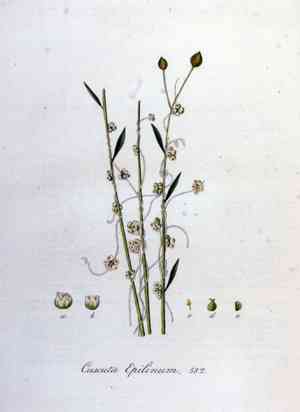
Flax dodder (Cuscuta epilinum)
Also known as: Flax Dodder
Flax is an annual herbaceous plant used primarily for linen production. Its stem, which grows to a height of 76 to 127 cm and a thickness of 0.5 to 1 millimeter, is mostly unbranched or only slightly branched. The stem is smooth, cylindrical, and pale green due to the presence of chlorophyll. Inside, the stem contains long, strong fibers that are essential for textile manufacturing. The plant does have roots and leaves, contrary to the description of "flax silk."
In This Article
Attributes of Flax dodder
Lifespan
Perennial
Plant Type
Herb, Vine
Plant Height
Less than 1 meter (length of stems depending on the host plant)
Spread
N/A
Leaf Color
N/A
Flower Size
2-3 mm
Flower Color
White
Images of Flax dodder
Quickly Identify Flax dodder
1
Flax Dodder can be identified by its thin, yellow to orange, thread-like stems that twine around the host plant. It lacks leaves and has small, white flowers that are typically clustered. The presence of parasitic tissues physically attached to the host plant is also a key indicator.
Scientific Classification of Flax dodder
Phylum
Vascular plants
Class
Dicotyledons
Order
Solanales
Family
Morning-glory
Genus
Dodder
Species
Flax dodder
Planting and Growing of Flax dodder
Care Difficulty
Hard
Watering Schedule
Every 2 days
Sunlight Requirements
Partial sun
Sunshine Duration
6-8 hours
Ideal Temperature
68-77℉
Soil Type
Potting Mix, Peat Mix
Soil pH
5.5-8.5
Fertilizer Type
Balanced
Pruning Season
Spring, Summer
Pruning Area
Branches, Leaves
Pruning Frequency
2 times a year
Repotting Season
Spring
Pot Type
Plastic, Ceramic
 How to Water Flax dodder?
Cuscuta epilinum is a parasitic plant that does not require much water. Its watering should be minimal, with just 50 ml per session, enough to slightly moisten the surrounding soil without creating standing water. Since it mainly relies on its host plant for nutrients, maintain a careful balance to avoid excessive moisture.
What are the symptoms of an underwatered Flax dodder?
›
What should I do if my Flax dodder is not getting enough water?
›
What are the symptoms of an overwatered Flax dodder?
›
How to save an overwatered Flax dodder?
›
 What Are the Sunlight Requirements for Flax dodder?
Partial sun to full sun exposure provides the best results for Cuscuta epilinum. It thrives in environments where it can bask in medium-to-high light, promoting vigorous growth and vibrant flower colors.
What is the ideal lighting condition for Cuscuta epilinum?
›
How can you provide optimal lighting conditions?
›
What benefits does ideal lighting offer?
›
 What Is the Ideal Temperature Range for Flax dodder?
For optimal growth of Cuscuta epilinum, the ideal temperature range is between 68°F and 77°F. Within this range, the plant can effectively carry out photosynthesis, maintain cellular functions, and support robust growth. This temperature range mimics the natural warm environments that the plant preferences, ensuring mild stress and promoting healthy development.
 What Soil is Best for Flax dodder?
Cuscuta epilinum thrives best in well-drained soils as it helps prevent waterlogging, which can cause root rot and other complications. Adequate drainage ensures that the roots have access to air and necessary nutrients, promoting healthy growth. While Cuscuta epilinum is not highly dependent on soil nutrients due to its parasitic nature, growing in nutrient-rich soils aids the host plants. This, in turn, enables the parasitic plant to benefit indirectly as it depends on a healthy host for sustenance. Maintaining moderate soil moisture levels is crucial for Cuscuta epilinum's optimal growth. Excessive moisture can lead to poor aeration and hinder nutrient absorption by the hosts, while low moisture levels can stress the host plants, affecting the parasite's survival.
 How to Fertilize Flax dodder?
For Cuscuta epilinum, a modest amount of fertilizer is generally sufficient. This plant is parasitic and does not rely heavily on fertilizers, but a balanced dose, such as a 1/4 strength liquid fertilizer, can be applied to boost growth when necessary. Over-fertilization should be avoided to prevent plant stress.
 How to Prune Flax dodder?
Carefully disentangle Cuscuta stems from the host plant. Trim as close to the base as possible without damaging the host for a more sustainable cut. After pruning, ensure that the host plant is healthy. Fertilize the host if necessary to encourage recovery and use mulching to suppress any lingering Cuscuta seeds.
More About Pruning Techniques→
 How to Propagate Flax dodder plant?
1
Begin by filling the seed tray with a well-draining seed-starting mix. Scatter the seeds of Cuscuta epilinum evenly across the surface, lightly covering them with a thin layer of soil. Mist the surface lightly to moisten without washing away the seeds.
2
Place the seed tray in a location that receives indirect sunlight and maintains a temperature around 18-22°C (64-72°F). Consistent watering is essential; use a mist bottle for moistening the surface lightly to avoid drying out but ensure it isn't overly wet.
3
Once seedlings have developed and grown strong roots, carefully transfer them into individual pots or the garden. Ensure they have adequate support and spacing to avoid competition for resources. Transplanting should be done gently to prevent root damage.
 How to Repot Flax dodder plant?
1
Look for signs such as roots emerging from the drainage holes, or when the plant's growth appears stunted. If these signs are present, it's time for a change in environment to facilitate healthier development.
2
Select a pot that is slightly larger than the current one, with good drainage holes. This prevents water logging and encourages root growth, ensuring that your Cuscuta epilinum thrives in its new home.
3
Opt for sandy, well-draining soil that mimics its natural environment. This helps with adequate drainage and prevents root rot, important for maintaining the plant's health post-repotting.



