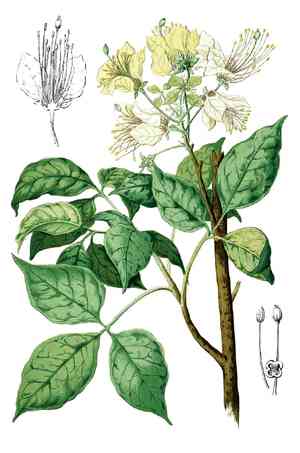
Crateva (Crateva) (Crateva)
Also known as: Spider Tree, Sacred Garlic Pear
Crateva belongs to a group of plants that produce flowers.
In This Article
Attributes of Crateva (Crateva)
Lifespan
Perennial
Plant Height
5 to 15 meters
Spread
3 to 10 meters
Leaf Color
Green
Flower Size
2 to 3 cm
Flower Color
White, Yellow, Pink
Images of Crateva (Crateva)
Quickly Identify Crateva (Crateva)
1
Crateva is identified by its trifoliate leaves, often with an aromatic characteristic. The flowers are usually white, yellow, or pink, forming in clusters, and they have a distinctive cross shape. The fruit is a berry, which is usually spherical or oval and contains numerous seeds.
Scientific Classification of Crateva (Crateva)
Phylum
Magnoliophyta
Class
Magnoliopsida
Order
Brassicales
Family
Capparaceae
Genus
Crateva
Planting and Growing of Crateva (Crateva)
Care Difficulty
Moderate
Watering Schedule
Every 3 days
Sunlight Requirements
Partial sun
Sunshine Duration
4-8 hours
Ideal Temperature
68-86℉
Soil Type
Potting Mix, Peat Mix
Soil pH
6-7.5
Fertilizer Type
Balanced
Pruning Season
Spring, Summer
Pruning Area
Branches, Leaves
Pruning Frequency
2 times a year
Repotting Season
Spring
Pot Type
Plastic, Ceramic
 How to Water Crateva (Crateva)?
The watering amount should ensure the soil is thoroughly moist but not soggy. For Crateva, watering with about 500 ml per session achieves this balance. The goal is a soil consistency that is damp to the touch at a depth of two inches, allowing the plant roots to effectively uptake water without risk of root rot.
What are the symptoms of an underwatered Crateva (Crateva)?
›
What should I do if my Crateva (Crateva) is not getting enough water?
›
What are the symptoms of an overwatered Crateva (Crateva)?
›
How to save an overwatered Crateva (Crateva)?
›
 What Are the Sunlight Requirements for Crateva (Crateva)?
Crateva thrives best in partial to full sun environments, ideally within 6-8 hours of sun exposure. This ensures robust growth, stronger stems, and prolific blooming.
How much light is ideal for Crateva?
›
What solutions help Crateva get ideal light?
›
What are benefits of ideal lighting for Crateva?
›
 What Is the Ideal Temperature Range for Crateva (Crateva)?
For optimal growth, Crateva plants thrive best in temperatures ranging from 68 to 86 degrees Fahrenheit. This range ensures that the plant can photosynthesize effectively and maintain healthy metabolic functions. Growth is most vigorous within these temperatures, and plants display vibrant foliage and flower development. Ensuring the plant remains within this range can reduce stress and increase disease resistance.
 What Soil is Best for Crateva (Crateva)?
Crateva thrives in well-drained soils that prevent waterlogging. This ensures that the roots receive adequate oxygen, promoting healthy growth and minimizing the risk of root rot. A nutrient-rich soil is crucial for Crateva as it supports robust foliage and flowering. Organic matter enhances soil fertility, providing a steady nutrient supply for optimal plant health. While well-draining, the soil should also retain some moisture to keep Crateva hydrated. This balance helps in maintaining consistent water availability without overwhelming the roots.
 How to Fertilize Crateva (Crateva)?
Crateva plants benefit from a moderate application of fertilizer. Use approximately 1/4 cup (about 60 ml) of balanced 10-10-10 liquid fertilizer diluted in a gallon of water for liquid fertilization. For slow-release granular fertilizers, 1/2 cup (around 120 grams) sprinkled evenly over the root zone should suffice. This ensures the plant gets adequate nutrients without overloading the soil.
 How to Prune Crateva (Crateva)?
Identify branches that are either growing inward or disrupting the natural form of the plant. Carefully saw these off close to the main branch or trunk, taking care not to damage the bark. Remove some of the older stems and branches at the base. This stimulates the growth of new branches, helps with better air circulation, and prevents the plant from becoming too dense.
 How to Propagate Crateva (Crateva) plant?
1
Fill the seed tray with a sterile seed-starting mix. Moisten the mix evenly, preparing the perfect environment for seed germination.
2
Scatter the Crateva seeds over the prepared mix and cover them lightly with a thin layer of soil. Use a spray bottle to mist the surface and maintain moisture without disturbing the seeds.
3
Cut 6-inch sections from a healthy Crateva branch. Strip the lower leaves, dip the cut end in rooting hormone, and plant it in a prepared pot with moist soil.
 How to Repot Crateva (Crateva) plant?
1
Crateva plants often show signs when it's time for repotting. Look for roots protruding from drainage holes or stunted growth, which signals the need for a larger pot. Spring and autumn are optimal times as these seasons encourage new growth and recovery.
2
Select a pot that's 1-2 inches larger in diameter than the current one. Ensure it has drainage holes to prevent waterlogging, which can harm root systems. The right pot provides ample space for root growth and helps in maintaining moisture levels appropriately.
3
Opt for well-draining loamy soil mixed with organic matter. This selection supports proper aeration and moisture retention, encouraging healthy root development and preventing root rot by ensuring excess water escapes efficiently.
Learn More About Crateva (Crateva) Diseases
Anthracnose
Bacterial Leaf Spot
Bacterial Soft Rot
Bacterial Wilt
Black Spot
Chemical Injury
Crown Gall
Damping-off
Downy Mildew
Drought Stress
Fusarium Wilt
Gray Mold
Leaf Curl
Leaf Spot
Mosaic
Nutrient Deficiency
Nutrient Toxicity
Powdery Mildew
Root Rot
Root-knot Nematode
Rusts
Sooty Mold
Spider Mites
Temperature Stress
Thrips Damage
White Mold

