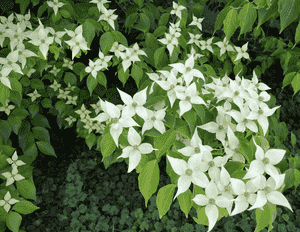
Kousa dogwood (Cornus kousa)
Also known as: Kousa, Chinese dogwood
The Crape Myrtle is celebrated for its striking appearance. With its vibrant flowers, appealing bark, and stunning fall foliage, this vase-shaped tree makes a wonderful addition to patios, yards, or lawns. It typically reaches a height of about 9 meters and is equally wide.
In This Article
Attributes of Kousa dogwood
Lifespan
Perennial
Plant Type
Tree
Plant Height
4 m to 10 m
Spread
2.5 m to 6 m
Leaf Color
Green Yellow Purple Red
Flower Size
2.5 cm to 8 cm
Flower Color
White Cream Yellow Pink Green
Images of Kousa dogwood
Quickly Identify Kousa dogwood
1
Bark peels in tan and brown patches, evolving with age for distinctive mottled effect.
2
Creamy white bracts in late spring, nearly covering tree, surrounding inconspicuous flowers.
3
Reddish-pink drupes, 1-1.5 inches in diameter, encasing yellowish-orange interior with lengthy stalk.
4
Dark green glossy leaves, oval-shaped, turning reddish-purple to scarlet in fall.
5
Smooth, upright stem starts purple/green, matures to light brown, with symmetrical branching.
Scientific Classification of Kousa dogwood
Phylum
Vascular plants
Class
Dicotyledons
Order
Cornales
Family
Dogwood
Genus
Dogwoods
Species
Kousa dogwood
Planting and Growing of Kousa dogwood
Care Difficulty
Easy
Watering Schedule
Every 8 days
Sunlight Requirements
Full sun
Sunshine Duration
4-8 hours
Ideal Temperature
60-75℉
Soil Type
Potting Mix, Peat Mix
Soil pH
6.5-7.5
Fertilizer Type
Balanced
Pruning Season
Spring, Summer
Pruning Area
Branches, Leaves
Pruning Frequency
2 times a year
Repotting Season
Spring
Pot Type
Plastic, Ceramic
 How to Water Kousa dogwood?
Cornus kousa, commonly known as Kousa Dogwood, prefers to be watered deeply but infrequently. It's best to ensure the water penetrates the soil deeply to encourage robust root growth. Typically, providing around 500ml of water per session is optimal.
More About Watering Techniques→
What are the symptoms of an underwatered Kousa dogwood?
›
What should I do if my Kousa dogwood is not getting enough water?
›
What are the symptoms of an overwatered Kousa dogwood?
›
How to save an overwatered Kousa dogwood?
›
 What Are the Sunlight Requirements for Kousa dogwood?
Cornus kousa thrives best in partial to full sun conditions. Sufficient sunlight ensures robust growth, vibrant foliage colors, and plentiful flowering, mimicking its natural environments preference for dappled to full sunlight.
More About Sunlight Requirements Techniques→
How much sunlight does Cornus kousa need?
›
What if Cornus kousa gets too much sun?
›
How can you enhance lighting for Cornus kousa indoors?
›
 What Is the Ideal Temperature Range for Kousa dogwood?
Cornus kousa thrives best within a temperature range of 60°F to 75°F. This temperature range supports optimal photosynthesis and overall plant health, ensuring vibrant foliage and robust flowering. Providing a consistent environment within this range minimizes stress and encourages growth.
 What Soil is Best for Kousa dogwood?
Kousa Dogwoods require well-drained soil to prevent root rot. Ensuring good drainage benefits the plant by promoting robust root health and reducing the risk of waterlogging that could harm the tree's growth. While Cornus kousa tolerates dry conditions, it thrives when its soil maintains consistent moisture. This need for moisture encourages optimal growth, as hydrated soil supports nutrient uptake and overall tree vigor. Incorporating organic matter, like compost, enhances soil fertility and structure. This enrichment boosts the plant's health by improving nutrient availability and promoting beneficial microbial activity in the soil.
More About Soil→
 How to Fertilize Kousa dogwood?
Cornus kousa, or Kousa Dogwood, requires a balanced approach to fertilization. Typically, you should apply about 1 pound of a balanced 10-10-10 granular fertilizer per inch of trunk diameter annually. Ensure this amount is well-distributed under the canopy and not concentrated in one spot to avoid root burn.
More About Fertilizing Techniques→
 How to Prune Kousa dogwood?
Begin by assessing the overall structure of your Cornus kousa, identifying dead, diseased, or damaged branches that need removal. Start with these problem branches using sterilized scissors or pruners, cutting them close to the main stem while maintaining a natural shape. Focus on ensuring even air circulation by removing any crossing or inward-facing branches. This step is vital for the prevention of disease and encourages healthy flowering. Finally, shape the tree by trimming back any overly vigorous new growth and giving it an aesthetic appearance that enhances the natural beauty of the Cornus kousa. For more experienced gardeners looking to refine their Cornus kousa, consider techniques such as thinning, which involves selectively removing inner branches to allow more light penetration and air circulation. When pruning the canopy, maintain an open-centered shape to enhance the tree’s layered, horizontal branch structure that is characteristic of Cornus kousa. Use heading cuts sparingly and only in areas where denser growth is desirable. Always cut above a node to encourage lateral branching and avoid leaving stubs that could become avenues for pests or diseases.
More About Pruning Techniques→
 How to Propagate Kousa dogwood plant?
1
Choose healthy and semi-hardwood sections of branches, around 6-8 inches in length, for cutting propagation. Ensure the cutting has at least two nodes.
2
Prepare a well-draining potting mix or a mixture of peat and perlite to promote good aeration and moisture retention for the cuttings.
3
Dip the cut end of the cutting into rooting hormone powder and plant it into the prepared soil medium. Ensure at least one node is beneath the soil surface to encourage rooting.
 How to Repot Kousa dogwood plant?
1
Cornus kousa shows signs of needing a new pot when roots start to circle the container, or if growth becomes sluggish despite proper care. The ideal time to repot is early spring just before new growth begins, or in autumn once dormancy sets in. These times ensure minimal stress to the plant as it transitions to a new home.
2
Choose a pot that is only slightly larger than the current one—approximately 1-2 inches in diameter. This careful selection prevents root rot by avoiding excessive soil moisture. A pot with drainage holes is essential to enable water to escape, preventing waterlogging and ensuring healthy root conditions.
3
Opt for a well-draining acidic soil mixture, which is crucial for Cornus kousa to thrive. Look for a mix containing peat moss, pine bark, and sand. This blend mimics their natural environment, helping maintain the right moisture level and acidity, crucial for nutrient absorption and plant health.



