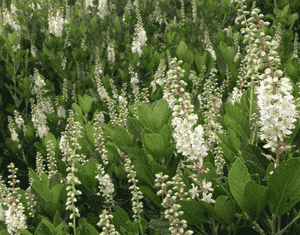
Summersweet (Clethra alnifolia)
Also known as: White alder
The Eastern Red Columbine (Aquilegia canadensis) is a flowering plant indigenous to North America. It is widely favored in woodland gardens due to its ability to attract both birds and butterflies.
In This Article
Attributes of Summersweet
Lifespan
Perennial
Plant Type
Shrub
Plant Height
1.5 m to 3 m
Spread
1.2 m to 1.8 m
Leaf Color
Green Yellow Brown
Flower Size
8 cm to 15 cm
Flower Color
White Pink
Images of Summersweet
Quickly Identify Summersweet
1
Fragrant white flowers on dense spikes (5-15 cm) bloom June to August.
2
Distinctive dry capsules (3 mm) with three valves, maturing to brown.
3
Glossy obovate leaves (7.5-10 cm long) turning golden brown in fall.
4
Slender trunk with gray, vertically striped bark developing into scaly ridges.
5
Pubescent fruit capsules, tan-brown in autumn, remaining on plant for over a year.
Scientific Classification of Summersweet
Phylum
Vascular plants
Class
Dicotyledons
Order
Ericales
Family
Clethra
Genus
Clethra
Species
Summersweet
Planting and Growing of Summersweet
Care Difficulty
Easy
Watering Schedule
Every 4 days
Sunlight Requirements
Full sun
Sunshine Duration
8-12 hours
Ideal Temperature
59-77℉
Soil Type
Potting Mix, Peat Mix
Soil pH
5.5-7
Fertilizer Type
Balanced
Pruning Season
Spring, Summer
Pruning Area
Branches, Leaves
Pruning Frequency
2 times a year
Repotting Season
Spring
Pot Type
Plastic, Ceramic
 How to Water Summersweet?
Clethra alnifolia, also known as sweet pepperbush, prefers its soil to be consistently moist, but not waterlogged. The watering amount should be around 500 milliliters per watering session. This amount ensures that the roots have adequate moisture without drowning them. Always ensure that the top 1-2 inches of soil are wet after watering to confirm sufficient hydration.
What are the symptoms of an underwatered Summersweet?
›
What should I do if my Summersweet is not getting enough water?
›
What are the symptoms of an overwatered Summersweet?
›
How to save an overwatered Summersweet?
›
 What Are the Sunlight Requirements for Summersweet?
Clethra alnifolia thrives in full to partial sun environments, ideally receiving 4 to 6 hours of sun daily. This light exposure ensures optimal growth, lush foliage, and robust flowering. Proper light conditions also reduce stress and improve pest resistance.
More About Sunlight Requirements Techniques→
What is the optimal sunlight exposure for Clethra alnifolia?
›
What solutions exist for achieving this ideal light exposure?
›
What benefits does Clethra alnifolia receive under ideal light conditions?
›
 What Is the Ideal Temperature Range for Summersweet?
Clethra alnifolia thrives in environments where the temperature is consistently within the range of 59°F to 77°F. This temperature range helps ensure good growth and blooming by providing adequate warmth without excessive heat or cold, facilitating optimal metabolic rates and chlorophyll synthesis.
 What Soil is Best for Summersweet?
Clethra alnifolia thrives in soil that retains moisture well, as it prevents the plant from experiencing drought stress. Consistent moisture accelerates growth and promotes healthier leaves and flowers. This plant benefits significantly from soil that is rich in organic matter. Organic matter improves soil structure, enhanced nutrient availability, and supports beneficial microorganisms, resulting in robust plant health. Despite its preference for moist conditions, Clethra alnifolia also requires soil that drains effectively to avoid waterlogging, which can lead to root rot. Well-drained soil ensures roots receive oxygen, fostering healthy growth.
 How to Fertilize Summersweet?
For Clethra alnifolia, use a balanced fertilizer with a ratio like 10-10-10. For liquid fertilizer, mix it at half-strength to avoid over-fertilization, as the plant is sensitive to excess nutrients.
 How to Prune Summersweet?
Always use sharp, clean pruning shears to make precise cuts and minimize the risk of disease. Wear gardening gloves to protect your hands from thorns and ensure cuts are made at a slight angle to prevent water from sitting on the cut surface. Start by removing any dead, diseased, or damaged stems. Next, thin the plant by cutting back any branches that are growing inward or crossing others. Aim to reduce the plant's height and shape by cutting back the tallest branches to a point just above a node.
More About Pruning Techniques→
 How to Propagate Summersweet plant?
1
Mix peat and perlite to create a well-draining medium for both seed sowing and cuttings. This combination enhances aeration and retains adequate moisture essential for root development.
2
Plant the seeds shallowly, covering them with a thin layer of soil. Maintain consistent moisture through light misting, ensuring not to overwater which can lead to fungal issues.
3
Cut a healthy stem with at least two nodes. Remove lower leaves and let the cutting dry for a few hours before placing it in the prepared growing medium under a propagator or plastic cover.
 How to Repot Summersweet plant?
1
Clethra alnifolia should be repotted when you notice that the roots are circling the inside of the pot, or if the growth seems stunted. Another clear sign is when the plant is waterlogged due to insufficient drainage. Choosing to repot in early spring or autumn ensures that the plant experiences minimal stress as it adapts to the new environment.
2
When selecting a pot for Clethra alnifolia, ensure it is 1-2 inches larger in diameter than the current pot. It should also have good drainage holes to prevent water from collecting at the base, which can lead to root rot. A slightly acidic potting environment stimulates healthy growth and mimics the plant’s natural habitat.
3
For optimal growth, Clethra alnifolia needs loamy soil mixed with organic matter to retain moisture while providing good drainage. The soil should be slightly acidic, as this plant thrives in such conditions. Using this type of soil will help the plant develop robust roots and lush foliage.



