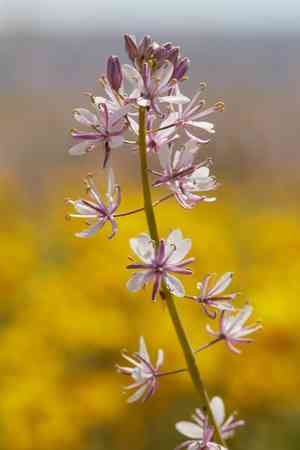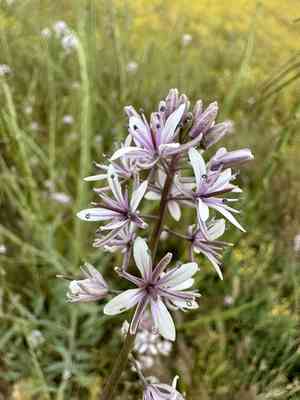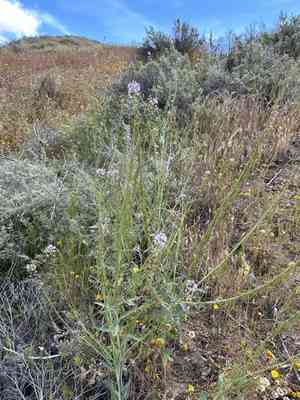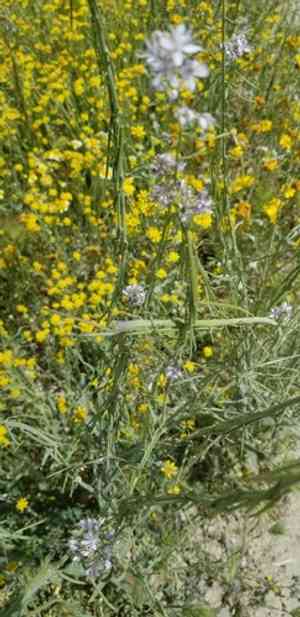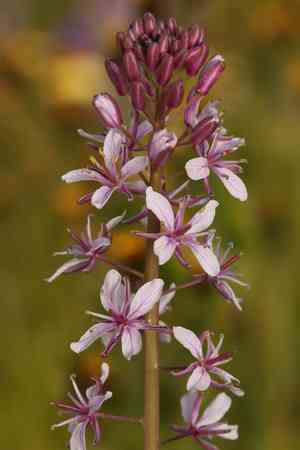
Lemmon's mustard(Caulanthus anceps)

Lemmon's mustard (Caulanthus anceps)

Also known as: Lemmon's mustard, desert candle, twin-stem mustard

Lemmon's mustard (Caulanthus anceps) showcases several features and adaptations that enable it to flourish in arid conditions. Its slender, upright stems are complemented by a branching growth pattern. The plant often displays yellow to purplish flowers that bloom along the stem, which aids in attracting pollinators. The leaves have a waxy coating, a crucial adaptation for minimizing water loss in dry climates. Additionally, its elongated and slim seed pods assist in effective seed dispersal, ensuring propagation in its native arid habitats. These characteristics collectively support the plant's survival and reproduction in challenging environments.

Attributes of Lemmon's mustard

Lifespan
Annual
Plant Type
Herb
Plant Height
0.5 to 1 meter
Spread
Not applicable - typically does not form a pronounced crown easily measurable
Leaf Color
Pale green
Flower Size
Approximately 0.5 to 1 cm
Flower Color
Pale yellow to white

ForwardPlant - Identify plants with a snap

Identify and diagnose plants, get toxicity alerts, and explore safety guides for all types of fungi.

Try for Free

Images of Lemmon's mustard

Lemmon's mustard(Caulanthus anceps)

Quickly Identify Lemmon's mustard

1
To identify Caulanthus anceps, look for a plant with tall, slender stems reaching up to 0.5 to 1 meter in height, elongated leaves that are pale green, and small, pale yellow to white flowers arranged along the stem.

Scientific Classification of Lemmon's mustard

Phylum
Vascular plants
Class
Dicotyledons
Order
Brassicales
Family
Cruciferae
Genus
Wild cabbage
Species
Lemmon's mustard

Planting and Growing of Lemmon's mustard

Care Difficulty
Hard
Watering Schedule
Every 2 days
Sunlight Requirements
Partial sun
Sunshine Duration
4-6 hours
Ideal Temperature
60-75℉
Soil Type
Potting Mix, Peat Mix
Soil pH
6.5-7.5
Fertilizer Type
Balanced
Pruning Season
Spring, Summer
Pruning Area
Branches, Leaves
Pruning Frequency
2 times a year
Repotting Season
Spring
Pot Type
Plastic, Ceramic

water icon How to Water Lemmon's mustard?

For Caulanthus anceps, you should water until the top soil is thoroughly moist but ensure that water does not accumulate at the bottom. Approximately 250 ml of water per session usually suffices. The principle is to simulate its natural environment where it experiences rainfall but has excellent drainage.
What are the symptoms of an underwatered Lemmon's mustard?
What should I do if my Lemmon's mustard is not getting enough water?
What are the symptoms of an overwatered Lemmon's mustard?
How to save an overwatered Lemmon's mustard?

sunlight icon What Are the Sunlight Requirements for Lemmon's mustard?

Sunlight Requirements: Partial sun, Full sun
Duration of light: 6 to 8 hours
Caulanthus anceps requires an ideal range of partial to full sun conditions. This ensures the plant receives enough light for optimal photosynthesis, resulting in healthy growth and vibrant blooms.
What type of sunlight is best for Caulanthus anceps?
How can you ensure Caulanthus anceps receives ideal lighting?
What benefits does ideal lighting bring to Caulanthus anceps?

temperature icon What Is the Ideal Temperature Range for Lemmon's mustard?

Ideal Temperature: 60 ~ 75℉
For optimal growth, Caulanthus anceps thrives best in temperatures between 60°F and 75°F. This range allows the plant to effectively conduct photosynthesis, maximize nutrient absorption, and maintain robust cellular functions. At this temperature range, the plant's metabolic processes perform optimally, ensuring healthy leaf and stem development.

soil icon What Soil is Best for Lemmon's mustard?

Soil type: Sandy loam, Loam
Soil PH: 6.5 ~ 7.5
Caulanthus anceps thrives best in well-drained soil that prevents waterlogging, which can harm the plant's roots and lead to poor growth or rot. Ensuring proper drainage helps maintain the plant's health and supports vigorous growth. This plant benefits from a nutrient-rich substrate, providing necessary nutrients that facilitate strong development. Feeding the soil with organic matter or balanced fertilizers can significantly improve the plant's vitality. Maintaining moderate moisture levels in the soil is paramount for Caulanthus anceps. The soil should hold enough moisture without becoming soggy, which helps in sustaining optimal hydration for the plant.

fertilize icon How to Fertilize Lemmon's mustard?

Fertilizer type: Balanced
For Caulanthus anceps, it is important to provide a balanced amount of nutrients. When using liquid fertilizer, aim for a concentration of 1/2 strength to avoid overwhelming the plant. Use approximately 200 milliliters of diluted fertilizer per application for small pots, or adjust based on container size. With slow-release granules, spread about 20 grams evenly across the soil surface per application.

prune icon How to Prune Lemmon's mustard?

Pruning Time: Spring
Start by locating any dead, damaged, or diseased leaves or stems. These should be removed first to prevent the spread of disease and pest infestation. Gently trim to maintain the plant's natural shape. Encouraging better airflow through strategic pruning can help prevent fungal diseases and support more robust growth. After pruning, clean your tools with a mild bleach solution or rubbing alcohol. This prevents potential disease transmission to other plants in your garden. More About Pruning Techniques

propagate icon How to Propagate Lemmon's mustard plant?

Propagate Time: Spring,Early summer
1
Start by collecting mature seeds from a healthy parent plant. Clean the seeds to remove any debris and soak them in water for a few hours to enhance germination. This process ensures that the seeds are viable and ready for planting.
2
Select healthy, disease-free stems from the parent plant. Use pruning shears to cut a segment approximately 4-6 inches long, ensuring there are several nodes. Remove the lower leaves to focus the energy on root development.
3
For seed propagation, plant the prepared seeds in a seed tray filled with well-draining soil mix. For cuttings, dip the cut end in rooting hormone before planting it in a pot with a similar soil mix. Place them in a warm, bright area, maintaining consistent moisture.
More About Propagating Techniques

repot icon How to Repot Lemmon's mustard plant?

Repotting frequency: Every 2-3 years
1
Caulanthus anceps should be repotted when its roots outgrow the current pot, visible through drainage holes or its growth stagnates. Late spring warmth signals ideal timing for effective root establishment in new soil.
2
Opt for a pot slightly larger than the current, ensuring it has ample drainage holes. A terracotta pot is ideal, as it allows air penetration and aids in moisture management, preventing waterlogging detrimental to plant health.
3
Select a well-draining cactus soil mix. This ensures excess water flows away swiftly, preventing root rot. A sandy, gritty composition allows airflow and replicates its natural rocky habitat, promoting healthier growth.

ForwardPlant - Identify plants with a snap

Find the best spots for them to optimize their health, simply using your phone.

Try for Free