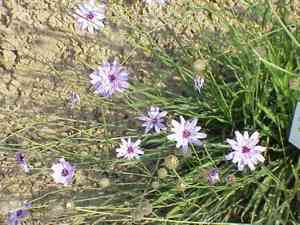
Catananche (Catananche) (Catananche)
Also known as: Cupid's Dart, Blue Cupidone
Catananche, also known as Cupid's Dart, are short-lived, clump-forming perennials that produce stunning blue to lavender-blue flowers from midsummer to autumn. These low-maintenance plants are perfect for flowering beds, border fronts, and cottage gardens. Additionally, their attractive blooms make them excellent choices for dried flower arrangements.
In This Article
Attributes of Catananche (Catananche)
Lifespan
Perennial
Plant Height
30-60 cm
Spread
20-40 cm
Leaf Color
Green
Flower Size
3-5 cm
Flower Color
Blue, Violet, White
Images of Catananche (Catananche)

Quickly Identify Catananche (Catananche)
1
Catananche can be identified by its unique daisy-like flowers that are typically blue or violet, with a darker center. The leaves are narrow and grass-like, and the plant has a bushy growth habit.
Scientific Classification of Catananche (Catananche)
Phylum
Magnoliophyta
Class
Magnoliopsida
Order
Asterales
Family
Asteraceae
Genus
Catananche
Planting and Growing of Catananche (Catananche)
Care Difficulty
Easy
Watering Schedule
Every 2 days
Sunlight Requirements
Full sun
Sunshine Duration
6-8 hours
Ideal Temperature
65-75℉
Soil Type
Potting Mix, Peat Mix
Soil pH
6.5-7.5
Fertilizer Type
Balanced
Pruning Season
Spring, Summer
Pruning Area
Branches, Leaves
Pruning Frequency
2 times a year
Repotting Season
Spring
Pot Type
Plastic, Terracotta
 How to Water Catananche (Catananche)?
When watering Catananche, it is crucial to provide just enough moisture to keep the soil lightly damp but not waterlogged. Aim for about 250 milliliters per watering session. Ensure that the water penetrates the soil evenly, reaching the roots without leaving puddles on the surface. The soil should feel moist to the touch but should not stick to your finger when you test it.
What are the symptoms of an underwatered Catananche (Catananche)?
›
What should I do if my Catananche (Catananche) is not getting enough water?
›
What are the symptoms of an overwatered Catananche (Catananche)?
›
How to save an overwatered Catananche (Catananche)?
›
 What Are the Sunlight Requirements for Catananche (Catananche)?
Optimal conditions for Catananche involve full sun exposure, translating to vibrant growth and abundant blooms, fostering a robust and healthy plant development.
Optimal Sunlight Exposure
›
Balancing Shade and Sun
›
Preventing Sunburn and Wilt
›
 What Is the Ideal Temperature Range for Catananche (Catananche)?
The ideal temperature range for Catananche is between 65°F and 75°F. At this range, the plant is able to carry out photosynthesis efficiently, promoting healthier growth and vibrant blooms. Temperatures within this ideal range help in maintaining optimal physiological functions.
 What Soil is Best for Catananche (Catananche)?
Catananche thrives in well-draining soil, which prevents waterlogging that can lead to root rot. The porous nature allows excess water to escape while maintaining necessary moisture for healthy growth. While Catananche is not overly demanding, a nutrient-rich soil supports its vibrant flowering. A balanced mix of organic matter enriches the soil, providing essential nutrients for stunning blooms. The plant prefers moderately fertile soil, ensuring it has enough nutrients without overwhelming it. Overly rich soil might lead to excess foliage at the expense of blossoms.
 How to Fertilize Catananche (Catananche)?
Catananche, or Cupid's Dart, is not an overly demanding plant when it comes to fertilizers. A balanced 10-10-10 liquid fertilizer can be applied at a rate of half-strength each time to avoid overwhelming the plant. Too much nitrogen can lead to excessive foliage at the expense of flowers.
 How to Prune Catananche (Catananche)?
Begin by using a pair of clean, sharp pruning shears. Identify any dead, damaged, or diseased stems and foliage first and cut them back to healthy growth points. This will prevent any potential spread of diseases and allow the plant to focus energy on healthy sections. Trim back spent blooms to the nearest leaf node to encourage new flower production. For overgrown plants, moderate pruning can be done to maintain the desired shape, but take care not to remove more than one-third of the plant at a time. Always make your cuts at a 45-degree angle to prevent water from sitting on the cut surface, which could lead to rot.
 How to Propagate Catananche (Catananche) plant?
1
Fill the seed tray with a high-quality seed starting mix. Ensure that the mix is lightly moistened to facilitate seed germination. Place the tray in a warm location, ideally about 18-24°C (65-75°F), and ensure it receives adequate light.
2
For seeds, sow them onto the seed mix surface and slightly press them in; do not bury deeply. For divisions, separate plant sections with a spade or knife, ensuring each section has roots attached. Replant divisions in prepared soil.
3
Water the seeds or divisions gently, maintaining consistent moisture without waterlogging. Regularly check the soil's moisture level and adjust conditions as necessary to ensure optimal growth.
 How to Repot Catananche (Catananche) plant?
1
Catananche needs repotting when you notice roots emerging from the drainage holes or the growth seems stunted. These are signals that the plant is root-bound and needs more space to thrive.
2
Select a pot with adequate drainage and slightly larger than the current one, preferably 1-2 inches wider. This prevents waterlogging and offers ample room for growth, ensuring healthier root development.
3
Opt for a well-draining potting mix containing a blend of sand and loam. This encourages proper aeration and prevents root rot while providing essential nutrients that mimic its natural habitat.
Learn More About Catananche (Catananche) Diseases
Anthracnose
Bacterial Leaf Spot
Bacterial Wilt
Crown Gall
Cyst Nematode
Damping-off
Downy Mildew
Drought Stress
Fusarium Wilt
Gray Mold
Leaf Spot
Mosaic
Nutrient Deficiency
Nutrient Toxicity
Powdery Mildew
Root Rot
Root-knot Nematode
Rusts
Sooty Mold
Spider Mites
Temperature Stress
Thrips Damage
White Mold

