Carlina (Carlina)(Carlina)

Carlina (Carlina) (Carlina)

Also known as: Carlina thistle, Stemless Carline Thistle

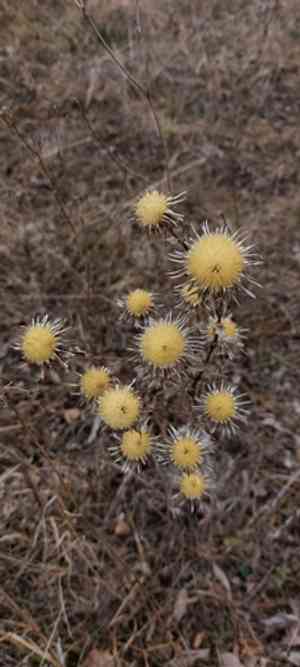
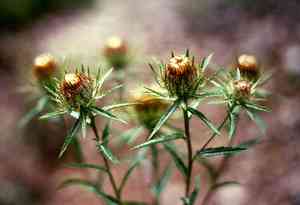
The genus spans from Madeira and the Canary Islands through Europe and northern Africa, extending to Siberia and northwestern China. It primarily consists of biennial herbs but also includes annuals, perennials, shrubs, and dwarf trees, with the tallest species growing up to 80 cm. The plants feature upright, either branching or unbranched stems. Leaves are characterized by toothed or lobed blades with spiny margins and sometimes have woolly hairs. Flowers can appear singly or in clusters, with hemispherical to bell-shaped heads surrounded by multiple layers of spiny phyllaries. The flowers themselves are tubular or funnel-shaped, coming in yellow or red hues. The fruit is a hairy cypsela, adorned with a pappus made of bristle tufts. The genus contains approximately 28 to 34 species.

Attributes of Carlina (Carlina)

Lifespan
Biennial
Plant Height
10-50 cm
Spread
20-40 cm
Leaf Color
Green, covered with spines
Flower Size
5-10 cm
Flower Color
Yellow to silver-white

ForwardPlant - Identify plants with a snap

Identify and diagnose plants, get toxicity alerts, and explore safety guides for all types of fungi.

Try for Free

Images of Carlina (Carlina)

Carlina (Carlina)(Carlina)

Quickly Identify Carlina (Carlina)

1
Carlina species can be identified by their rosette of spiky leaves and large, thistle-like flower heads that often have a metallic sheen. The flowers can range from yellow to purple and are often found blooming in late summer to autumn.

Scientific Classification of Carlina (Carlina)

Phylum
Magnoliophyta
Class
Magnoliopsida
Order
Asterales
Family
Asteraceae
Genus
Carlina

Planting and Growing of Carlina (Carlina)

Care Difficulty
Moderate
Watering Schedule
Every 2 days
Sunlight Requirements
Full sun
Sunshine Duration
6-10 hours
Ideal Temperature
60-75℉
Soil Type
Potting Mix, Peat Mix
Soil pH
6.5-8
Fertilizer Type
Balanced
Pruning Season
Spring, Summer
Pruning Area
Branches, Leaves
Pruning Frequency
2 times a year
Repotting Season
Spring
Pot Type
Ceramic, Plastic

water icon How to Water Carlina (Carlina)?

For the Carlina plant, it is essential to water it with care. The soil should be allowed to dry out between waterings. Each time you water, ensure the soil is moistened uniformly, typically needing around 250 ml of water depending on the pot size and climate.
What are the symptoms of an underwatered Carlina (Carlina)?
What should I do if my Carlina (Carlina) is not getting enough water?
What are the symptoms of an overwatered Carlina (Carlina)?
How to save an overwatered Carlina (Carlina)?

sunlight icon What Are the Sunlight Requirements for Carlina (Carlina)?

Sunlight Requirements: Full sun
Duration of light: 6 to 8 hours
Carlina thrives best in full sunlight. Ideal lighting results in strong, healthy growth with robust flowering and a vibrant leaf tone, optimizing photosynthesis and plant health.
What is the appropriate amount of light for Carlina?
How can I ensure my Carlina receives enough sunlight indoors?
What advantages does adequate sunlight provide to Carlina?

temperature icon What Is the Ideal Temperature Range for Carlina (Carlina)?

Ideal Temperature: 60 ~ 75℉
Carlina species thrive best in temperatures ranging from 60°F to 75°F. This range supports the plant’s metabolic processes, ensuring optimal growth and blooming. Maintaining these temperatures, especially during the growing season, maximizes photosynthesis and nutrient absorption.

soil icon What Soil is Best for Carlina (Carlina)?

Soil type: Sandy soil, Loam, Calcareous soil
Soil PH: 6.5 ~ 8
Carlina thrives in well-drained soils, allowing its roots to breathe and preventing root rot. Good drainage facilitates healthy growth, improving nutrient uptake and supporting vibrant blooms. Rich, nutrient-laden soils provide Carlina with essential minerals that support strong stem development and robust foliage, enhancing its overall appearance and resilience against pests and diseases. Carlina prefers slightly alkaline soils, which optimize nutrient availability and metabolic processes, aiding in maximizing growth potential and bolstering plant health.

fertilize icon How to Fertilize Carlina (Carlina)?

Fertilizer type: Balanced
For Carlina, it's important to apply fertilizers in moderation. Use a balanced 10-10-10 NPK fertilizer at a half-strength solution for liquid fertilizers. For slow-release granular fertilizers, a dose of 50 grams per square meter is sufficient. Always follow the package instructions to avoid nutrient burn.

prune icon How to Prune Carlina (Carlina)?

Pruning Time: Spring, Summer
Start by identifying any dead, discolored, or diseased branches. These should be your priority for removal. Then, look for branches that cross each other or grow inwards; these can obstruct sunlight or rub against each other, causing damage. When making cuts, do so just above a leaf node or bud. This encourages new growth in the right direction. Hold the branch steady and make a clean cut to prevent leaving any ragged edges. For thicker branches, use a sawing motion to avoid splintering. As you continue, maintain the natural shape of the Carlina plant. Avoid boxing or artificially reshaping it unless absolutely necessary. Pruning should complement its natural form, not contradict it.

propagate icon How to Propagate Carlina (Carlina) plant?

Propagate Time: Spring,Early spring,Late spring
1
Use well-draining soil mixed with sand to ensure proper air circulation around the seeds or divisions. Make sure the soil is moist but not waterlogged, as excess water can lead to rot.
2
Plant Carlina seeds on the soil surface and lightly cover them with a thin layer of soil. Ensure the seeds are spaced appropriately to prevent overcrowding and to provide each seedling with enough room to grow.
3
Carefully dig up a mature Carlina plant and separate it into several smaller sections, making sure each piece has several roots and shoots. Replant these divisions at the same depth they were originally growing.

repot icon How to Repot Carlina (Carlina) plant?

Repotting frequency: Every two years
1
Carlina plants often need repotting when their roots start poking out of the drainage holes or the plant becomes root-bound. Also, slow growth or depleted nutrients in old soil are signals for repotting. Spring and summer are ideal as they promote stronger recovery and growth.
2
Select a pot that is just one size larger than the current one for Carlina. A pot too large may retain excess moisture, risking root rot. Ensure it has good drainage holes to facilitate proper water drainage, keeping the plant's roots healthy and preventing over-saturation.
3
A well-drained, sandy loam soil is perfect for repotting Carlina. This type of soil mimics their natural environment, providing necessary aeration and preventing excessive moisture retention which could harm the roots. It supports healthy root development and plant growth.

ForwardPlant - Identify plants with a snap

Find the best spots for them to optimize their health, simply using your phone.

Try for Free