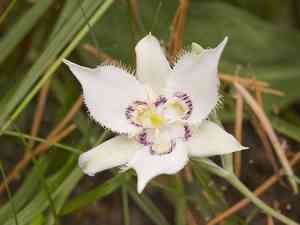
Lyall's mariposa lily (Calochortus lyallii)
Also known as: Lyall's Mariposa Lily
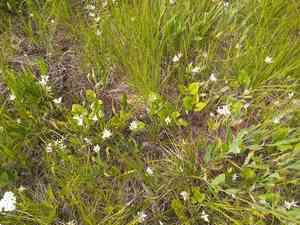
Lyall's mariposa lily is notable for its eye-catching flowers, which feature a mix of white petals, vibrant yellow centers, and magenta markings on the inner petals. The term ‘mariposa’ translates to butterfly in Spanish, highlighting the flower's resemblance to butterfly wings. This unique lily thrives near pine forests, specifically in the foothills of the Cascade Mountains in Washington State, USA, and Canada, making it a rare and beautiful sight in its natural setting.
In This Article
Attributes of Lyall's mariposa lily
Lifespan
Perennial
Plant Type
Herb
Plant Height
10 cm to 25 cm
Spread
Not applicable
Leaf Color
Green
Flower Size
4-6 cm
Flower Color
White to pink with purple markings
Images of Lyall's mariposa lily
Quickly Identify Lyall's mariposa lily
1
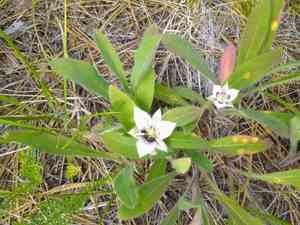
Identification of Calochortus lyallii can be done by observing its unique flowers. The plant has three broad, petal-like sepals and three similar-looking petals which are usually white to pinkish with a purple spot at the base. The leaves are linear and grass-like, primarily growing at the base of the plant.
Scientific Classification of Lyall's mariposa lily
Phylum
Vascular plants
Class
Monocotyledons
Order
Liliales
Family
Lily
Genus
Mariposas
Species
Lyall's mariposa lily
Planting and Growing of Lyall's mariposa lily
Care Difficulty
Moderate
Watering Schedule
Every 2 days
Sunlight Requirements
Full sun
Sunshine Duration
6-10 hours
Ideal Temperature
50-70℉
Soil Type
Potting Mix, Peat Mix
Soil pH
6.5-7.5
Fertilizer Type
Balanced
Pruning Season
Spring, Summer
Pruning Area
Branches, Leaves
Pruning Frequency
2 times a year
Repotting Season
Spring
Pot Type
Plastic, Ceramic
 How to Water Lyall's mariposa lily?
Calochortus lyallii has moderate water needs, requiring about 250 ml each time you water. It's crucial to ensure the soil is well-drained and not soggy after watering. The water should penetrate deep into the soil but the surface should dry out between watering to mimic its natural habitat.
What are the symptoms of an underwatered Lyall's mariposa lily?
›
What should I do if my Lyall's mariposa lily is not getting enough water?
›
What are the symptoms of an overwatered Lyall's mariposa lily?
›
How to save an overwatered Lyall's mariposa lily?
›
 What Are the Sunlight Requirements for Lyall's mariposa lily?
Calochortus lyallii ideally requires full sun to partial sun, with 6 to 8 hours of daily sunlight. This encourages robust blooms and healthy foliage, maintaining optimal growth, and delivering vibrant flowers typical of its species.
How much sun does Calochortus lyallii require?
›
Can Calochortus lyallii grow in shade?
›
What solutions exist if there's insufficient natural light?
›
 What Is the Ideal Temperature Range for Lyall's mariposa lily?
The ideal temperature range for Calochortus lyallii is between 50°F and 70°F. This range allows the plant to grow and thrive without experiencing stress. Maintaining this temperature range will help ensure robust growth and optimal health for the plant. Proper sunlight and watering, combined with this temperature range, create an ideal environment for Calochortus lyallii.
 What Soil is Best for Lyall's mariposa lily?
Calochortus lyallii thrives in well-draining soils. This characteristic prevents waterlogging, which can lead to root rot, thereby ensuring healthy root systems and vibrant blooms. This plant benefits from loam or sandy loam soil, which provides essential nutrients necessary for its growth. A fertile soil base supports robust flower production and overall vigor. The soil should retain moisture without becoming soggy. This balance ensures the plant has sufficient water access while avoiding excessive soil moisture that can harm the roots.
 How to Fertilize Lyall's mariposa lily?
For Calochortus lyallii, it's crucial to apply fertilizers sparingly. Use a diluted liquid fertilizer at half strength to avoid burning the roots. For slow-release granules, follow the package instructions but start with a lighter dose to ensure the plant's sensitivity is accounted for.
 How to Prune Lyall's mariposa lily?
To prune Calochortus lyallii, start by sterilizing your garden shears to prevent any infections. Look at the plant and identify any dead or yellowing leaves; these should be the first to go. Cut them back to the base or nearest healthy part to avoid unsightly stumps. For flowering stems past their peak, cut back to the nearest leaf node to encourage further blooming. This routine tidies up the plant and channels energy to viable parts.
More About Pruning Techniques→
 How to Propagate Lyall's mariposa lily plant?
1
Begin by acquiring high-quality Calochortus lyallii seeds. Soak the seeds in warm water for 24 hours to enhance germination rates. Ensure seeds are healthy and free of disease.
2
Fill the seed tray with the fine potting mix. Space the seeds evenly, covering them lightly with more potting mix. Maintain soil moisture by misting with water.
3
Place the seed tray in a warm, sunny location. Calochortus lyallii seeds require temperatures of 15-20°C for optimal germination. Monitor moisture levels to prevent drying out or waterlogging.
 How to Repot Lyall's mariposa lily plant?
1
Repot your Calochortus lyallii when you see its roots peeking out of the drainage holes or when the soil ceases to drain well. These are tell-tale signs that the plant is outgrowing its current home and needs more space to thrive.
2
Select a pot that is only one size larger than the current one and has excellent drainage holes. The size ensures that the plant doesn't expend too much energy on root growth, and good drainage prevents waterlogging, thus keeping the roots healthy.
3
Opt for a well-draining sandy soil mix rich in organic matter. This type of soil mimics the natural habitat of Calochortus lyallii, providing necessary nutrients while ensuring that water doesn't stagnate around the roots.



