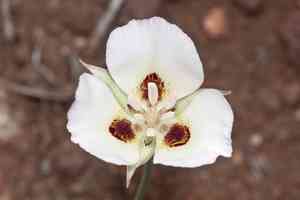
Dunn's mariposa lily(Calochortus dunnii)

Dunn's mariposa lily (Calochortus dunnii)

Also known as: Dunn's Mariposa Lily

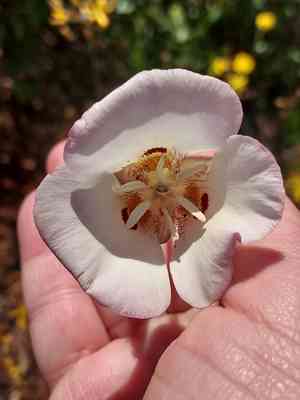
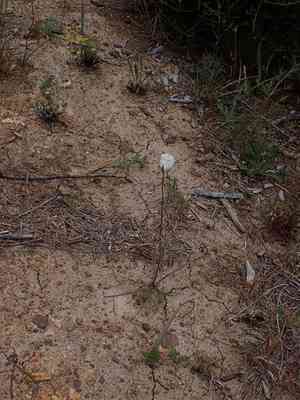
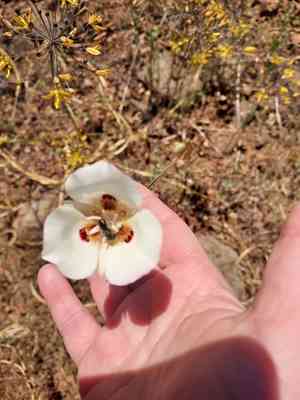
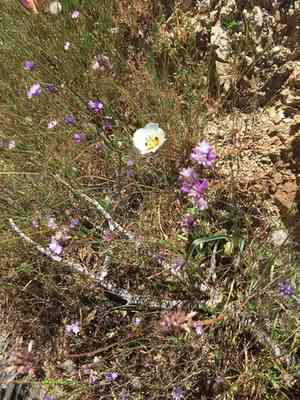
Dunn's mariposa lily (Calochortus dunnii) is a perennial herb that often blends into its surroundings until it flowers. Emerging from distinctive bulbous roots, it produces slender, grass-like leaves and tall, delicate stems. Each stem typically showcases a single, elegant, cup-shaped flower, predominantly in hues of white or pink with striking red or purple markings at the base of the petals.

This lily thrives in rocky, well-drained soils, commonly found on slopes in chaparral or coastal sage scrub habitats. Its drought resilience is notable, with its lifecycle finely attuned to the seasonal rainfall patterns of Southern California's Peninsular Ranges. The bulbous root system allows it to endure dry summers, making it a remarkable fixture in its native arid environments.

Attributes of Dunn's mariposa lily

Lifespan
Perennial
Plant Type
Herb
Plant Height
15 - 30 cm
Spread
N/A
Leaf Color
Green
Flower Size
2 - 5 cm
Flower Color
White, lavender, pink with purple spots and yellow markings

ForwardPlant - Identify plants with a snap

Identify and diagnose plants, get toxicity alerts, and explore safety guides for all types of fungi.

Try for Free

Images of Dunn's mariposa lily

Dunn's mariposa lily(Calochortus dunnii)

Quickly Identify Dunn's mariposa lily

1
Dunn\'s Mariposa Lily can be identified by its unique bell-shaped flowers which are typically white, lavender, or pink with darker purple spots and yellow markings. The leaves are linear with a basal rosette, and the plant grows a slender stem reaching up to 30 cm in height.

Scientific Classification of Dunn's mariposa lily

Phylum
Vascular plants
Class
Monocotyledons
Order
Liliales
Family
Lily
Genus
Mariposas
Species
Dunn's mariposa lily

Planting and Growing of Dunn's mariposa lily

Care Difficulty
Moderate
Watering Schedule
Every 2 days
Sunlight Requirements
Full sun
Sunshine Duration
4-6 hours
Ideal Temperature
60-75℉
Soil Type
Potting Mix, Peat Mix
Soil pH
6.5-7.5
Fertilizer Type
Balanced
Pruning Season
Spring, Summer
Pruning Area
Branches, Leaves
Pruning Frequency
Once a year
Repotting Season
Spring
Pot Type
Plastic, Ceramic

water icon How to Water Dunn's mariposa lily?

Calochortus dunnii should receive water until the soil is moist but not saturated. Ensure the water penetrates at least 2 to 3 inches below the surface. This depth allows the roots ample opportunity to absorb moisture without risk of waterlogging.
What are the symptoms of an underwatered Dunn's mariposa lily?
What should I do if my Dunn's mariposa lily is not getting enough water?
What are the symptoms of an overwatered Dunn's mariposa lily?
How to save an overwatered Dunn's mariposa lily?

sunlight icon What Are the Sunlight Requirements for Dunn's mariposa lily?

Sunlight Requirements: Full sun, Partial sun
Duration of light: 6 to 8 hours
Calochortus dunnii thrives in full to partial sun, typically needing 6 to 8 hours of bright light daily. Optimal light enhances photosynthesis, supporting vibrant blooms and robust growth, crucial for its sustenance.
Optimal Location
Artificial Light Supplement
Sunlight Timing

temperature icon What Is the Ideal Temperature Range for Dunn's mariposa lily?

Ideal Temperature: 60 ~ 75℉
The ideal temperature range for Calochortus dunnii is between 60°F and 75°F. In this range, the plant experiences optimal growth conditions enabling it to thrive and bloom efficiently. Such temperatures provide the right balance of warmth and light, encouraging photosynthesis and nutrient uptake.

soil icon What Soil is Best for Dunn's mariposa lily?

Soil type: Sandy soil, Loam, Sandy loam
Soil PH: 6.5 ~ 7.5
Calochortus dunnii thrives in well-drained soil to prevent waterlogging, which is crucial for its bulb health. Ensuring good drainage helps avoid root rot and promotes healthy growth. This species prefers soil with moderate fertility, which supports its growth without overwhelming it with nutrients. Balanced soil fertility encourages steady flowering and robust leaf development. Maintaining a soil pH between 6.5 and 7.5 is optimal for Calochortus dunnii as it facilitates nutrient availability and absorption, crucial for vibrant blooms and sturdy foliage.

fertilize icon How to Fertilize Dunn's mariposa lily?

Fertilizer type: Balanced
For Calochortus dunnii, a balanced fertilizer diluted to half strength is ideal. Use a 10-10-10 liquid fertilizer, applying it at a rate of 1 tablespoon per gallon of water. When applying slow-release fertilizer, follow the manufacturer's instructions, typically spreading 1 to 2 tablespoons per square foot around the base of the plant. Always be cautious not to exceed the recommended dosage to prevent nutrient burn.

prune icon How to Prune Dunn's mariposa lily?

Pruning Time: Spring, Summer
Begin pruning Calochortus dunnii in either spring or summer, when the plant is actively growing. Focus on cutting back dead or diseased stems to encourage new growth. Use sharp, clean scissors or pruning shears for precise cuts. Aim to maintain a natural shape, trimming just above a leaf node or bud to stimulate healthy development. More About Pruning Techniques

propagate icon How to Propagate Dunn's mariposa lily plant?

Propagate Time: Early spring,Late spring
1
Fill seed trays with the chosen soil mix, ensuring it is moist but not waterlogged. Gently press the soil down to eliminate air pockets and ensure level planting beds.
2
Scatter Calochortus dunnii seeds evenly across the soil surface, keeping a sufficient distance between each to accommodate growth. Lightly cover with a thin layer of soil to protect from disturbance.
3
Place trays in a warm, bright location away from direct sunlight. Maintain consistent moisture by misting, avoiding overly wet conditions that can lead to rot.
More About Propagating Techniques

repot icon How to Repot Dunn's mariposa lily plant?

Repotting frequency: Once every two years
1
Calochortus dunnii signals its need for repotting when its roots outgrow the current container, often visible at the drainage holes, or when the growth rate noticeably declines even under optimal conditions. Opt for repotting in spring or autumn when the plant undergoes active growth, minimizing stress.
2
Select a pot that is 2-3 inches wider in diameter than the current one. Ensure it has adequate drainage holes to prevent waterlogging. A slightly larger pot will give room for root expansion, promoting healthy growth and reducing the risk of root rot.
3
Opt for well-draining sandy soil, as Calochortus dunnii thrives in environments that prevent water accumulation. This type of soil ensures adequate aeration, reducing the risk of fungal diseases and enabling the roots to breathe and expand healthily.

ForwardPlant - Identify plants with a snap

Find the best spots for them to optimize their health, simply using your phone.

Try for Free