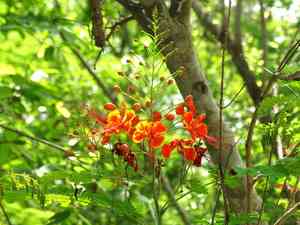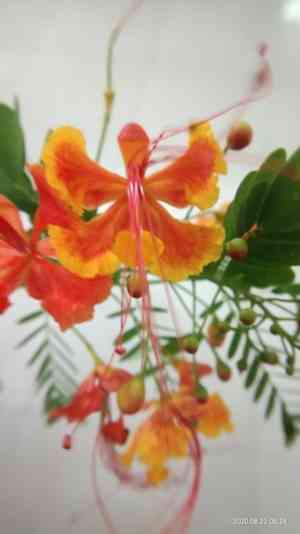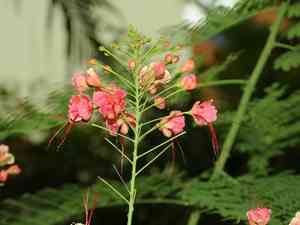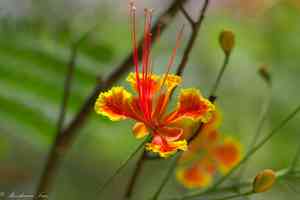
Peacock flower(Caesalpinia pulcherrima)

Peacock flower (Caesalpinia pulcherrima)

Also known as: ʻohai aliʻi, Dwarf poinciana

The national flower of Barbados, known as the Pride of Barbados (Caesalpinia pulcherrima), is a stunning ornamental plant often found in gardens and landscapes. While its seeds are toxic if ingested, the plant is valued for its vibrant red and yellow blossoms. Various parts of the Pride of Barbados are utilized in traditional medicine by communities in the Caribbean and Indonesia. It should be noted that the plant is harmful to dogs and cats but serves as a food source for butterflies and bees.

Attributes of Peacock flower

Lifespan
Perennial
Plant Type
Shrub, Tree
Plant Height
3 m
Spread
2 m to 4 m
Leaf Color
Green
Flower Size
5 cm to 8 cm
Flower Color
Yellow Red Orange Gold

PlantJoy - Identify plants with a snap

Identify and diagnose plants, get toxicity alerts, and explore safety guides for all types of fungi.

Try for Free

Images of Peacock flower

Peacock flower(Caesalpinia pulcherrima)

Quickly Identify Peacock flower

1
Vibrant orange-red blossoms
2
Fern-like foliage
3
Sharp prickles on stems
4
Bipinnately compound leaves
5
Dynamic bark transformation

Scientific Classification of Peacock flower

Phylum
Vascular plants
Class
Dicotyledons
Order
Fabales
Family
Legume
Genus
Caesalpinia
Species
Peacock flower

Planting and Growing of Peacock flower

Care Difficulty
Easy
Watering Schedule
Every 8 days
Sunlight Requirements
Full sun
Sunshine Duration
6-10 hours
Ideal Temperature
70-85℉
Soil Type
Potting Mix, Peat Mix
Soil pH
6.5-7.5
Fertilizer Type
Balanced
Pruning Season
Spring, Summer
Pruning Area
Branches, Leaves
Pruning Frequency
2 times a year
Repotting Season
Spring
Pot Type
Plastic, Ceramic

water icon How to Water Peacock flower?

Caesalpinia pulcherrima requires about 300 ml of water per session to ensure that the soil remains evenly moist at all times. The principle to follow is to water thoroughly until the water is just about to drain out from the base of the pot, ensuring full saturation of the root ball without waterlogging.
What are the symptoms of an underwatered Peacock flower?
What should I do if my Peacock flower is not getting enough water?
What are the symptoms of an overwatered Peacock flower?
How to save an overwatered Peacock flower?
More About Watering Techniques

sunlight icon What Are the Sunlight Requirements for Peacock flower?

Sunlight Requirements: Full sun, Partial sun
Duration of light: Six to eight hours
Caesalpinia pulcherrima thrives in full sun to partial sun, meaning exposure to six to eight hours of light. This range ensures robust flowering, vigorous growth, and greater overall health.
How to achieve optimal light conditions?
What specific actions can help maintain optimal light?
What benefits will the plant receive from ideal lighting?
More About Sunlight Requirements Techniques

temperature icon What Is the Ideal Temperature Range for Peacock flower?

Ideal Temperature: 70 ~ 85℉
The ideal temperature range for growing Caesalpinia pulcherrima is between 70°F and 85°F. Within this temperature range, the plant can efficiently carry out its physiological processes such as photosynthesis and respiration. Maintaining this temperature range ensures optimal growth and flowering conditions, promoting overall plant health and maximized aesthetic appeal.

soil icon What Soil is Best for Peacock flower?

Soil type: Sandy loam, Loam
Soil PH: 6.5 ~ 7.5
Caesalpinia pulcherrima thrives in well-drained soil, which prevents waterlogging and root rot. This condition aids in healthy root development and ensures robust plant growth. Rich loamy soil provides essential nutrients for the plant's vibrant blooms and lush foliage. It ensures a steady supply of macronutrients and micronutrients, supporting continuous flowering. While well-drained, a balance with adequate moisture retention is crucial. Sandy loam caters to this need, ensuring that the plant remains hydrated without drowning its roots. More About Soil

fertilize icon How to Fertilize Peacock flower?

Fertilizer type: Balanced
Caesalpinia pulcherrima, commonly known as the Pride of Barbados, thrives with moderate fertilization. Use a balanced 10-10-10 or 20-20-20 fertilizer at half-strength. Always ensure the soil is moist before applying to avoid root burn. For a thriving plant, adjust based on its growth and seasonal changes. More About Fertilizing Techniques

prune icon How to Prune Peacock flower?

Pruning Time: Spring, Summer
Gather sharp pruning shears and sterilize them with alcohol to prevent disease transmission. Wear gloves to protect your hands from thorns. Begin by removing dead or weak branches at the base. Cut back around one-third of the plant's branches to encourage bushier growth. Make cuts at a 45-degree angle to encourage a natural healing process. Shape the plant by trimming long, straggly branches. Focus on areas where growth seems dense to allow sunlight and air to penetrate, which helps more flowers thrive. After pruning, water the plant thoroughly and apply a balanced fertilizer to promote recovery and development of new growth. More About Pruning Techniques

propagate icon How to Propagate Peacock flower plant?

Propagate Time: Spring,Early spring
1
For seed propagation, prepare a light and well-draining soil mix. Use a combination of peat moss, perlite, and vermiculite to ensure adequate aeration and moisture retention. This mix helps prevent seed rot and encourages healthy seedling growth.
2
Sow the seeds in the prepared soil mix at a depth of about 1/4 inch. Space them evenly to allow for growth, and cover lightly with soil. Mist them gently with water, and cover the tray with a plastic dome to maintain humidity and warmth for germination.
3
For cutting propagation, select healthy shoots and cut a 4 to 6-inch section just below a node. Remove leaves from the lower half, dip the cut end in rooting hormone, and plant it in moist, well-draining soil. Cover with a plastic bag to maintain humidity until roots develop.
More About Propagating Techniques

repot icon How to Repot Peacock flower plant?

Repotting frequency: Every 2-3 years
1
Repotting is ideal when you notice the roots growing out of the drainage holes, signaling that the plant is root-bound. Additionally, if you observe the soil drying out faster than usual or the plant's growth slowing, it's time for a new pot. Spring and summer provide optimal conditions for recovery and regrowth after repotting.
2
Select a pot with a diameter 2-3 inches larger than the current one. This allows enough room for root expansion without overwhelming the plant's root system. Ensure the pot has adequate drainage holes; this prevents waterlogged soils and helps maintain a healthy root environment. A terracotta pot can be a great choice as it provides breathability to the roots.
3
Choose a well-draining potting mix to ensure that excess water flows away from the roots, reducing the risk of root rot. Look for a mix that contains sand, perlite, or pine bark, which help to aerate the soil. A well-draining mix maintains adequate moisture levels while supporting nutrient intake, promoting robust plant growth.
More About Repotting Techniques

PlantJoy - Identify plants with a snap

Find the best spots for them to optimize their health, simply using your phone.

Try for Free

Toxicity of Peacock flower

Is Peacock flower toxic to humans?

The peacock flower is largely non-toxic, with the exception of its seeds, which are imbued with harmful substances called tannins. Tannins are the same toxic compounds present in oak trees, and consuming the seeds of the peacock flower can produce effects similar to ingesting parts of oak trees. These effects encompass symptoms such as nausea, vomiting, cramps, abdominal pain, and diarrhea. It is advisable to keep these plants out of reach of young children and individuals with cognitive challenges.

Is Peacock flower toxic to cat?

The peacock flower presents a moderate level of toxicity for felines. If a cat consumes any parts of the plant, including its leaves or seeds, it could endure negative health consequences. It is vital for cat owners to remain alert and deter their pets from nibbling or consuming any portion of the peacock flower. Following ingestion, a cat might exhibit signs of physical distress. Immediate veterinary intervention is crucial to address any health complications arising from contact with the peacock flower.

Is Peacock flower toxic to dog?

The peacock flower is identified as having a moderate level of toxicity towards dogs. Poisoning usually arises when a dog consumes any part of the plant, with the leaves and seeds being notably harmful. After ingesting these portions, a dog may demonstrate symptoms including vomiting, diarrhea, lethargy, or abdominal discomfort. It is vital for dog owners to be watchful and to keep their pets away from peacock flower. Should a dog ingest any section of the peacock flower, it is imperative to seek prompt veterinary attention to secure the most favorable outcome for the animal.

Identify toxic plants for your safety

Learn which plants are harmful to you and your pets, and make informed choices for a safer home!

Try for Free
WARNING
The judgment on toxicity and danger is for reference only. We DO NOT GUARANTEE any accuracy of such judgment. Therefore, you SHALL NOT rely on such judgment. It is IMPORTANT TO SEEK PROFESSIONAL ADVICE in advance when necessary.
More About Toxic Techniques