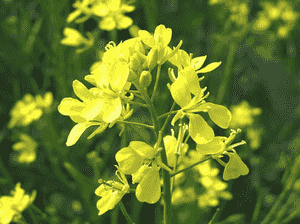
Chinese mustard (Brassica juncea)
Also known as: Oriental mustard, Indian mustard, Mustard greens
*Brassica juncea*, commonly known as mustard greens or Indian mustard, is an annual herb that typically reaches heights of 30 to 46 cm. While it can become invasive in certain regions, it is highly valued for its edible parts. The leaves and flowers have a hot mustard flavor. Young leaves are great for salads, while older leaves are better suited for cooking. The seeds, harvested from summer to fall, are used to add a spicy mustard taste to various dishes.
In This Article
Attributes of Chinese mustard
Lifespan
Annual, Biennial, Perennial
Plant Type
Herb
Plant Height
30 cm to 1.5 m
Spread
30 cm to 90 cm
Leaf Color
Green
Flower Size
7 mm to 1 cm
Flower Color
Yellow
Images of Chinese mustard
Quickly Identify Chinese mustard
1
Bright green leaves with serrated edges and a purplish tint.
2
Stiff stems reaching up to 3 feet (91 cm) tall.
3
Small yellow flowers with four cross-shaped petals.
4
Elongated pods maturing to tan or brown, containing small brown seeds.
5
Diverse leaves ranging from lobed to petiole, with purple veins and a whitish bloom.
Scientific Classification of Chinese mustard
Phylum
Vascular plants
Class
Dicotyledons
Order
Mustards, capers, and allies
Family
Cruciferae
Genus
Kales
Species
Chinese mustard
Planting and Growing of Chinese mustard
Care Difficulty
Easy
Watering Schedule
Every 8 days
Sunlight Requirements
Full sun
Sunshine Duration
6-10 hours
Ideal Temperature
60-75℉
Soil Type
Potting Mix, Peat Mix
Soil pH
6.5-7.5
Fertilizer Type
Balanced
Pruning Season
Spring, Summer
Pruning Area
Branches, Leaves
Pruning Frequency
2 times a year
Repotting Season
Spring
Pot Type
Plastic, Terracotta
 How to Water Chinese mustard?
For Brassica juncea, the key is to keep the soil consistently moist but not waterlogged. Water the plant with approximately 250 ml each time, making sure the top inch of the soil feels dry before you water again. This approach helps to ensure the roots can uptake water efficiently without the risk of root rot.
More About Watering Techniques→
What are the symptoms of an underwatered Chinese mustard?
›
What should I do if my Chinese mustard is not getting enough water?
›
What are the symptoms of an overwatered Chinese mustard?
›
How to save an overwatered Chinese mustard?
›
 What Are the Sunlight Requirements for Chinese mustard?
Brassica juncea grows best under full sun to partial sun conditions, receiving about 6-8 hours of light daily, which enhances photosynthesis and nutrient absorption, leading to healthy, vibrant foliage.
More About Sunlight Requirements Techniques→
Question 1: What is the ideal lighting for Brassica juncea?
›
Question 2: How can one achieve ideal lighting conditions for Brassica juncea?
›
Question 3: What are the benefits of providing ideal lighting for Brassica juncea?
›
 What Is the Ideal Temperature Range for Chinese mustard?
Brassica juncea thrives best within a temperature range of 60 to 75°F. This is because these temperatures facilitate optimal photosynthesis and growth, while avoiding stress factors associated with too high heat or too cold conditions. Maintaining this range ensures robust development and prolific yield.
 What Soil is Best for Chinese mustard?
Brassica juncea thrives in well-drained soil as it prevents waterlogging, which can lead to root rot. Ensuring good drainage enhances root aeration and nutrient uptake, promoting healthy plant growth. This plant prefers nutrient-rich soil to support its fast growth and leafy yield. Amending soil with organic matter like compost can provide essential nutrients, boosting robustness and productivity. Soil that retains moderate moisture without becoming soggy is ideal. Maintaining adequate moisture levels aids in consistent plant growth and prevents plant stress, especially during dry spells.
More About Soil→
 How to Fertilize Chinese mustard?
For Brassica juncea, use about one tablespoon of balanced 10-10-10 granular fertilizer per plant. Depending on the health and size of the plant, you may need to adjust this amount slightly. Ensuring you do not exceed this amount helps avoid potential root damage.
More About Fertilizing Techniques→
 How to Prune Chinese mustard?
Ensure you have sharp, clean pruning shears to make clean cuts and reduce the transfer of diseases. Sterilize the tools with rubbing alcohol before starting and assess your Brassica juncea to identify which parts need pruning. Begin by removing any dead or yellowing leaves at the base of the plant. Trim off any leggy parts to promote more compact growth. Focus on cutting above the leaf node to encourage branching. Regularly check for any signs of pest infestation or disease and prune affected areas immediately.
More About Pruning Techniques→
 How to Propagate Chinese mustard plant?
1
To prepare the seeds for propagation, begin by soaking them in warm water overnight. This helps to soften the seed coat and encourages faster germination when they are sown.
2
Select healthy, non-flowering branches and cut a segment approximately 4-6 inches long. Remove lower leaves to expose nodes that will be placed in the rooting medium.
3
For division propagation, dig up the entire plant and gently separate it into smaller sections, ensuring each section has adequate roots, stems, and leaves to sustain new growth.
 How to Repot Chinese mustard plant?
1
It's time to repot Brassica juncea when roots start peeking through drainage holes or when plant growth becomes stunted. The best season is spring when the plant can adjust well before growing season.
2
Choose a pot that is one size bigger than the current one. Ensure it has adequate drainage holes to prevent waterlogging, which will help keep the roots healthy and thriving.
3
Opt for a well-draining potting soil rich in organic matter. Good drainage prevents water from pooling around the roots, minimizing the risk of root rot and encouraging healthy growth.
Learn More About Chinese mustard Diseases
Anthracnose
Bacterial Leaf Spot
Bacterial Soft Rot
Clubroot
Damping-off
Downy Mildew
Drought Stress
Fusarium Wilt
Gray Mold
Leaf Spot
Mosaic
Nutrient Deficiency
Nutrient Toxicity
Powdery Mildew
Root Rot
Root-knot Nematode
Rusts
Sooty Mold
Spider Mites
Temperature Stress
Thrips Damage
White Mold
Chemical Injury



