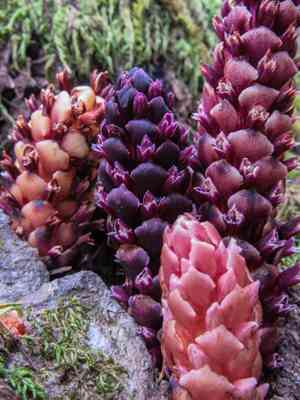
Vancouver groundcone (Boschniakia hookeri)
Also known as: Small Groundcone, Vancouver Groundcone
The Vancouver groundcone is a distinct parasitic plant that lacks chlorophyll and obtains nutrients by connecting to the roots of other plants. It has a thick, fleshy stem with scaly structures instead of leaves and produces a cluster of reddish-purple to brown flowers. This plant thrives in shaded, moist forest areas and depends entirely on its host plants for nourishment.
In This Article
Attributes of Vancouver groundcone
Lifespan
Perennial
Plant Type
Herb
Plant Height
Up to 30 cm
Spread
Not applicable, as it is a parasitic plant that grows from the roots of host plants.
Leaf Color
Not applicable, as it lacks chlorophyll and typical leaves.
Flower Size
1-2 cm
Flower Color
Purple to brown
Images of Vancouver groundcone
Quickly Identify Vancouver groundcone
1
This plant can be identified by its distinct cone-shaped inflorescences that emerge from the ground. The flowers are small and can range in color from purple to brown. Boschniakia hookeri lacks chlorophyll, which is a common trait of parasitic plants.
Scientific Classification of Vancouver groundcone
Phylum
Vascular plants
Class
Dicotyledons
Order
Lamiales
Family
Broomrape
Genus
ground cone
Species
Vancouver groundcone
Planting and Growing of Vancouver groundcone
Care Difficulty
Hard
Watering Schedule
Every 2 days
Sunlight Requirements
Partial sun
Sunshine Duration
4-6 hours
Ideal Temperature
60-75℉
Soil Type
Potting Mix, Peat Mix
Soil pH
5.5-7
Fertilizer Type
Balanced
Pruning Season
Spring, Summer
Pruning Area
Branches, Leaves
Pruning Frequency
2 times a year
Repotting Season
Spring
Pot Type
Plastic, Ceramic
 How to Water Vancouver groundcone?
Boschniakia hookeri requires careful watering. The soil should be moist but not waterlogged. Ensure that water is added until the soil is evenly dampened but not saturated. A regular check of soil moisture is key.
What are the symptoms of an underwatered Vancouver groundcone?
›
What should I do if my Vancouver groundcone is not getting enough water?
›
What are the symptoms of an overwatered Vancouver groundcone?
›
How to save an overwatered Vancouver groundcone?
›
 What Are the Sunlight Requirements for Vancouver groundcone?
Partial sun provides Boschniakia hookeri the best conditions, balancing sufficient light for photosynthesis and reducing stress. This range prevents leaf damage and enhances resilience.
What is the ideal light exposure?
›
How to achieve ideal lighting?
›
Benefits of ideal lighting conditions?
›
 What Is the Ideal Temperature Range for Vancouver groundcone?
The ideal temperature range for Boschniakia hookeri is between 60°F and 75°F. Within this range, the plant can maintain optimal physiological processes such as growth, photosynthesis, and nutrient uptake. Temperatures within this range ensure the plant remains healthy and shows vigorous growth.
 What Soil is Best for Vancouver groundcone?
Boschniakia hookeri thrives in well-drained soil, which prevents waterlogging, reducing root rot and promoting healthy growth. Proper drainage ensures that the roots receive enough oxygen. This plant benefits from nutrient-rich soil, rich in organic matter that enhances its growth. This provides vital nutrients necessary for vigorous development and sustenance. Although well-drained, the soil should retain some moisture to keep Boschniakia hookeri hydrated. Maintaining moisture levels supports steady biorhythms for healthy foliage and blooms.
 How to Fertilize Vancouver groundcone?
Boschniakia hookeri requires minimal fertilization due to its parasitic nature. Aim for a low concentration, such as a 1/4th strength of a typical houseplant liquid fertilizer every month during the growing season.
 How to Prune Vancouver groundcone?
Boschniakia hookeri, known as a parasitic plant, requires understanding of its host interaction. Ensure that pruning doesn’t disrupt this relationship as it's crucial for nourishment. Given its delicate nature and parasitic dependency, handle Boschniakia hookeri with care during pruning to avoid unnecessary stress that could impact its growth.
More About Pruning Techniques→
 How to Propagate Vancouver groundcone plant?
1
Collect ripe seeds from a mature Boschniakia hookeri plant. Ensure seeds are completely dry before storing or planting to avoid mold growth. Ripe seeds should be collected carefully to retain viability.
2
Prepare the seed tray with a well-draining growing medium. Moisten the medium lightly to ensure proper seed contact and prevent seeds from being disturbed. Avoid over-watering as it may lead to fungal issues.
3
Evenly distribute the seeds on the surface of the prepared seed tray and lightly cover them with a thin layer of growing medium. Ensure consistent moisture by misting regularly, but be cautious not to create overly wet conditions.
 How to Repot Vancouver groundcone plant?
1
Boschniakia hookeri needs repotting when its roots start growing out of the drainage holes, or the plant begins to appear stressed with stunted growth. Spring and autumn are ideal as the weather is mild, reducing transplant shock.
2
Select a pot that is one size bigger than the current. The pot should have adequate drainage holes to prevent waterlogging and root rot, ensuring the plant’s healthy growth.
3
Opt for a well-draining soil mix rich in organic matter, which offers essential nutrients and ensures excess water doesn't stay around the roots, mitigating risk of fungal diseases.
Learn More About Vancouver groundcone Diseases
Anthracnose
Bacterial Leaf Spot
Bacterial Soft Rot
Bacterial Wilt
Black Spot
Chemical Injury
Crown Gall
Cyst Nematode
Damping-off
Downy Mildew
Drought Stress
Fusarium Wilt
Gray Mold
Leaf Curl
Leaf Spot
Mosaic
Nutrient Deficiency
Nutrient Toxicity
Powdery Mildew
Root Rot
Root-knot Nematode
Rusts
Sooty Mold
Spider Mites
Temperature Stress
Thrips Damage
White Mold



