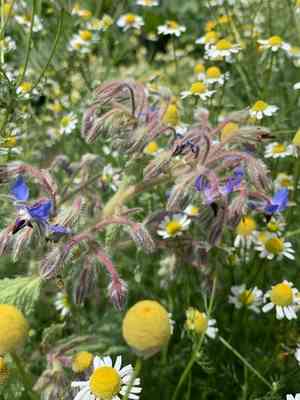
Borages (Borago) (Borago)
Also known as: Borage, Starflower
The genus Borages comprises five herbaceous species commonly found throughout the Mediterranean region. The name is likely derived from the Latin word 'burra,' meaning hairy, a nod to the characteristic hairy leaves of these plants. While often cultivated for their ornamental appeal, borage species can be either annual or perennial, depending on the specific herb.
In This Article
Attributes of Borages (Borago)
Lifespan
Annual
Plant Height
Up to 60-100 cm
Spread
Approximately 30-60 cm
Leaf Color
Green
Flower Size
Around 2-3 cm
Flower Color
Blue, occasionally pink
Images of Borages (Borago)
Quickly Identify Borages (Borago)
1
Look for hairy stems and leaves, star-shaped blue or pink flowers, and a distinct cucumber-like scent from the leaves.
Scientific Classification of Borages (Borago)
Phylum
Magnoliophyta
Class
Magnoliopsida
Order
Boraginales
Family
Boraginaceae
Genus
Borago
Planting and Growing of Borages (Borago)
Care Difficulty
Easy
Watering Schedule
Every 4 days
Sunlight Requirements
Full sun
Sunshine Duration
6-10 hours
Ideal Temperature
65-75℉
Soil Type
Potting Mix, Peat Mix
Soil pH
6-7.5
Fertilizer Type
Balanced
Pruning Season
Spring, Summer
Pruning Area
Branches, Leaves
Pruning Frequency
2 times a year
Repotting Season
Spring
Pot Type
Plastic, Ceramic
 How to Water Borages (Borago)?
Borago needs a consistent watering regimen where the soil is kept moist but not waterlogged. This can be achieved by providing approximately 250 ml of water each time, ensuring the soil is moistened throughout without any standing water remaining.
What are the symptoms of an underwatered Borages (Borago)?
›
What should I do if my Borages (Borago) is not getting enough water?
›
What are the symptoms of an overwatered Borages (Borago)?
›
How to save an overwatered Borages (Borago)?
›
 What Are the Sunlight Requirements for Borages (Borago)?
Borago prospers in both full sun and partial sun conditions. This light range supports its developmental vigor and flowering potential, keeping the plant healthy and vibrant.
Preferred Daily Sunlight Duration
›
Solution for Ideal Light Conditions
›
Benefits of Ideal Sun Exposure
›
 What Is the Ideal Temperature Range for Borages (Borago)?
Borago thrives best in temperatures ranging from 65°F to 75°F. This range supports ideal photosynthesis and growth rates, allowing the plant to produce healthy foliage and flowers. Make sure your growing environment remains within this temperature range for the best results.
 What Soil is Best for Borages (Borago)?
Borago thrives in well-drained soil, which prevents waterlogging that can lead to root rot. This soil helps the plant develop strong roots and ensures better nutrient absorption. Moderately fertile soil supports the growth of Borago without causing excessive foliage at the expense of flowers. This ensures a balanced development resulting in a lush, productive plant. Borago prefers soil with a slightly alkaline tendency, which maximizes nutrient availability and promotes robust plant growth. This preference helps the plant to flourish in different environments.
 How to Fertilize Borages (Borago)?
For Borago, it's vital to ensure that the soil receives an adequate amount of nutrients, yet excessive fertilization should be avoided. When applying liquid fertilizers, use about 10-15 ml per plant in a diluted form to prevent root burn. For slow-release granules, apply approximately 50 grams per square meter.
 How to Prune Borages (Borago)?
First, identify the main stems of Borago. You should avoid cutting these as much as possible unless they are damaged. Focus on side stems and flowers. Begin by removing any dead or dying leaves. This step will not only neaten the appearance of the plant but also reduce the risk of diseases. Cut back flowering stems to about 1/3 of their length. This action promotes denser foliage growth and can increase the number of flowers produced in the future. After cutting back stems, gently shape the plant into a more desirable form. Pay attention to symmetry and aesthetic appearance, especially if Borago is used in decorative settings.
 How to Propagate Borages (Borago) plant?
1
Fill seed trays with potting soil and moisten the soil thoroughly. Make sure the soil is leveled and firmed down lightly to create a suitable seedbed.
2
Scatter borage seeds evenly over the soil surface, and lightly cover them with a thin layer of soil or vermiculite to ensure good seed-to-soil contact.
3
Place the seed tray in a warm, bright location. Maintain consistent moisture in the soil by gently misting it with water as needed until germination occurs.
 How to Repot Borages (Borago) plant?
1
You'll know it's time to repot Borago when roots start emerging from the drainage holes, the plant appears root-bound, or growth seems stunted. Spring and early summer are ideal seasons since this coincides with its active growth phase, minimizing stress and promoting quick establishment.
2
Select a pot that is one size larger than the current one, with adequate drainage holes. The increased space allows roots to spread comfortably, contributing to vigorous growth. A pot with good drainage prevents waterlogging and root rot, creating a healthy environment.
3
Opt for a well-draining potting mix containing perlite or sand to ensure aeration and prevent water retention. Such soil mimics Borago's natural habitat, promoting healthy root development and reduces the risk of fungal diseases from overwatering.
Toxicity
Ingestion
WARNING
The judgment on toxicity and danger is for reference only. We DO NOT GUARANTEE any accuracy of such judgment. Therefore, you SHALL NOT rely on such judgment. It is IMPORTANT TO SEEK PROFESSIONAL ADVICE in advance when necessary.

