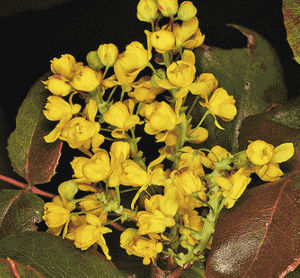
Creeping barberry(Berberis repens)

Creeping barberry (Berberis repens)

Also known as: Creeping oregon grape, Edging barberry, Creeping hollygrape

Creeping barberry (Berberis repens) is a robust shrub that typically reaches a height of 46 to 76 cm and spreads 61 to 91 cm wide. Native to Northern California and the Sierra Nevada region, it flourishes in well-drained loamy soils. This plant prefers slightly acidic to neutral pH levels and does well in partial to full shade, although it can handle some sunlight. Keeping the soil moist but avoiding waterlogging is key to its growth. Mulching is also beneficial for moisture retention and weed control.

Attributes of Creeping barberry

Lifespan
Perennial
Plant Type
Shrub
Plant Height
20 cm to 45 cm
Spread
20 cm to 45 cm
Leaf Color
Green Blue Purple Lavender
Flower Size
3 cm to 10 cm
Flower Color
Yellow Gold

PlantJoy - Identify plants with a snap

Identify and diagnose plants, get toxicity alerts, and explore safety guides for all types of fungi.

Try for Free

Images of Creeping barberry

Creeping barberry(Berberis repens)

Quickly Identify Creeping barberry

1
Low-growing broadleaf evergreen with creeping stolons, forming dense ground cover.
2
Oval, holly-like leaves with spines, compound pinnate structure, bluish-green color in summer.
3
Small blackish-blue berries in grape-like clusters, slightly tart taste, edible and attractive to birds.

Scientific Classification of Creeping barberry

Phylum
Vascular plants
Class
Dicotyledons
Order
Ranunculales
Family
Barberry
Genus
salmon barberry
Species
Creeping barberry

Planting and Growing of Creeping barberry

Care Difficulty
Easy
Watering Schedule
Every 2 days
Sunlight Requirements
Partial sun
Sunshine Duration
6-10 hours
Ideal Temperature
50-77℉
Soil Type
Potting Mix, Peat Mix
Soil pH
6.5-7.5
Fertilizer Type
Balanced
Pruning Season
Spring, Summer
Pruning Area
Branches, Leaves
Pruning Frequency
2 times a year
Repotting Season
Spring
Pot Type
Terracotta, Plastic

water icon How to Water Creeping barberry?

When watering Berberis repens, aim for about 250 milliliters of water each time. This amount should be enough to moisten the soil without leaving it soggy. It is essential to let the soil dry slightly between waterings to prevent root rot. The goal is for the water to reach the root zone without pooling on the surface.
What are the symptoms of an underwatered Creeping barberry?
What should I do if my Creeping barberry is not getting enough water?
What are the symptoms of an overwatered Creeping barberry?
How to save an overwatered Creeping barberry?

temperature icon What Is the Ideal Temperature Range for Creeping barberry?

Ideal Temperature: 50 ~ 77℉
The ideal temperature range for the growth of Berberis repens is between 50°F and 77°F. These temperatures provide an optimal environment for photosynthesis and other physiological processes. Within this range, the plant can effectively absorb nutrients and water, resulting in healthy growth and development.

soil icon What Soil is Best for Creeping barberry?

Soil type: Loam, Sandy loam, Sand soil
Soil PH: 6.5 ~ 7.5
Berberis repens thrives in well-draining soil conditions. This reduces the risk of root rot and helps maintain healthy root systems by preventing waterlogged conditions. The balance of air and water in such soils ensures optimal growth and nutrient uptake. This plant prefers soil that retains some moisture while still offering good drainage. It ensures the plant has access to sufficient water without excess, promoting steady growth and resilience against drought. Incorporating organic matter into the soil is beneficial for Berberis repens. It improves soil structure, provides necessary nutrients, and enhances microbial activity, leading to healthier plants with vibrant growth.

fertilize icon How to Fertilize Creeping barberry?

Fertilizer type: Balanced
Berberis repens, commonly known as creeping barberry, requires balanced fertilization. Typically, use a liquid fertilizer diluted to half strength every two weeks during active growth. A recommended amount would be about 1/4 tablespoon per gallon of water.

prune icon How to Prune Creeping barberry?

Pruning Time: Spring, Summer, Autumn
Begin by using sharp, sterilized pruning shears to cut back any dead or diseased branches. Trim back the plant to maintain your desired shape, ensuring to cut just above a leaf node to promote new growth. Thinning out congested areas can also enhance air circulation and light penetration throughout the plant. Focus on shaping Berberis repens by slightly rounding the edges for a more uniform appearance, making sure to trim evenly from all sides. Avoid aggressive cuts and maintain a balanced look by pruning each side equally to ensure symmetrical growth.

propagate icon How to Propagate Creeping barberry plant?

Propagate Time: Spring, Early spring
1
Choose a healthy parent plant to take cuttings from, ensuring it is disease-free and watered a day before. This maximizes the success of rooting by promoting hydration in the cuttings.
2
Using clean pruning shears, cut a 4-6 inch segment from a young, healthy stem. Remove any flowers or buds to concentrate energy on root development.
3
Dip the cut end in rooting hormone and plant it in a pot filled with a well-draining growing medium. Keep the soil consistently moist but not waterlogged for optimal root growth.
More About Propagating Techniques

repot icon How to Repot Creeping barberry plant?

Repotting frequency: Every 2-3 years
1
It's crucial to repot Berberis repens when you notice slow growth, roots emerging from drainage holes, or soil that no longer retains moisture well. These signs indicate the plant is ready for a larger pot with refreshed soil.
2
Select a pot that's roughly 2 inches larger in diameter than the current one. Clay pots work well as they provide stability and assist in moisture regulation, preventing overwatering—a common issue with Berberis repens.
3
Opt for a well-draining, loamy soil mix rich in organic matter. Such soil ensures that water doesn't stagnate, which could lead to root rot, while providing the necessary nutrients for healthy growth.

PlantJoy - Identify plants with a snap

Find the best spots for them to optimize their health, simply using your phone.

Try for Free

Toxicity of Creeping barberry

Is Creeping barberry toxic to humans?

Creeping barberry is a plant that contains berberine, a toxic compound found in nearly all of its parts, with the exception of ripe berries, making it particularly hazardous for consumption by pregnant or breastfeeding women. Berberine toxicity poses risks to both developing fetuses and newborns; therefore, abstaining from consumption is crucial. Excessive amounts of berberine may lead to adverse effects such as diarrhea, nausea, vomiting, kidney inflammation, jaundice, liver damage, and allergic reactions. Additionally, contact with this plant can lead to skin irritation, including rashes.

Identify toxic plants for your safety

Learn which plants are harmful to you and your pets, and make informed choices for a safer home!

Try for Free
WARNING
The judgment on toxicity and danger is for reference only. We DO NOT GUARANTEE any accuracy of such judgment. Therefore, you SHALL NOT rely on such judgment. It is IMPORTANT TO SEEK PROFESSIONAL ADVICE in advance when necessary.
More About Toxic Techniques

