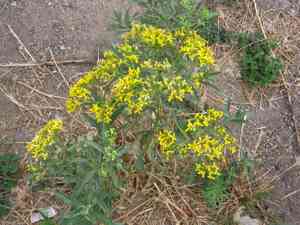
Willow ragwort (Barkleyanthus) (Barkleyanthus)
Also known as: Barkley's-Ragwort
Willow ragwort (Jacobaea erucifolia) is a perennial plant that typically grows to a height of 1 to 2 meters, though it can occasionally reach over 4 meters. The leaves are lance-shaped and arranged alternately, often becoming denser near the tips of the branches. The plant features an inflorescence that can be a broad cluster of several flower heads or smaller clusters located in the leaf axils or at the ends of branches. Each flower head includes a few yellow ray florets, which are pistillate, and up to 25 or more yellow disc florets, which are bisexual. The fruit is a rough-textured cypsela with a pyramidal or prism shape, accompanied by a pappus of numerous barbed white bristles. Willow ragwort, which includes a single species, is native to parts of Europe and western Asia, commonly found in regions such as the United Kingdom, France, Germany, Russia, and Turkey.
Attributes of Willow ragwort (Barkleyanthus)
Images of Willow ragwort (Barkleyanthus)
Quickly Identify Willow ragwort (Barkleyanthus)
Scientific Classification of Willow ragwort (Barkleyanthus)
Planting and Growing of Willow ragwort (Barkleyanthus)
 How to Water Willow ragwort (Barkleyanthus)?
 What Are the Sunlight Requirements for Willow ragwort (Barkleyanthus)?
 What Is the Ideal Temperature Range for Willow ragwort (Barkleyanthus)?
 What Soil is Best for Willow ragwort (Barkleyanthus)?
 How to Fertilize Willow ragwort (Barkleyanthus)?
 How to Prune Willow ragwort (Barkleyanthus)?
 How to Propagate Willow ragwort (Barkleyanthus) plant?
 How to Repot Willow ragwort (Barkleyanthus) plant?
Toxicity
Ingestion

