Shortleaf baccharis (Baccharis brachyphylla)
Also known as: Shortleaf Baccharis, Stickleaf Baccharis
Shortleaf baccharis thrives in desert landscapes due to its resilience to arid conditions. Its small, tough leaves help reduce water loss, enhancing its drought resistance. The shrub's dense, compact growth and short stems allow it to flourish in full sunlight and well-drained soils. Additionally, its unassuming flowers attract pollinators, contributing to the local ecosystem.
In This Article
Attributes of Shortleaf baccharis
Lifespan
Perennial
Plant Type
Shrub
Plant Height
1 to 3 feet
Spread
2 to 3 feet
Leaf Color
Green
Flower Size
0.1 to 0.2 inches
Flower Color
White
Images of Shortleaf baccharis
Quickly Identify Shortleaf baccharis
1
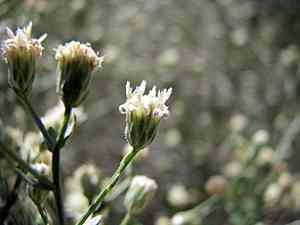
To identify Baccharis brachyphylla, look for a low-growing shrub with small, oblong leaves that are sticky to the touch. Flowers are small and white, forming clusters at the ends of branches.
Scientific Classification of Shortleaf baccharis
Phylum
Vascular plants
Class
Dicotyledons
Order
Asterales
Family
Daisy
Genus
Baccharises
Species
Shortleaf baccharis
Planting and Growing of Shortleaf baccharis
Care Difficulty
Moderate
Watering Schedule
Every 3 days
Sunlight Requirements
Full sun
Sunshine Duration
4-8 hours
Ideal Temperature
50-80℉
Soil Type
Potting Mix, Peat Mix
Soil pH
6.5-7.5
Fertilizer Type
Balanced
Pruning Season
Spring, Summer
Pruning Area
Branches, Leaves
Pruning Frequency
2 times a year
Repotting Season
Spring
Pot Type
Plastic, Ceramic
 How to Water Shortleaf baccharis?
Baccharis brachyphylla prefers its soil to be moist but not waterlogged. Generally, providing about 250 milliliters of water per session should suffice to keep the balance just right. Ensure water reaches the root zone without pooling on the surface.
What are the symptoms of an underwatered Shortleaf baccharis?
›
What should I do if my Shortleaf baccharis is not getting enough water?
›
What are the symptoms of an overwatered Shortleaf baccharis?
›
How to save an overwatered Shortleaf baccharis?
›
 What Are the Sunlight Requirements for Shortleaf baccharis?
Baccharis brachyphylla ideally benefits from full sun to partial sun, which facilitates vigorous growth and resilience. Suitable exposure enhances blooming and ensures optimal photosynthetic rate, crucial for energy production.
How much sunlight does Baccharis brachyphylla need?
›
What if full sun is not available?
›
How can I tell if my plant is getting the ideal light?
›
 What Is the Ideal Temperature Range for Shortleaf baccharis?
Baccharis brachyphylla thrives best in environments where the temperature ranges from 50°F to 80°F. This range allows for optimal physiological functions such as photosynthesis and nutrient uptake, providing the plant with the necessary conditions for robust growth.
 What Soil is Best for Shortleaf baccharis?
Baccharis brachyphylla thrives in well-draining soil, preventing root rot by allowing excess water to escape. This type of soil supports root aeration, crucial for healthy growth and nutrient uptake. This plant prefers soil with moderate nutrient content. While it can endure low fertility, a balanced availability of essential nutrients ensures robust foliage and blooming, enhancing its overall vigor. Baccharis brachyphylla adapts well to slightly alkaline soils, with a pH range up to 7.5. This environment facilitates optimal nutrient availability, fostering vigorous growth and vibrant foliage.
 How to Fertilize Shortleaf baccharis?
For Baccharis brachyphylla, it's ideal to use a balanced fertilizer at a moderate rate. Typically, a concentration of 1/4 teaspoon per gallon of water works well for liquid fertilizers. For solid fertilizers, use about 1 tablespoon sprinkled around the base.
 How to Prune Shortleaf baccharis?
Begin by removing any dead or damaged branches, cutting them back to the main stem. Then, thin out crowded areas to allow for light and air penetration. Trim back overgrown branches to promote a more compact growth habit. Always cut at a 45-degree angle just above a node to encourage new growth. Aim to achieve a rounded or desired shape by selectively pruning. This encourages a fuller plant and a more attractive appearance. Be deliberate in your cuts and avoid cutting more than a third of the plant at a time.
More About Pruning Techniques→
 How to Propagate Shortleaf baccharis plant?
1
Before planting, prepare the seeds by soaking them in lukewarm water for 24 hours. This process helps to soften the seed coat, enhancing germination rates.
2
Select healthy, non-flowering stems for cuttings. These should be around 10-15 cm long and preferably taken from the current season's growth as these parts tend to root more successfully.
3
Prepare a well-draining soil mixture. Combine equal parts of sand and peat moss, ensuring it is slightly moist before planting seeds or cuttings.
 How to Repot Shortleaf baccharis plant?
1
Baccharis brachyphylla signals the need for repotting when it becomes root-bound, meaning the roots start circling the pot. Another sign is when water runs through the pot quickly, indicating soil degradation. Ideally, repot during spring or summer when the plant is in its active growth phase to reduce shock.
2
Select a pot that is one size larger to accommodate further root growth, ensuring it has proper drainage holes. A slightly larger pot helps prevent overwatering problems while giving roots enough space to expand, fostering optimal growth and health.
3
Opt for well-draining sandy soil. This choice prevents waterlogged conditions that can lead to root rot, ensuring adequate aeration and drainage while mimicking the plant's native desert environment. A mix of potting soil with perlite or sand works wonders.
Toxicity
Ingestion
WARNING
The judgment on toxicity and danger is for reference only. We DO NOT GUARANTEE any accuracy of such judgment. Therefore, you SHALL NOT rely on such judgment. It is IMPORTANT TO SEEK PROFESSIONAL ADVICE in advance when necessary.



