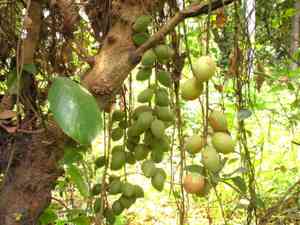
Burmese grape (Baccaurea ramiflora)
Also known as: Latka
The Banyan tree (Ficus benghalensis) is a slow-growing, dense tree commonly found throughout southern and southeastern Asia. It thrives both in natural forests and home gardens, appreciated for its fruits, ornamental appeal, and the ample shade it provides. The Banyan tree also plays a significant role in local traditional folklore.
In This Article
Attributes of Burmese grape
Lifespan
Perennial
Plant Type
Tree
Plant Height
8 m to 23 m
Spread
25 cm to 70 cm
Leaf Color
Green
Flower Size
2.5 cm
Flower Color
Yellow Green Brown
Images of Burmese grape
Quickly Identify Burmese grape
1
Look for a medium-sized tree with multiple stems, broad glossy leaves, and clusters of small, spherical fruits growing directly on the trunk and branches.
Scientific Classification of Burmese grape
Phylum
Vascular plants
Class
Dicotyledons
Order
Nances, spurges, willows and allies
Family
Leaf-flower
Genus
Baccaurea
Species
Burmese grape
Planting and Growing of Burmese grape
Care Difficulty
Moderate
Watering Schedule
Every 4 days
Sunlight Requirements
Partial sun
Sunshine Duration
4-8 hours
Ideal Temperature
75-86℉
Soil Type
Potting Mix, Peat Mix
Soil pH
5.5-7.5
Fertilizer Type
Balanced
Pruning Season
Spring, Summer
Pruning Area
Branches, Leaves
Pruning Frequency
2 times a year
Repotting Season
Spring
Pot Type
Plastic, Ceramic
 How to Water Burmese grape?
Baccaurea ramiflora thrives on moderate watering. It is vital to ensure that the soil is damp but not waterlogged. Watering should be thorough enough to moisten the entire root zone. The principle is to allow the top layer of soil to dry out between waterings to prevent root rot.
What are the symptoms of an underwatered Burmese grape?
›
What should I do if my Burmese grape is not getting enough water?
›
What are the symptoms of an overwatered Burmese grape?
›
How to save an overwatered Burmese grape?
›
 What Are the Sunlight Requirements for Burmese grape?
A semi-shady environment or partial sun exposure fosters the best developmental conditions for Baccaurea ramiflora, promoting healthier leaves and substantial fruit yields.
More About Sunlight Requirements Techniques→
Optimal Location
›
Solutions for Ideal Lighting
›
Benefits of Ideal Light
›
 What Is the Ideal Temperature Range for Burmese grape?
Baccaurea ramiflora thrives in warm and humid environments, ideally between 75°F and 86°F. This temperature range ensures optimal physiological processes such as photosynthesis and nutrient uptake, promoting overall healthy growth and fruit production. Maintaining consistent temperatures within this range will help prevent stress and support robust developmental stages.
 What Soil is Best for Burmese grape?
Baccaurea ramiflora thrives best in well-draining soil as it prevents waterlogging, which can harm the roots. The use of sandy loam or loamy soil is ideal as it provides proper drainage while retaining sufficient moisture for the plant's growth. The plant benefits from soil rich in organic matter, which offers essential nutrients and supports healthy growth. Adding compost or well-decomposed manure can enhance the soil's fertility, promoting robust growth and fruit production. While Baccaurea ramiflora needs well-draining soil, it also requires a moderate level of moisture retention to keep the soil consistently damp but not soggy. This balance ensures the plant has access to moisture during dry spells.
 How to Fertilize Burmese grape?
For Baccaurea ramiflora, a balanced approach to fertilization is crucial. Use liquid fertilizers diluted to half strength, ensuring that you provide approximately 120-150 ml per liter of water. Too much fertilizer can harm the plant’s roots, while too little may not provide enough nutrients for optimal growth.
 How to Prune Burmese grape?
Start by identifying any dead or diseased branches. These can usually be spotted by their lack of leaves or a noticeably darker color. Carefully remove them at the base to promote new growth. Select a dominant, central leader branch and prune any competing vertical stems. This helps in shaping the tree and ensuring balanced growth, promoting better structural integrity and fruit production. Look for areas where branches are densely packed. Thinning out these areas allows better air circulation and light penetration, which are essential for the healthy development of fruits and foliage.
More About Pruning Techniques→
 How to Propagate Burmese grape plant?
1
Harvest seeds from ripe Baccaurea ramiflora fruits. Clean them thoroughly to remove any pulp residue, which could lead to fungal growth when sown.
2
Select healthy, semi-hardwood cuttings from existing plants. Ensure each cutting is about six inches long and remove leaves from the lower half.
3
Utilize grafting techniques such as cleft or bud grafting to propagate Baccaurea ramiflora. It requires careful alignment of the vascular cambium for successful union.
 How to Repot Burmese grape plant?
1
Know it's time to repot your Baccaurea ramiflora when you see roots emerging from the drainage holes or the growth rate noticeably slows down. Additionally, if the soil seems depleted and water holds poor balance, it's repotting time.
2
Select a pot that is 2-3 inches bigger in diameter than the current one, ensuring it has ample drainage holes. This larger size encourages healthy root expansion and prevents waterlogging, providing an ideal growth environment.
3
Opt for a well-draining loamy soil mix, perhaps supplemented with perlite or sand. This composition prevents water buildup, thus reducing root rot risk and promoting oxygenation essential for vibrant and healthy plant growth.
Learn More About Burmese grape Diseases
Anthracnose
Bacterial Leaf Spot
Bacterial Soft Rot
Bacterial Wilt
Crown Gall
Cyst Nematode
Damping-off
Downy Mildew
Drought Stress
Fusarium Wilt
Gray Mold
Leaf Curl
Leaf Spot
Mosaic
Nutrient Deficiency
Nutrient Toxicity
Powdery Mildew
Root Rot
Root-knot Nematode
Rusts
Sooty Mold
Spider Mites
Temperature Stress
Thrips Damage
White Mold



