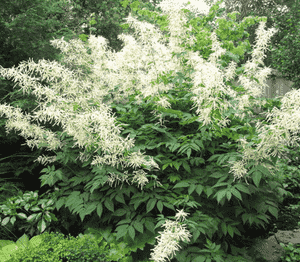
Goat's beard (Aruncus dioicus)
Also known as: Buck's-beard
Aruncus dioicus, often referred to as goat's beard, buck's-beard, or bride's feathers, features distinct male and female plants. This plant has earned the Royal Horticultural Society's Award of Garden Merit.
In This Article
Attributes of Goat's beard
Lifespan
Perennial
Plant Type
Herb
Plant Height
1.2 m to 1.8 m
Spread
60 cm to 1.2 m
Leaf Color
Green
Flower Size
0.5 mm to 1.5 mm
Flower Color
White Cream Yellow
Images of Goat's beard
Quickly Identify Goat's beard
1
Tall stature of 3-6 feet (91-183 cm), creating a bushy appearance.
2
Creamy-white flowers in large plume-like clusters, blooming from May to June.
3
Diminutive seed capsules with 2-4 seeds, blending with foliage.
4
Bi-pinnately compound dark green leaves, with lanceolate leaflets and serrated margins.
5
Lower leaves larger than upper ones, enhancing lush foliage.
Scientific Classification of Goat's beard
Phylum
Vascular plants
Class
Dicotyledons
Order
Rosales
Family
Rose
Genus
Aruncus
Species
Goat's beard
Planting and Growing of Goat's beard
Care Difficulty
Easy
Watering Schedule
Every 4 days
Sunlight Requirements
Partial sun
Sunshine Duration
6-10 hours
Ideal Temperature
60-75℉
Soil Type
Potting Mix, Peat Mix
Soil pH
6.5-7.5
Fertilizer Type
Balanced
Pruning Season
Spring, Summer
Pruning Area
Branches, Leaves
Pruning Frequency
2 times a year
Repotting Season
Spring
Pot Type
Plastic, Ceramic
 How to Water Goat's beard?
For Aruncus dioicus, each watering session should thoroughly moisten the soil down to the roots, which generally means around 500 milliliters of water. The aim is to ensure the soil is moist yet not waterlogged, mimicking its natural habitat’s moisture levels.
More About Watering Techniques→
What are the symptoms of an underwatered Goat's beard?
›
What should I do if my Goat's beard is not getting enough water?
›
What are the symptoms of an overwatered Goat's beard?
›
How to save an overwatered Goat's beard?
›
 What Are the Sunlight Requirements for Goat's beard?
Partial sun to full shade is optimal for Aruncus dioicus. This range supports its natural growth patterns, offering sufficient energy for blooming and foliage development without overwhelming the plant with harsh light conditions.
More About Sunlight Requirements Techniques→
What is the ideal light condition for Aruncus dioicus?
›
How can I achieve optimal light conditions for this plant?
›
What are the benefits of providing the ideal light for this plant?
›
 What Is the Ideal Temperature Range for Goat's beard?
For optimal growth, Aruncus dioicus thrives best in temperatures between 60°F and 75°F. This range ensures the plant can maintain its physiological processes effectively, leading to healthy growth and flowering. Outside this range, the plant may experience stress, which can impact its development and reproductive success.
 What Soil is Best for Goat's beard?
Aruncus dioicus thrives in soil that retains moisture well without becoming waterlogged. Such soil helps maintain the plant's lush foliage and support its vigorous growth. A soil rich in organic matter is beneficial for this plant, as it provides essential nutrients that enhance growth and flowering. Organic matter also improves soil structure and aeration. While moisture is essential, the soil must also drain well to prevent root rot. Good drainage ensures that excess water flows away, protecting the plant’s root system.
More About Soil→
 How to Fertilize Goat's beard?
For Aruncus dioicus, a balanced fertilizer with equal parts nitrogen, phosphorus, and potassium (N-P-K) is ideal. For liquid fertilizers, apply about 1/2 strength of the recommended dose to avoid root burn. For solid, use 1 cup of granules per plant per application.
More About Fertilizing Techniques→
 How to Prune Goat's beard?
Begin pruning by removing any dead, diseased, or damaged stems. This not only improves appearance but also boosts the plant's energy efficiency by directing its resources towards healthy growth. After removing the deadwood, trim back long or unruly stems to maintain the desired shape. This usually involves cutting back to a bud or node that faces the direction you want future growth to take. If any part of the Aruncus dioicus is getting too dense, selectively remove stems from the center to improve air circulation. This helps prevent fungal diseases by ensuring good airflow around the plant.
More About Pruning Techniques→
 How to Propagate Goat's beard plant?
1
Begin by soaking the seeds in water for 24 hours to soften the seed coat. This process helps in breaking seed dormancy and boosts germination rates significantly.
2
Fill the seed starter trays with a well-draining potting mix, place the seeds on top, and lightly cover them with soil. Keep the soil moist but not wet, ensuring the seeds remain at an optimal temperature for germination.
3
Carefully dig up the mature plant in early spring. Using a sharp knife, divide the root clump into sections with at least two growth buds per division, ensuring roots are intact for successful re-establishment.
 How to Repot Goat's beard plant?
1
You'll know it's time to repot Aruncus dioicus when you notice roots poking through the drainage holes, or if the plant appears stunted. Ideally, the best time to repot is during early spring or fall when the plant is relatively dormant.
2
Selecting the right pot is crucial for the healthy growth of Aruncus dioicus. Opt for a pot that is just a couple of inches larger in diameter than the current one to prevent excessive soil retention, which could lead to root rot. Ensure it has adequate drainage holes to allow excess water to escape. Terracotta pots are often a good choice as they allow better air circulation for the roots.
3
The soil should be well-draining and slightly acidic to neutral, mimicking its natural habitat. A mix containing peat, perlite, and composted pine bark is ideal. This composition ensures proper aeration and moisture retention without becoming waterlogged, providing optimal conditions for growth.
Toxicity
Ingestion
WARNING
The judgment on toxicity and danger is for reference only. We DO NOT GUARANTEE any accuracy of such judgment. Therefore, you SHALL NOT rely on such judgment. It is IMPORTANT TO SEEK PROFESSIONAL ADVICE in advance when necessary.



