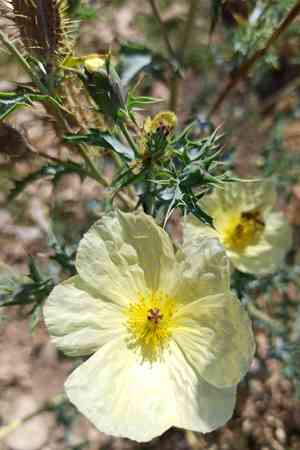
Argemone intermedia (Argemone intermedia)
Also known as: Prickly Poppy, Mexican Poppy
Argemone intermedia stands out with its bright yellow flowers and thorny seed capsules, resembling a poppy. It is commonly found in dry, arid areas, flourishing under intense sunlight and in poor, rocky soils. The plant features deeply lobed, blue-green leaves and stout, prickly stems, giving it a rugged appearance suitable for tough environments.
In This Article
Attributes of Argemone intermedia
Lifespan
Annual
Plant Type
Herb
Plant Height
30-100 cm
Spread
30-50 cm
Leaf Color
Green with white venation
Flower Size
5-10 cm
Flower Color
White to yellow
Images of Argemone intermedia
Quickly Identify Argemone intermedia
1
To identify Argemone intermedia, look for its deeply lobed, spiny leaves, and large, white to yellow flowers with numerous stamens. The plant also exudes a yellowish latex when cut.
Scientific Classification of Argemone intermedia
Phylum
Vascular plants
Class
Dicotyledons
Order
Ranunculales
Family
Poppy
Genus
Prickly poppies
Species
Argemone intermedia
Planting and Growing of Argemone intermedia
Care Difficulty
Easy
Watering Schedule
Every 2 days
Sunlight Requirements
Full sun
Sunshine Duration
4-8 hours
Ideal Temperature
60-75℉
Soil Type
Potting Mix, Peat Mix
Soil pH
6.5-7.5
Fertilizer Type
Balanced
Pruning Season
Spring, Summer
Pruning Area
Branches, Leaves
Pruning Frequency
2 times a year
Repotting Season
Spring
Pot Type
Plastic, Ceramic
 How to Water Argemone intermedia?
Argemone intermedia prefers deep watering, ensuring soil saturation without causing waterlogging. Aim for around 500ml, ensuring the water penetrates the root zone effectively.
What are the symptoms of an underwatered Argemone intermedia?
›
What should I do if my Argemone intermedia is not getting enough water?
›
What are the symptoms of an overwatered Argemone intermedia?
›
How to save an overwatered Argemone intermedia?
›
 What Are the Sunlight Requirements for Argemone intermedia?
Argemone intermedia prefers full sun to partial sun conditions. Ensuring this light range strengthens the plant's structure, enhances leaf color, and supports abundant flowering.
What is the best light exposure for Argemone intermedia?
›
How to ensure Argemone intermedia gets enough sunlight?
›
What benefits does optimal sunlight bring to Argemone intermedia?
›
 What Is the Ideal Temperature Range for Argemone intermedia?
Argemone intermedia thrives best at temperatures ranging from 60°F to 75°F. This temperature range ensures that the plant can photosynthesize efficiently and maintain its metabolic processes at an optimal rate, leading to healthy growth and flowering.
 What Soil is Best for Argemone intermedia?
Argemone intermedia thrives in well-draining soils. Ensuring proper drainage prevents root rot and allows for healthier root development, which is crucial for nutrient uptake and growth. While not overly demanding, this plant appreciates a nutrient-rich base to support its growth. A fertile ground will encourage lush foliage and vibrant blooms, enhancing its ornamental appeal. Argemone intermedia prefers soils with moderate moisture levels. Maintaining adequate moisture without waterlogging ensures the plant retains vitality and resilience against drought conditions.
 How to Fertilize Argemone intermedia?
Argemone intermedia requires a balanced fertilizer application. For liquid fertilizers, use a 20-20-20 formula at a concentration of 1 tablespoon per gallon of water. For slow-release fertilizers, apply 1/2 cup per square foot around the plant annually.
 How to Prune Argemone intermedia?
Inspect the plant and identify any dead, damaged, or diseased branches. Also, look out for overly dense areas where sunlight and air might not penetrate well. Mark these branches for removal as they could hinder the plant's overall health and growth. When cutting, aim to make clean cuts at a 45-degree angle above a leaf node or bud. This method encourages better healing and promotes the growth of new branches. Ensure cuts are precise to avoid crushing the stems, which can lead to infections. Immediately collect and dispose of all pruned material, especially if it showed signs of disease. This prevents the spread of potential diseases and keeps the immediate area tidy, reducing pest attraction and maintaining garden aesthetics.
 How to Propagate Argemone intermedia plant?
1
Begin by collecting mature seeds from the plant. Clean them off any debris and soak them in water for 24 hours to soften the seed coat, which enhances germination rates. Plant them in the seed tray filled with a well-draining potting mix.
2
To propagate via cuttings, select a healthy stem and cut a segment about 6 inches long. Remove the leaves from the lower half of the cutting to avoid rot and dip the cut end in rooting hormone to promote root development.
3
Place the seeds or cutting into the soil at a depth of about twice the size of the seed. Gently water the substrate, ensuring it's moist but not waterlogged. Maintain consistent moisture to support development.
 How to Repot Argemone intermedia plant?
1
Look for signs such as roots poking out of drainage holes, or if the plant appears to be outgrowing its pot. These indicators suggest that it's time to give Argemone intermedia a new home to thrive.
2
Choose a pot slightly larger than the current one, with good drainage holes to prevent waterlogging. A larger pot offers space for root expansion, promotes healthy growth, and prevents overwatering issues.
3
Opt for well-draining sandy soil, as it mimics its natural habitat and ensures optimal moisture levels. This type of soil reduces the risk of root rot and keeps the plant healthy by providing proper aeration.
Toxicity
Ingestion
WARNING
The judgment on toxicity and danger is for reference only. We DO NOT GUARANTEE any accuracy of such judgment. Therefore, you SHALL NOT rely on such judgment. It is IMPORTANT TO SEEK PROFESSIONAL ADVICE in advance when necessary.
Learn More About Argemone intermedia Diseases
Anthracnose
Bacterial Leaf Spot
Bacterial Soft Rot
Bacterial Wilt
Chemical Injury
Damping-off
Downy Mildew
Drought Stress
Fusarium Wilt
Gray Mold
Leaf Spot
Mosaic
Nutrient Deficiency
Nutrient Toxicity
Powdery Mildew
Root Rot
Root-knot Nematode
Rusts
Sooty Mold
Spider Mites
Temperature Stress
Thrips Damage
White Mold



