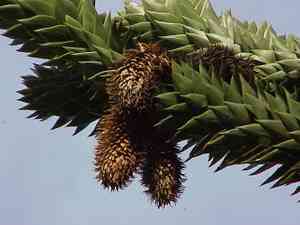
Monkey puzzle tree (Araucaria araucana)
Also known as: Chilean pine, Chile nut, Parana pine, Pewen
The monkey puzzle tree, scientifically named Araucaria araucana, stands out with its sharp, scale-like leaves that spiral around its branches, giving it a reptilian look. It also produces large cones that attract birds and squirrels. The name "monkey puzzle" originated from a 19th-century remark suggesting that its spiky, unique structure would be a challenging puzzle for monkeys to climb, even though monkeys are not found in its native regions of Chile and Argentina.
In This Article
Attributes of Monkey puzzle tree
Lifespan
Perennial
Plant Type
Tree
Plant Height
15 m to 24 m
Spread
6 m to 9 m
Leaf Color
Green
Flower Size
N/A (Gymnosperms do not have flowers)
Flower Color
Green Yellow Brown
Images of Monkey puzzle tree
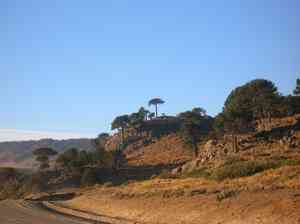
Quickly Identify Monkey puzzle tree
1
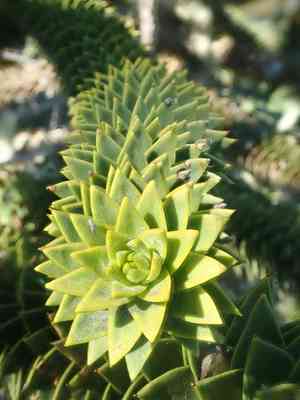
Triangular, sharp-pointed leaves with glossy dark green finish.
2
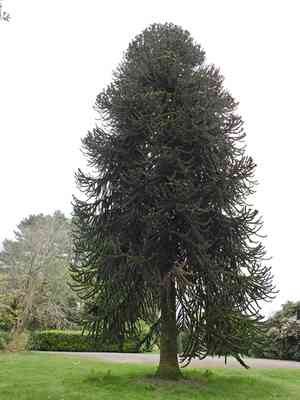
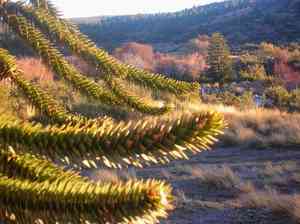
Whorled branch pattern on tall, columnar tree up to 130 feet (40 meters) high.
3
Large reproductive cones, with female cones up to 8 inches (20 cm) long.
4
Thick, scaly bark with deep-set, wrinkled texture and horizontal folds.
5
Ovoid to spherical woody cones as fruit, maturing in 2-3 years.
Scientific Classification of Monkey puzzle tree
Phylum
Vascular plants
Class
Conifers
Order
Pinales
Family
Araucaria
Genus
Araucaria
Species
Monkey puzzle tree
Planting and Growing of Monkey puzzle tree
Care Difficulty
Hard
Watering Schedule
Every 3 days
Sunlight Requirements
Full sun
Sunshine Duration
4-8 hours
Ideal Temperature
50-75℉
Soil Type
Potting Mix, Peat Mix
Soil pH
6.5-7.5
Fertilizer Type
Balanced
Pruning Season
Spring, Summer
Pruning Area
Branches, Leaves
Pruning Frequency
2 times a year
Repotting Season
Spring
Pot Type
Plastic, Ceramic
 How to Water Monkey puzzle tree?
For Araucaria araucana, which is accustomed to well-drained soil conditions, water approximately 500 ml per session. Ensure that the water soaks through but doesn’t leave the soil overly soggy, mimicking the natural rainfall it would receive in its native habitat.
More About Watering Techniques→
What are the symptoms of an underwatered Monkey puzzle tree?
›
What should I do if my Monkey puzzle tree is not getting enough water?
›
What are the symptoms of an overwatered Monkey puzzle tree?
›
How to save an overwatered Monkey puzzle tree?
›
 What Are the Sunlight Requirements for Monkey puzzle tree?
Araucaria araucana thrives in full to partial sun, ideally experiencing 6 to 8 hours of sunlight daily. This exposure ensures vigorous growth, hearty foliage, and resistance to environmental stressors.
More About Sunlight Requirements Techniques→
What is the best lighting condition for Araucaria araucana?
›
How can you achieve the ideal lighting for Araucaria araucana?
›
What are the benefits of ideal lighting for Araucaria araucana?
›
 What Is the Ideal Temperature Range for Monkey puzzle tree?
The ideal temperature range for Araucaria araucana lies between 50°F and 75°F. Maintaining this range is crucial as it supports optimal physiological processes. It ensures the plant's metabolism functions effectively, helping in photosynthesis and nutrient uptake, ultimately promoting robust growth and vitality. Understanding environmental conditions in your locality is key to achieving this ideal temperature range indoors or outdoors.
 What Soil is Best for Monkey puzzle tree?
Araucaria araucana thrives best in well-drained soils. This prevents waterlogging, which can damage the roots and lead to poor plant health. The well-drained nature allows for sufficient oxygen penetration, vital for root respiration and overall tree vitality. Araucaria araucana benefits from nutrient-rich soil that contains essential minerals like nitrogen, phosphorus, and potassium. Such soil supports robust growth and a dense foliage canopy, ensuring that the plant achieves its majestic stature. Although well-drained, the soil should maintain adequate moisture to support Araucaria araucana, especially during dry periods. Moisture-retentive soils reduce the frequency of irrigation needed and ensure the plant remains verdant and lush.
More About Soil→
 How to Fertilize Monkey puzzle tree?
Araucaria araucana, commonly known as the monkey puzzle tree, requires careful fertilization to maintain its health. Typically, a balanced fertilizer with an equal ratio such as 10-10-10 NPK can be used. For liquid fertilizer, applying half a cup diluted in a gallon of water is generally sufficient for a young tree. Mature trees may require adjustment depending on soil conditions and growth observations.
 How to Prune Monkey puzzle tree?
Use clean, sharp pruning shears to make precise cuts. Ensure that the tools are sanitized to prevent the spread of disease. Having the right tools will make the process easier and more efficient, allowing for cleaner cuts that heal faster. Focus on removing any dead, damaged, or diseased branches. Also, look for branches that are crossing or rubbing against each other, as these can cause damage over time. By choosing the right branches to remove, you improve air circulation and light penetration within the tree. Make cuts at a slight angle, just above a bud or side branch that faces outward. This encourages growth in the desired direction and helps prevent water from pooling on the cut surface, reducing the risk of infection. Aim to maintain the natural shape of the Araucaria by tapering the pruning towards the top. Avoid cutting the central leader unless absolutely necessary. This approach helps the tree retain its characteristic silhouette.
More About Pruning Techniques→
 How to Propagate Monkey puzzle tree plant?
1
Choose mature and healthy seeds from a reliable source. Inspect the seeds for any signs of damage or disease before planting to avoid propagation issues.
2
Use a well-draining soil mix with a neutral to slightly acidic pH. Add perlite or sand to the soil to improve aeration and drainage.
3
Plant seeds at a depth of 1 to 2 inches. Cover them lightly with soil and ensure they are evenly spaced to allow for adequate growth and airflow.
 How to Repot Monkey puzzle tree plant?
1
Araucaria araucana signals its need for repotting when roots start emerging from drainage holes, or if the plant seems stunted despite optimal watering and lighting. Wait until spring or autumn for milder weather conditions to minimize stress during the process.
2
Select a pot about 2 inches larger in diameter than the current one, ensuring it has ample drainage holes. A slightly larger pot allows root expansion without risking water stagnation, promoting better growth and preventing root rot.
3
Opt for a well-draining, loamy soil mix, rich in organic matter. This facilitates adequate aeration and moisture retention, essential for the Araucaria araucana to thrive, ensuring healthy root development and disease prevention.



