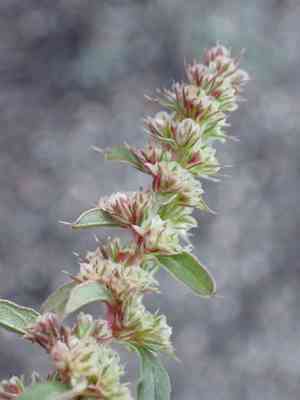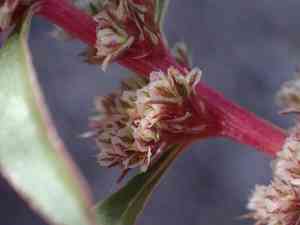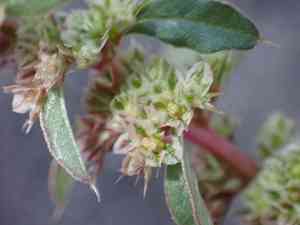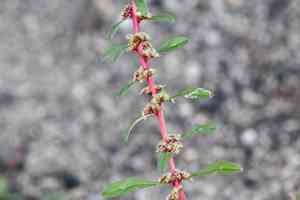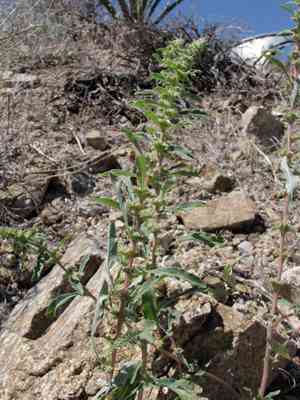
Torrey's amaranthus(Amaranthus torreyi)

Torrey's amaranthus (Amaranthus torreyi)

Also known as: Bigelow's amaranth

Torrey's amaranthus, or Amaranthus torreyi, is an annual herb known for its sturdy, bushy form, often growing up to about a meter tall. Its lance-shaped leaves, which can exhibit a green to reddish hue, are typically arranged in a spiral pattern on the stems. The plant produces dense clusters of small, greenish flowers located at the stem tips and in the leaf axils, blooming from summer through fall. It is well-suited to dry environments, utilizing a deep taproot to access limited water resources. Despite its weed-like tendencies, its small yet nutritious seeds and hardiness make it an important part of its ecosystem, particularly in challenging conditions.

Attributes of Torrey's amaranthus

Lifespan
Annual
Plant Type
Herb
Plant Height
Typically 30-70 cm (12-28 inches)
Spread
Not applicable; the plant does not form a crown
Leaf Color
Green
Flower Size
Small (less than 1 cm)
Flower Color
Green

ForwardPlant - Identify plants with a snap

Identify and diagnose plants, get toxicity alerts, and explore safety guides for all types of fungi.

Try for Free

Images of Torrey's amaranthus

Torrey's amaranthus(Amaranthus torreyi)

Quickly Identify Torrey's amaranthus

1
Identification: Look for a small, erect plant with green foliage and tiny green flowers clustered in dense spikes. The leaves are typically ovate and may have a slightly wavy margin.

Scientific Classification of Torrey's amaranthus

Phylum
Vascular plants
Class
Dicotyledons
Order
Caryophyllales
Family
Amaranth
Genus
Amaranths
Species
Torrey's amaranthus

Planting and Growing of Torrey's amaranthus

Care Difficulty
Moderate
Watering Schedule
Every 2 days
Sunlight Requirements
Full sun
Sunshine Duration
6-10 hours
Ideal Temperature
68-77℉
Soil Type
Potting Mix, Peat Mix
Soil pH
6.5-7.5
Fertilizer Type
Balanced
Pruning Season
Spring, Summer
Pruning Area
Branches, Leaves
Pruning Frequency
2 times a year
Repotting Season
Spring
Pot Type
Plastic, Ceramic

water icon How to Water Torrey's amaranthus?

Amaranthus torreyi requires a moderate amount of water. You should aim to saturate the soil thoroughly but ensure it does not become waterlogged. Ideally, water until the top 2-3 inches of soil are moist, which roughly translates to about 250 mL of water per session, depending on pot size and soil composition.
What are the symptoms of an underwatered Torrey's amaranthus?
What should I do if my Torrey's amaranthus is not getting enough water?
What are the symptoms of an overwatered Torrey's amaranthus?
How to save an overwatered Torrey's amaranthus?

sunlight icon What Are the Sunlight Requirements for Torrey's amaranthus?

Sunlight Requirements: Full sun, Partial sun
Duration of light: 6 to 8 hours daily
Amaranthus torreyi prefers full sun to partial sun, thriving best in warm, bright conditions. Ideal light enhances photosynthesis, ensuring rich foliage, optimal health, and robust growth.
How much light does Amaranthus torreyi require?
What solutions ensure ideal lighting?
What are the benefits of ideal lighting?

temperature icon What Is the Ideal Temperature Range for Torrey's amaranthus?

Ideal Temperature: 68 ~ 77℉
For optimal growth of Amaranthus torreyi, maintaining temperatures between 68°F and 77°F is pivotal. This range ensures that enzymatic activities and physiological processes within the plant are functioning at their peak. Within these temperatures, the plant is most likely to exhibit vibrant foliage and robust growth. It is essential that the environmental conditions support consistent temperature maintenance to avoid any developmental delays that may arise from temperature fluctuations.

soil icon What Soil is Best for Torrey's amaranthus?

Soil type: Sandy soil, Loam, Sandy loam
Soil PH: 6.5 ~ 7.5
Amaranthus torreyi thrives in soil that offers excellent drainage. This prevents root rot and ensures the plant gets the oxygen it needs. Well-drained soils allow water to flow through easily, reducing the chances of water-logged conditions that can harm the plant's root system. For optimal growth, ensure the soil is rich in essential nutrients such as nitrogen, phosphorus, and potassium. These nutrients support vigorous growth, robust stem development, and vibrant foliage, crucial for a healthy Amaranthus torreyi. The sandy loam composition creates a light and airy texture beneficial for root expansion. Amaranthus torreyi benefits from such soil as it allows roots to penetrate deeply, accessing more water and nutrients while facilitating healthy growth.

fertilize icon How to Fertilize Torrey's amaranthus?

Fertilizer type: Balanced
When fertilizing Amaranthus torreyi, it's essential to use a balanced 10-10-10 NPK fertilizer. For liquid fertilizers, use approximately half a teaspoon per gallon of water. For granular ones, around 1/4 cup per plant per annum should suffice.

prune icon How to Prune Torrey's amaranthus?

Pruning Time: Spring, Summer
Begin by identifying and removing any dead or diseased leaves. This redirects energy to healthier parts of the plant and prevents potential disease spread. Amaranthus torreyi can benefit from a light trim to encourage a more desirable shape. Snip branches back to a leaf node to promote bushier growth. If the plant becomes too tall, cut back the main stems by about one-third of their length. This action invigorates growth lower down and keeps the plant more compact. More About Pruning Techniques

propagate icon How to Propagate Torrey's amaranthus plant?

Propagate Time: Spring, Early summer
1
Start by obtaining quality seeds from a reliable source. Soak the seeds in water for about 12 hours before planting to soften the seed coat, which can enhance germination rates by facilitating water absorption.
2
Fill your seed trays with a sterile potting mix and level the surface. Sow the seeds evenly on the surface and lightly cover them with a fine layer of the potting mix. Mist the surface with water to ensure adequate moisture without disturbing the seeds.
3
Place the trays in a warm, bright location out of direct sunlight. Maintain a consistent temperature of around 21°C (70°F) to encourage germination. Use a clear cover on the tray to retain moisture and provide a greenhouse effect.
More About Propagating Techniques

repot icon How to Repot Torrey's amaranthus plant?

Repotting frequency: Every two to three years
1
Amaranthus torreyi should be repotted when you observe signs like roots growing out of the drainage holes or the plant's growth appearing stunted. This indicates that the plant's current pot is too small, and the root system needs more space to expand. It's ideal to do this during its active growing season, which is typically in spring or early summer, to reduce stress on the plant.
2
Selecting the right pot is crucial for Amaranthus torreyi. Choose a pot that is 1-2 inches larger in diameter than the current one to encourage growth without overwhelming the plant. Ensure the pot has ample drainage holes to prevent waterlogging, which can lead to root rot. The additional space will allow the roots to grow healthily and support the plant as it matures.
3
A well-draining, sandy loam soil is perfect for Amaranthus torreyi. This type of soil ensures good aeration and drainage, preventing root rot and other water-related issues. Incorporating organic matter like compost can enhance soil fertility, providing essential nutrients that support robust plant growth. This balance of structure and nutrients is ideal for your plant.

ForwardPlant - Identify plants with a snap

Find the best spots for them to optimize their health, simply using your phone.

Try for Free

Toxicity

Ingestion

Identify toxic plants for your safety

Learn which plants are harmful to you and your pets, and make informed choices for a safer home!

Try for Free
WARNING
The judgment on toxicity and danger is for reference only. We DO NOT GUARANTEE any accuracy of such judgment. Therefore, you SHALL NOT rely on such judgment. It is IMPORTANT TO SEEK PROFESSIONAL ADVICE in advance when necessary.