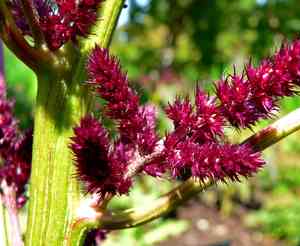
Thunberg's pigweed (Amaranthus thunbergii)
Also known as: Red pigweed
Amaranthus thunbergii, also known as Thunberg's pigweed or Thunberg's amaranthus, is native to Africa. Its leaves are often used as a leafy vegetable or for adding flavor to dishes.
In This Article
Attributes of Thunberg's pigweed
Lifespan
Annual
Plant Type
Herb
Plant Height
0.1 - 1.5 meters
Spread
0.1 - 0.5 meters
Leaf Color
Green
Flower Size
1 - 3 mm
Flower Color
Green
Images of Thunberg's pigweed
Quickly Identify Thunberg's pigweed
1
Look for broad, smooth leaves with wavy or serrated edges, and small clusters of greenish flowers arranged in dense spikes or panicles.
Scientific Classification of Thunberg's pigweed
Phylum
Vascular plants
Class
Dicotyledons
Order
Caryophyllales
Family
Amaranth
Genus
Amaranths
Species
Thunberg's pigweed
Planting and Growing of Thunberg's pigweed
Care Difficulty
Easy
Watering Schedule
Every 4 days
Sunlight Requirements
Partial sun
Sunshine Duration
6-8 hours
Ideal Temperature
65-75℉
Soil Type
Potting Mix
Soil pH
6.5-7.5
Fertilizer Type
Balanced
Pruning Season
Spring, Summer
Pruning Area
Branches, Leaves
Pruning Frequency
2 times a year
Repotting Season
Spring
Pot Type
Plastic, Ceramic
 How to Water Thunberg's pigweed?
For Amaranthus thunbergii, it is crucial to maintain a consistently moist soil environment. However, the watering quantity should allow excess water to drain through the soil without waterlogging. A good rule of thumb is to apply about 200 milliliters of water each time, ensuring the soil is thoroughly moistened but not soggy.
What are the symptoms of an underwatered Thunberg's pigweed?
›
What should I do if my Thunberg's pigweed is not getting enough water?
›
What are the symptoms of an overwatered Thunberg's pigweed?
›
How to save an overwatered Thunberg's pigweed?
›
 What Are the Sunlight Requirements for Thunberg's pigweed?
Amaranthus thunbergii thrives in partial to full sun settings. Ensuring this light range fosters strong growth and enhances photosynthetic efficiency, resulting in a healthier, more vibrant plant.
What is the best light exposure?
›
How can I ensure optimal lighting indoors?
›
What are the benefits of optimal lighting?
›
 What Is the Ideal Temperature Range for Thunberg's pigweed?
Amaranthus thunbergii thrives best in temperatures ranging between 65°F and 75°F. This range allows for optimal photosynthesis and metabolic processes, ensuring healthy growth and vibrant foliage.
 What Soil is Best for Thunberg's pigweed?
Amaranthus thunbergii thrives in well-drained soil, which prevents waterlogging and root rot. This type of soil ensures optimal oxygen flow, supporting robust root growth and healthy plant development. Rich in organic matter, nutrient-rich soil provides Amaranthus thunbergii with essential nutrients for growth. A fertile environment supports vibrant foliage and increases the plant's resilience to pests and diseases. This plant benefits from soil that retains moderate moisture, striking a balance between dryness and oversaturation. This quality helps maintain consistent moisture levels, supporting steady growth.
 How to Fertilize Thunberg's pigweed?
When fertilizing Amaranthus thunbergii, it's essential to use a balanced liquid fertilizer diluted to half the recommended strength. For slow-release fertilizers, apply 30 grams evenly around the plant base to ensure proper nutrient absorption without overwhelming the roots.
 How to Prune Thunberg's pigweed?
Look for any stems that are discolored or wilted. Cut these stems back to the base to prevent disease spread to healthy parts of the plant. Trim back excessively long stems to maintain the desired shape and size. Cut just above a leaf node to stimulate new growth and fill out the plant. Remove flower heads as they start to fade. This prevents seeds from dispersing and focuses the plant’s energy on growth rather than reproduction.
 How to Propagate Thunberg's pigweed plant?
1
Begin by filling seed trays with a high-quality potting mix. Lightly press the seeds into the soil surface and cover them with a thin layer of soil. Ensure good contact between the seeds and the soil. Water gently with a spray bottle to avoid displacing the seeds. Maintain consistent moisture until germination occurs.
2
Place the seed trays in a location with indirect sunlight and maintain a temperature of around 20-25°C (68-77°F) to facilitate germination. If necessary, use a heat mat to provide bottom heat, as it can accelerate the sprouting process. Once seedlings emerge, move them to a brighter spot to encourage healthy growth.
3
When seedlings develop their first true leaves, they are ready to be transplanted into larger pots or directly into the soil. Handle the seedlings gently by the leaves to avoid damaging the stems. Ensure the new planting area is well-prepared with nutrient-rich soil and good drainage.
 How to Repot Thunberg's pigweed plant?
1
Amaranthus thunbergii needs repotting when you notice roots coming out of the drainage holes, or the plant looks too big for its container. Repotting in spring or summer is ideal as the plant is actively growing and can quickly adapt to new soil.
2
Select a pot that is 2-3 inches larger in diameter than the current one. Ensure the pot has good drainage to prevent waterlogging. A pot with adequate drainage holes allows excess water to escape, keeping the roots healthy and aerated.
3
Use a well-draining potting mix that retains some moisture but doesn't become waterlogged. This mix provides the right balance of aeration and moisture, ensuring the roots have access to both air and water, promoting healthy growth.
Toxicity
Ingestion
WARNING
The judgment on toxicity and danger is for reference only. We DO NOT GUARANTEE any accuracy of such judgment. Therefore, you SHALL NOT rely on such judgment. It is IMPORTANT TO SEEK PROFESSIONAL ADVICE in advance when necessary.
Learn More About Thunberg's pigweed Diseases
Anthracnose
Bacterial Leaf Spot
Bacterial Soft Rot
Bacterial Wilt
Chemical Injury
Damping-off
Downy Mildew
Drought Stress
Fusarium Wilt
Gray Mold
Leaf Spot
Mosaic
Nutrient Deficiency
Nutrient Toxicity
Powdery Mildew
Root Rot
Root-knot Nematode
Rusts
Sooty Mold
Spider Mites
Temperature Stress
Thrips Damage
White Mold



