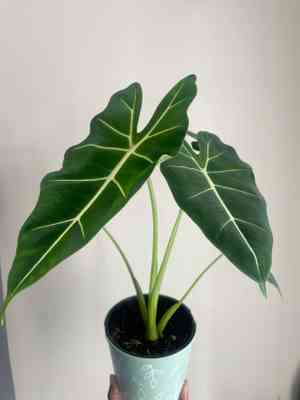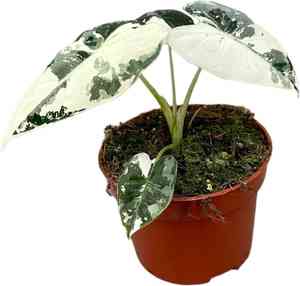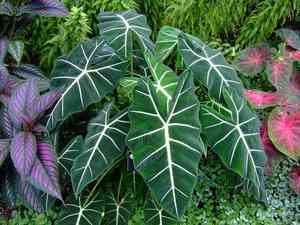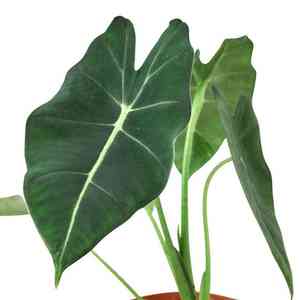
Elephant's ear(Alocasia micholitziana)

Elephant's ear (Alocasia micholitziana)

Also known as: Green Velvet, Alocasia 'Frydek'

The Alocasia micholitziana, commonly known as Elephant's Ear, is frequently grown indoors for its unique and striking leaves. These leaves are notable for their dark green hue and prominent white veins, and they can reach lengths of up to 30 cm. While this plant can produce flowers, it typically requires very humid conditions to do so and thus rarely blooms indoors.

Attributes of Elephant's ear

Lifespan
Perennial
Plant Type
Herb
Plant Height
30 cm to 91 cm
Spread
60 cm
Leaf Color
Dark green with prominent white veins
Flower Size
Small, usually less than 2 inches (5 cm) when in bloom
Flower Color
Pink Red

ForwardPlant - Identify plants with a snap

Identify and diagnose plants, get toxicity alerts, and explore safety guides for all types of fungi.

Try for Free

Images of Elephant's ear

Elephant's ear(Alocasia micholitziana)

Quickly Identify Elephant's ear

1
To identify Alocasia micholitziana, look for its distinctive arrow-shaped, velvety leaves with bold white veins and a slightly waxy texture.

Scientific Classification of Elephant's ear

Phylum
Vascular plants
Class
Monocotyledons
Order
Water plantains and allies
Family
Arum
Genus
Elephant's-ears
Species
Elephant's ear

Planting and Growing of Elephant's ear

Care Difficulty
Hard
Watering Schedule
Every 2 days
Sunlight Requirements
Partial sun
Sunshine Duration
6-10 hours
Ideal Temperature
65-80℉
Soil Type
Potting Mix, Peat Mix
Soil pH
6.5-7.5
Fertilizer Type
Balanced
Pruning Season
Spring, Summer
Pruning Area
Branches, Leaves
Pruning Frequency
2 times a year
Repotting Season
Spring
Pot Type
Plastic, Ceramic

water icon How to Water Elephant's ear?

The ideal watering is about 250 ml each time, enough to moisten the soil thoroughly but not saturate it. It is crucial to ensure that the top inch of the soil is dry before watering again. Alocasia micholitziana prefers to remain neither too soggy nor too dry.
What are the symptoms of an underwatered Elephant's ear?
What should I do if my Elephant's ear is not getting enough water?
What are the symptoms of an overwatered Elephant's ear?
How to save an overwatered Elephant's ear?
More About Watering Techniques

sunlight icon What Are the Sunlight Requirements for Elephant's ear?

Sunlight Requirements: Partial sun
Duration of light: 2 to 4 hours
Partial sun is ideal, offering a blend of shade and light resembling its native environment. Optimal lighting ensures vibrant leaf color, structural strength, and resistance to environmental stresses.
What is the ideal light for Alocasia micholitziana?
How to achieve optimal light exposure?
Benefits of ideal lighting conditions?
More About Sunlight Requirements Techniques

temperature icon What Is the Ideal Temperature Range for Elephant's ear?

Ideal Temperature: 65 ~ 80℉
The ideal temperature range for Alocasia micholitziana is between 65°F and 80°F. In this range, the plant can thrive with optimal growth and vibrant foliage. Maintaining a constant temperature within this limit helps to mimic the plant’s natural tropical habitat, thereby ensuring robust health.

soil icon What Soil is Best for Elephant's ear?

Soil type: Loam, Sandy loam, Peat soil
Soil PH: 6.5 ~ 7.5
Alocasia micholitziana thrives in well-drained soil, which prevents waterlogging and root rot. Proper drainage ensures that the plant's roots receive adequate oxygen, promoting healthy growth and reducing the risk of fungal diseases. This plant benefits from soil rich in organic matter, as it provides essential nutrients and enhances water retention. Organic matter improves soil structure, creating an ideal environment for root development and nutrient uptake. Adequate moisture retention in the soil is crucial for Alocasia micholitziana, as it requires consistent moisture levels. Soils that retain moisture well help prevent the plant from drying out between waterings, supporting lush, vibrant foliage. More About Soil

fertilize icon How to Fertilize Elephant's ear?

Fertilizer type: Balanced
Alocasia micholitziana benefits from a balanced 20-20-20 fertilizer diluted to half strength. Using too strong a concentration can lead to nutrient burn. Always ensure the soil is moist before applying any fertilizer to aid absorption and prevent root damage. More About Fertilizing Techniques

prune icon How to Prune Elephant's ear?

Pruning Time: Spring, Summer
Start by identifying any yellow or brown leaves. These leaves are no longer beneficial and can be removed by cutting them off at the base of the stem. Make clean cuts to avoid tearing which can damage healthy tissue. After removing any unsightly or dead leaves, you can trim back the plant slightly to encourage new growth. Cut just above a leaf node, which is a small bump on the stem where new leaves can sprout. This will encourage bushier growth by stimulating the plant to produce more leaves. Trim any excessively long stems or those that are growing in an undesirable direction to maintain a pleasing plant shape. Alocasia micholitziana can have a sculptural form, and regular pruning helps retain its aesthetic appearance. More About Pruning Techniques

propagate icon How to Propagate Elephant's ear plant?

Propagate Time: Spring, Early spring, Late spring
1
Begin by carefully removing the plant from its pot, taking care not to damage the roots. Gently shake off excess soil to fully reveal the root system. This allows you to easily identify natural divisions in the rhizome for separation.
2
Using a sharp knife, cut the rhizome into sections, ensuring each segment has roots and at least one growth node. This ensures that each division is capable of growing into a healthy plant.
3
Plant each division into a separate pot filled with suitable potting mix. Water lightly to settle the soil around the roots and place the pots in a warm, well-lit area to promote growth. This stage is crucial for root stabilization.
More About Propagating Techniques

repot icon How to Repot Elephant's ear plant?

Repotting frequency: Every 1-2 years
1
Repot your Alocasia micholitziana when it shows signs of being root-bound, like roots growing out of drainage holes or the plant tipping over easily. Spring and summer are ideal times for repotting, as the plant is actively growing, allowing it to recover more quickly.
2
Select a pot that is just one size larger than the current one to avoid waterlogging. Pots with good drainage are essential to prevent root rot. A slightly heavy pot may help balance the plant's large leaves and prevent tipping.
3
Opt for a well-draining, chunky mix containing components like perlite, orchid bark, and peat. This ensures excess water drains well, while also providing the roots with adequate aeration and preventing rot.

ForwardPlant - Identify plants with a snap

Find the best spots for them to optimize their health, simply using your phone.

Try for Free

Toxicity of Elephant's ear

Is Elephant's ear toxic to humans?

Elephant's ear presents a mild toxicity hazard to humans when ingested. This entire plant contains calcium oxalate, which is the source of its toxic characteristics. Consumption of any portion of elephant's ear can provoke a variety of symptoms. People may suffer from severe irritation in the mouth and throat, often accompanied by a burning sensation. Swelling of the tongue, lips, and upper airway may also occur, possibly causing breathing difficulties. Furthermore, ingestion may lead to gastrointestinal disturbances, such as nausea, vomiting, and diarrhea. It is vital for individuals, particularly those with children or pets, to acknowledge the potential dangers and to prevent any accidental consumption of elephant's ear.

Is Elephant's ear toxic to cat?

The Elephant's ear plant presents a mild toxicity hazard to felines. Should a cat accidentally consume any part of the plant, it might experience various physical discomforts. This plant encompasses toxic components, and ingestion can lead to symptoms of oral irritation in cats, such as excessive drooling, pawing at their mouths, or experiencing swallowing difficulties. Elephant's ear is recognized for containing calcium oxalate crystals, responsible for these adverse reactions. It’s imperative to seek immediate veterinary care if a cat has ingested or made contact with any portion of the Elephant's ear plant. Swift intervention is vital to alleviate the impact of the toxins and to safeguard the health of the affected cat.

Is Elephant's ear toxic to dog?

Elephant's ear presents a mild toxicity threat to dogs. Dogs might unintentionally ingest parts of the elephant's ear, which can lead to poisoning. The whole plant contains toxic properties, and consumption may cause symptoms such as irritation in the mouth, excessive drooling, vomiting, and trouble swallowing due to calcium oxalate crystals. Should a dog show any signs of discomfort after being in contact with elephant's ear, it is crucial to obtain prompt veterinary attention.

Identify toxic plants for your safety

Learn which plants are harmful to you and your pets, and make informed choices for a safer home!

Try for Free
WARNING
The judgment on toxicity and danger is for reference only. We DO NOT GUARANTEE any accuracy of such judgment. Therefore, you SHALL NOT rely on such judgment. It is IMPORTANT TO SEEK PROFESSIONAL ADVICE in advance when necessary.
More About Toxic Techniques