Garlic(Allium sativum)

Garlic (Allium sativum)

Also known as: Common garlic, Churl's treacle

Garlic (Allium sativum) is a widely cherished plant, celebrated for its culinary versatility and simple cultivation requirements. Typically sown in autumn and gathered by mid-summer, garlic is affectionately dubbed the "stinking rose" and serves a dual purpose as a natural insect deterrent in gardens.

Culturally, garlic holds a special place in various traditions. In Korean folklore, it plays a pivotal role in creation myths. Meanwhile, in European legends, garlic is famed for its ability to repel vampires and other malevolent spirits, reflecting its deep-rooted significance in protective customs.

Attributes of Garlic

Lifespan
Perennial, Annual
Plant Type
Herb
Plant Height
1 m
Spread
23 cm to 30 cm
Leaf Color
Green
Flower Size
0.3-0.6 cm
Flower Color
White Pink

ForwardPlant - Identify plants with a snap

Identify and diagnose plants, get toxicity alerts, and explore safety guides for all types of fungi.

Try for Free

Images of Garlic

Garlic(Allium sativum)

Quickly Identify Garlic

1
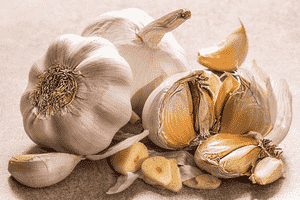
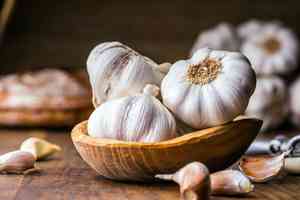
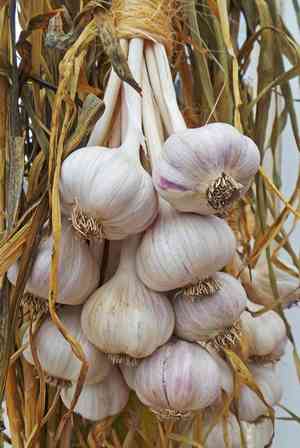
Segmented bulbs with cloves enclosed in papery sheaths, forming a spherical structure (2-4 inches / 5-10 cm).
2
Umbel inflorescence with small white or pinkish flowers protected by a membranous spathe (2-4 inches / 5-10 cm).
3
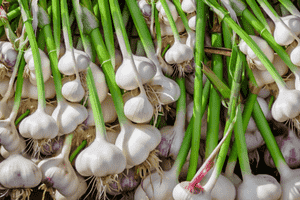
Linear-lanceolate leaves with parallel venation, bright green color, measuring 1 inch wide and 8-16 inches long.
4
Short, flattened stem forming a disk at the base, surrounded by a pseudostem from overlapping leaf bases.
5
Capsule fruit perched atop flowering stalk, changing texture and color at maturity, splitting open when ripe.

Scientific Classification of Garlic

Phylum
Vascular plants
Class
Monocotyledons
Order
Asparagus and allies
Family
Amaryllis
Genus
Onions
Species
Garlic

Planting and Growing of Garlic

Care Difficulty
Easy
Watering Schedule
Every 2 days
Sunlight Requirements
Full sun
Sunshine Duration
4-8 hours
Ideal Temperature
60-70℉
Soil Type
Potting Mix, Peat Mix
Soil pH
6.5-7.5
Fertilizer Type
Balanced
Pruning Season
Spring, Summer
Pruning Area
Branches, Leaves
Pruning Frequency
2 times a year
Repotting Season
Spring
Pot Type
Terracotta, Plastic

water icon How to Water Garlic?

For Allium sativum, also known as garlic, an appropriate watering amount is around 500 milliliters per session. The goal is to provide enough moisture to reach about 15-20 centimeters beneath the surface. This ensures the roots can adequately absorb the water without over-saturating, as soggy soil can lead to root rot.
What are the symptoms of an underwatered Garlic?
What should I do if my Garlic is not getting enough water?
What are the symptoms of an overwatered Garlic?
How to save an overwatered Garlic?
More About Watering Techniques

sunlight icon What Are the Sunlight Requirements for Garlic?

Sunlight Requirements: Full sun
Duration of light: 8-10 hours
Allium sativum requires full sun, ideally receiving 8-10 hours of direct sunlight per day. This ensures robust growth and the best possible yield of flavorful and well-sized garlic bulbs.
What is the best lighting condition for Allium sativum?
How can I ensure Allium sativum receives ideal sunlight?
What benefits does Allium sativum gain from ideal sunlight exposure?
More About Sunlight Requirements Techniques

temperature icon What Is the Ideal Temperature Range for Garlic?

Ideal Temperature: 60 ~ 70℉
The ideal temperature range for growing Allium sativum (garlic) is between 60°F and 70°F. This range provides optimal conditions for bulb development and growth. Consistent temperatures within this range can maximize yield and ensure uniform quality.

soil icon What Soil is Best for Garlic?

Soil type: Sandy loam, Loam
Soil PH: 6.5 ~ 7.5
Garlic thrives in soil that drains well, preventing water from pooling around the roots. Waterlogged conditions can lead to bulb rot, ultimately undermining the plant's growth. Ensuring proper drainage maintains healthy garlic with robust and flavorful bulbs. Garlic benefits from soil enriched with organic matter, which provides essential nutrients for bulb development. A rich nutrient composition supports the plant's vigor, leading to larger, tastier bulbs. Regular addition of compost or organic fertilizers enhances soil fertility. Garlic requires loose soil that facilitates unrestricted root expansion and bulb formation. Compacted soil hinders growth, resulting in smaller bulbs. Maintaining a loose soil texture through regular tilling is beneficial for promoting healthy root and bulb development. More About Soil

fertilize icon How to Fertilize Garlic?

Fertilizer type: Balanced
For Allium sativum, it is essential to use a balanced fertilizer with a nutrient ratio, such as 10-10-10. During the initial growth stages, apply approximately 10 grams per square meter to promote root development. Adjust amounts as needed during different growth phases.

prune icon How to Prune Garlic?

Pruning Time: Spring, Summer
When the garlic plant starts developing a curly flower stalk known as a scape, it signals that it is time to prune. Use sharp scissors or pruning shears to cleanly cut the scape about an inch above the top leaf. Doing this redirects the plant's energy downward to develop the bulb rather than the flower. More About Pruning Techniques

propagate icon How to Propagate Garlic plant?

Propagate Time: Autumn, Early spring
1
Select healthy, disease-free garlic bulbs that are firm and large for division. These characteristics indicate vigorous growth potential and enhance propagation success.
2
Ensure the soil is well-drained and rich in organic matter. Amend the soil with compost to improve its structure and nutrient content, creating an ideal environment for garlic propagation.
3
Gently separate the cloves from a mature garlic bulb using your hands or a knife. Ensure that each clove remains intact with a portion of the basal plate to encourage root development.
More About Propagating Techniques

repot icon How to Repot Garlic plant?

Repotting frequency: Every 1-2 years
1
Freshly planting or dividing Allium sativum often takes place every spring or autumn as this is when growth is either commencing or concluding. An ideal sign that it's time to repot garlic is when its roots begin to outgrow the current pot, appearing through the drainage holes, indicating its need for more space.
2
Choose a pot with adequate depth and drainage, usually 10-12 inches deep, to compensate for the bulb's vertical growth. This depth supports ample root development, ensuring steady and robust garlic growth. Preferably, clay or ceramic pots are beneficial as they offer breathability, reducing risks related to water stagnation.
3
Select nutrient-rich loamy soil that drains well but retains ample moisture to nourish Allium sativum effectively. Incorporating organic matter, like compost, can optimize soil fertility and water retention. This blend prevents waterlogging, a common adversary to garlic bulbs, encouraging healthy growth.

ForwardPlant - Identify plants with a snap

Find the best spots for them to optimize their health, simply using your phone.

Try for Free

Toxicity of Garlic

Is Garlic toxic to cat?

While garlic (Allium sativum) is a delightful addition to human cuisine, its high concentration of sulfur compounds can be extremely harmful to cats. Signs of garlic ingestion (which may include weakness, disorientation, dark urine, pale gums, and vomiting or diarrhea) might not manifest right away. Therefore, if you believe your cat has ingested garlic, it is crucial to consult your veterinarian without delay; prompt medical intervention may be required in severe instances.

Is Garlic toxic to dog?

Garlic poses a moderate level of toxicity to dogs. The bulb, which is the section most commonly used in culinary preparations, contains the highest concentration of toxins. Frequently, dogs may consume it inadvertently when offered human food remnants as table scraps. Signs of garlic toxicity in dogs manifest as vomiting, anemia, increased heart rate, and lethargy. Though rare, more severe reactions such as coma or death can occur. Typically, dogs ingest it in amounts that result in mild illness.

Identify toxic plants for your safety

Learn which plants are harmful to you and your pets, and make informed choices for a safer home!

Try for Free
WARNING
The judgment on toxicity and danger is for reference only. We DO NOT GUARANTEE any accuracy of such judgment. Therefore, you SHALL NOT rely on such judgment. It is IMPORTANT TO SEEK PROFESSIONAL ADVICE in advance when necessary.
More About Toxic Techniques