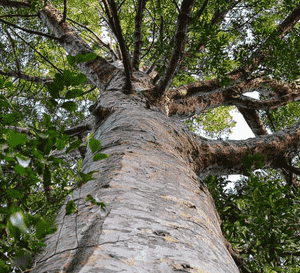
Smooth-barked kauri (Agathis robusta)
Also known as: Queensland kauri
Smooth-barked kauri (Agathis robusta) hails from Queensland, Australia. As it matures, it loses its lower branches, resulting in a smooth, straight trunk that is excellent for timber production. The tree's bark produces a hard resin called dammar, which is used for caulking boats, as an adhesive, and in ink formulations.
In This Article
Attributes of Smooth-barked kauri
Lifespan
Perennial
Plant Type
Tree
Plant Height
30 m to 50 m
Spread
4.5 m to 9 m
Leaf Color
Green
Flower Size
7 mm to 9 mm
Flower Color
White Pink Cream Purple
Images of Smooth-barked kauri


Quickly Identify Smooth-barked kauri
1
Straight trunk with light grey-brown, flaking bark
2
Leathery elliptic leaves, 3-4 inches (7.5-10 cm) long
3
Oppositely or spirally arranged leaves
4
Separate male and female cones on same plant
5
Female cones transition from green to brown, 4-6 inches (10-15 cm) tall
Scientific Classification of Smooth-barked kauri
Phylum
Vascular plants
Class
Conifers
Order
Pinales
Family
Araucaria
Genus
Kauri
Species
Smooth-barked kauri
Planting and Growing of Smooth-barked kauri
Care Difficulty
Moderate
Watering Schedule
Every 2 days
Sunlight Requirements
Full sun
Sunshine Duration
4-8 hours
Ideal Temperature
65-77℉
Soil Type
Potting Mix, Peat Mix
Soil pH
5.5-6.5
Fertilizer Type
Balanced
Pruning Season
Spring, Summer
Pruning Area
Branches, Leaves
Pruning Frequency
2 times a year
Repotting Season
Spring
Pot Type
Plastic, Ceramic
 How to Water Smooth-barked kauri?
Agathis robusta, commonly known as the Queensland Kauri, thrives on a watering principle that maintains consistency but avoids waterlogging. When watering, ensure the soil is moist but not soggy, allowing the first few inches of soil to dry out before the next watering. Aim for a deep soak that reaches the roots, approximately 500ml per session.
What are the symptoms of an underwatered Smooth-barked kauri?
›
What should I do if my Smooth-barked kauri is not getting enough water?
›
What are the symptoms of an overwatered Smooth-barked kauri?
›
How to save an overwatered Smooth-barked kauri?
›
 What Are the Sunlight Requirements for Smooth-barked kauri?
The ideal light for Agathis robusta is partial to full sun, with benefits including improved growth, vibrant foliage, and improved resilience. The plant flourishes under balanced light conditions that mimic its natural tropical environment.
More About Sunlight Requirements Techniques→
What is Agathis robusta's ideal light condition?
›
How to achieve ideal lighting conditions for Agathis robusta?
›
What benefits does ideal lighting provide to Agathis robusta?
›
 What Is the Ideal Temperature Range for Smooth-barked kauri?
Agathis robusta thrives best in temperatures ranging from 65°F to 77°F. Maintaining this range ensures optimal growth and health, as the plant is adapted to thrive in moderate climates. This temperature range supports physiological processes, including photosynthesis, water uptake, and nutrient assimilation, ensuring robust development. It is crucial to minimize fluctuations within this range to prevent stress and maintain a stable growth environment.
 What Soil is Best for Smooth-barked kauri?
Agathis robusta thrives in well-drained soil to prevent root rot. Ensuring proper drainage helps maintain healthy roots, facilitating the plant’s growth and stability. Nutrient-rich soil is crucial for the robust growth of Agathis robusta, providing essential nutrients that bolster its development and resilience against environmental stressors. Moderate moisture retention in the soil helps maintain an optimal hydration level for Agathis robusta without risking waterlogging, promoting healthy and balanced growth.
 How to Fertilize Smooth-barked kauri?
For Agathis robusta, fertilizer application should be made cautiously. Use approximately 100 grams of a balanced slow-release granular fertilizer per square meter once every six months. Liquid fertilizers should be diluted to half-strength and applied with care to avoid nutrient burn.
 How to Prune Smooth-barked kauri?
For pruning Agathis robusta, it’s essential to use sharp and clean pruning shears or a handsaw. Sharp tools make clean cuts that heal faster and the cleanliness prevents the spread of disease. Ensure your tools are suitable for the thickness of the branches you plan to prune. Begin by removing any dead, diseased, or broken branches, cutting back to healthy wood. Use the 'three-cut method' for larger branches to avoid tearing the bark. This method involves an undercut, followed by a top cut a bit further out, and then removing the stub cleanly. When shaping your Agathis robusta, aim for an open crown to improve air circulation and light penetration. Prune selectively, maintaining the natural form of the tree while removing any crossing or inward-growing branches that could impede airflow or sunlight.
More About Pruning Techniques→
 How to Propagate Smooth-barked kauri plant?
1
Collect seeds from mature Agathis robusta cones. It's important to ensure the seeds are ripe and free from any diseases or pest damage. Clean the seeds adequately to remove any external residues.
2
Fill the seed tray with a sterile potting mix and create small depressions for each seed. Place the seeds in the depressions and cover them lightly with potting mix. Water gently to settle the mix.
3
Place the seed tray in a warm location with indirect sunlight. Maintain a consistent temperature of around 25°C (77°F) and ensure the soil remains moist but not waterlogged.
 How to Repot Smooth-barked kauri plant?
1
Watch for roots emerging from drainage holes or a slowed growth rate. These are good indicators that your Agathis robusta needs more space. Ideally, repotting should be done when the plant is actively growing in spring or summer. Avoid repotting during dormancy, as this might stress the plant.
2
Select a pot that is one size larger than the current one, with ample drainage holes. A slightly larger pot ensures that the roots have room to grow without overwhelming the plant with too much soil, which can lead to water retention and root rot.
3
Opt for a well-draining potting mix that retains enough moisture without becoming waterlogged. Such soils usually contain a mix of organic matter and minerals like perlite. This ensures your plant retains moisture while allowing excess water to drain, thus preventing root rot.



