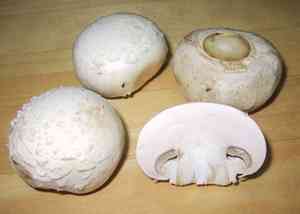
Button mushroom (Agaricus bisporus)
Also known as: Portobello mushroom, Common mushroom, Champignon mushroom, Chestnut mushroom
In US supermarkets, the majority of mushrooms available are cultivated varieties of the button mushroom species. The white versions are commonly labeled as "white button mushrooms," the brown ones are marketed as "cremini" or "baby bellas," and when fully mature, they are known as "portobellos." These mushrooms are rarely found in the wild and primarily thrive in grassy areas across the Northern Hemisphere.
In This Article
Attributes of Button mushroom
Lifespan
Annual
Plant Type
Mushroom
Plant Height
3 inches
Spread
5 inches
Leaf Color
N/A
Flower Size
N/A
Flower Color
N/A
Quickly Identify Button mushroom
1
Identify Agaricus bisporus by its smooth, rounded cap, which can be white or brown, and its densely packed gills that turn from pink to brown with age. The stem is firm and has a ring of tissue near the top.
Scientific Classification of Button mushroom
Phylum
Club fungi
Class
Mushroom-forming fungi
Order
Gilled fungi
Family
Agaricaceae
Genus
Agaricus
Species
Button mushroom
Planting and Growing of Button mushroom
Care Difficulty
Easy
Watering Schedule
Every 2 days
Sunlight Requirements
Full shade
Sunshine Duration
6-10 hours
Ideal Temperature
53-60℉
Soil Type
Potting Mix, Peat Mix
Soil pH
6.5-7.5
Fertilizer Type
Balanced
Pruning Season
Spring, Summer
Pruning Area
Branches, Leaves
Pruning Frequency
2 times a year
Repotting Season
Spring
Pot Type
Plastic, Ceramic
 How to Water Button mushroom?
Water Agaricus bisporus with about 500 ml of water per session. The key is to ensure the soil remains damp but not waterlogged. Mushroom cultivation thrives on maintaining moisture without causing root rotting. The principle is to retain a rich, humid environment while allowing some natural evaporation, keeping the substrate just moist enough for optimum growth.
What are the symptoms of an underwatered Button mushroom?
›
What should I do if my Button mushroom is not getting enough water?
›
What are the symptoms of an overwatered Button mushroom?
›
How to save an overwatered Button mushroom?
›
 What Are the Sunlight Requirements for Button mushroom?
The ideal light range for Agaricus bisporus is complete shade. This prevents stress from direct beams, and maintains optimal moisture and growth conditions for thriving mushrooms.
What are the best lighting conditions for Agaricus bisporus?
›
How can I ensure my Agaricus bisporus gets the right amount of light?
›
What are the benefits of providing ideal lighting for Agaricus bisporus?
›
 What Is the Ideal Temperature Range for Button mushroom?
Agaricus bisporus, commonly known as the button mushroom, thrives best within a temperature range of 53°F to 60°F. This range ensures optimal growth conditions, encouraging the substrate to maintain appropriate moisture while preventing harmful pathogens.
 What Soil is Best for Button mushroom?
Agaricus bisporus thrives in well-nourished soil, which provides essential nutrients for growth and development. Maintaining a balance of nitrogen, phosphorus, and potassium ensures strong mushroom yield and health. This plant needs soil that can retain moisture without excessive water logging. Loamy soil helps maintain optimal moisture balance, crucial for mushroom cultivation, preventing dehydration. Proper soil aeration is essential for Agaricus bisporus as it enhances oxygen availability, promoting healthy development. Aerated soil supports cellular respiration and growth efficiency.
 How to Fertilize Button mushroom?
For Agaricus bisporus, careful consideration of fertilization is essential. Using balanced fertilizers with a nitrogen-phosphorus-potassium (N-P-K) ratio like 10-10-10 can be beneficial. Apply liquid fertilizer at a quarter strength to avoid over-fertilizing. When using slow-release fertilizers, adhere closely to package instructions, ensuring not to exceed 1 pound per 100 square feet for solid application. This ensures mushrooms receive necessary nutrients without risk of toxicity.
 How to Prune Button mushroom?
To prune Agaricus bisporus effectively, focus on the mature mushrooms that are ready for harvest. Gently twist and pull the mushroom at its base, ensuring you do not damage the mycelium network. After removal, clear any remaining debris or stubs to promote healthy regrowth and to prevent mold or bacteria from establishing in leftover organic matter. This thoughtful pruning during harvest maximizes both yield and the subsequent growth cycles.
 How to Propagate Button mushroom plant?
1
Begin by preparing the culture medium using potato dextrose agar (PDA) as a nutrient-rich base. Sterilize the medium in an autoclave to remove contaminants, ensuring a clean and fertile environment for mycelial growth.
2
Under a laminar flow hood, inoculate the PDA medium with a sterile tool, introducing spores or a small piece of healthy mycelium from a pure culture. Keep the environment sterile to prevent contamination.
3
Place the inoculated dishes in a controlled environment with the temperature set between 20-25°C. Maintain high humidity levels and indirect light to encourage robust mycelial growth over several weeks.
 How to Repot Button mushroom plant?
1
Look for signs that your Agaricus bisporus needs repotting such as roots growing out of the drainage holes, slow growth, or yellowing leaves. These indicators suggest that the plant needs more space or fresh nutrients in its potting mix.
2
Select a pot that is slightly larger than the current one, with adequate drainage holes to prevent water-logging. The right pot size allows the roots to expand and supports better aeration, promoting healthy growth and preventing root rot.
3
Choose fertile, well-draining compost to encourage healthy growth. This type of soil provides necessary nutrients and ensures proper moisture retention, preventing waterlogging and facilitating the overall health of your Agaricus bisporus.

