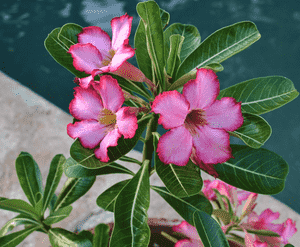
Desert rose(Adenium obesum)

Desert rose (Adenium obesum)

Also known as: Impala lily, Mock azalea

The desert rose, known for its striking flowers, is often grown as a houseplant or bonsai. Native to the Sahara, tropical Africa, and Arabia, this succulent needs at least 50°F (10°C) to stay healthy. Interestingly, its sap was historically used to poison arrows in Africa.

Attributes of Desert rose

Lifespan
Perennial
Plant Type
Succulent, Shrub
Plant Height
1 m to 3 m
Spread
90 cm to 1.5 m
Leaf Color
Green Gray
Flower Size
4 cm to 6 cm
Flower Color
Pink Red White

PlantJoy - Identify plants with a snap

Identify and diagnose plants, get toxicity alerts, and explore safety guides for all types of fungi.

Try for Free

Images of Desert rose

Desert rose(Adenium obesum)

Quickly Identify Desert rose

1
Fleshy, glossy, dark green leaves in a spiraling arrangement, 2-4 inches (5-10 cm) long.
2
Smooth, thick, swollen stems with gray-green color, reaching up to 3 feet (90 cm).
3
Showy, tubular flowers, 2 inches (5 cm) across, pink to red in color.
4
Bell-shaped blooms with white throat, five petals, and protruding stamens.
5
Twin elongated follicles with brown-grey hue, hairy texture, and small oblong seeds.

Scientific Classification of Desert rose

Phylum
Vascular plants
Class
Dicotyledons
Order
Gentianales
Family
Dogbane
Genus
Adenium
Species
Desert rose

Planting and Growing of Desert rose

Care Difficulty
Easy
Watering Schedule
Every 2 days
Sunlight Requirements
Full sun
Sunshine Duration
4-6 hours
Ideal Temperature
68-86℉
Soil Type
Potting Mix, Peat Mix
Soil pH
6.5-7.5
Fertilizer Type
Balanced
Pruning Season
Spring, Summer
Pruning Area
Branches, Leaves
Pruning Frequency
2 times a year
Repotting Season
Spring
Pot Type
Plastic, Ceramic

water icon How to Water Desert rose?

Adenium obesum, also known as the Desert Rose, requires careful watering. The key is to mimic its natural arid habitat. Water thoroughly, ensuring that excess water drains out completely, but allow the soil to dry out fully between each watering session. This approach prevents root rot and encourages healthy growth. Aim for about 250 milliliters per watering session to keep the plant happy and healthy.
What are the symptoms of an underwatered Desert rose?
What should I do if my Desert rose is not getting enough water?
What are the symptoms of an overwatered Desert rose?
How to save an overwatered Desert rose?
More About Watering Techniques

sunlight icon What Are the Sunlight Requirements for Desert rose?

Sunlight Requirements: Full sun
Duration of light: 6-8 hours daily
Adenium obesum thrives in full sun, receiving 6-8 hours daily. Ideal sunlight promotes vigorous growth, rich foliage, and abundant flowering.
How much direct sunlight does Adenium obesum need?
What happens if Adenium obesum does not receive enough sunlight?
How can I ensure Adenium obesum gets the ideal light?
More About Sunlight Requirements Techniques

temperature icon What Is the Ideal Temperature Range for Desert rose?

Ideal Temperature: 68 ~ 86℉
Adenium obesum thrives best in temperatures ranging from 68°F to 86°F. This range provides an optimal environment for photosynthesis and growth. Adenium prefers warm weather, similar to its native habitat, ensuring robust flowering and health. Maintaining these conditions helps reduce stress on the plant, promoting longevity and vibrancy.

soil icon What Soil is Best for Desert rose?

Soil type: Sandy soil, Loam, Sandy loam
Soil PH: 6.5 ~ 7.5
Adenium obesum, known as the desert rose, thrives in well-draining soil. This is crucial to prevent root rot. The roots enjoy moisture but can't sit in water, making sandy soil optimal for healthy growth. While Adenium obesum enjoys sandy soil, it still requires nutrients for vibrant blooms. Incorporating organic matter like compost benefits the plant by supplying essential nutrients, boosting its overall growth. The root system of Adenium obesum requires aeration for optimal growth. Sandy loam provides the perfect balance of air circulation and root support, which helps the plant stay healthy and robust. More About Soil

fertilize icon How to Fertilize Desert rose?

Fertilizer type: Balanced
When it comes to fertilizing Adenium obesum, less is often more. Apply liquid fertilizer at half the recommended strength on the package instructions to prevent over-fertilization. This plant is efficient at utilizing nutrients, so a balanced fertilizer with an N-P-K ratio of 10-10-10 is typically suitable. For slow-release fertilizers, make sure to evenly distribute small quantities on the soil to avoid concentrated nutrient pockets.

prune icon How to Prune Desert rose?

Pruning Time: Spring, Summer
Begin by examining the plant to identify any dead, diseased, or leggy branches. These are your primary targets for pruning, as removing them will contribute to a healthier plant. Focus on shaping the plant to your desired form. Begin trimming down long, unbalanced branches, making diagonal cuts about half an inch above a node or fork to encourage new growth. To promote bushier growth, pinch or trim the tips of branches. This will encourage branching and result in a fuller canopy, which can enhance flowering during the blooming seasons.

propagate icon How to Propagate Desert rose plant?

Propagate Time: Early spring, Late spring, Summer
1
For seed propagation, start by soaking Adenium obesum seeds in warm water for 24 hours to soften the outer shell. This step aids in quicker germination by allowing water to penetrate the seed more effectively.
2
Select healthy branches for cuttings, making a clean cut at a 45-degree angle to maximize surface area for rooting. Let the cut ends dry for a day to form calluses, reducing rot risk.
3
Grafting involves securing a branch from a mature plant onto a rootstock. Ensure both graft and stock are of similar thickness. Use grafting tape to bind them firmly until they heal together.
More About Propagating Techniques

repot icon How to Repot Desert rose plant?

Repotting frequency: Every 2-3 years
1
Adenium obesum should be repotted when you notice signs like roots creeping out of the drainage holes, soil drying out too quickly, or the plant becoming top-heavy. Ideally, do this during its active growing season for optimal recovery.
2
Select a pot that offers good drainage holes and is just slightly larger than the current pot. A terracotta pot is ideal as it allows air exchange and helps prevent overwatering, an important factor for maintaining healthy Adenium roots.
3
Choose a well-draining cactus mix that allows water to quickly pass through without retaining moisture. This kind of soil mimics the Adenium's natural desert environment, reducing the risk of root rot.
More About Repotting Techniques

PlantJoy - Identify plants with a snap

Find the best spots for them to optimize their health, simply using your phone.

Try for Free

Toxicity of Desert rose

Is Desert rose toxic to humans?

The desert rose is commonly cultivated as a perennial ornamental plant and poses significant toxicity risks to humans, cats, dogs, horses, and various other animals. Although slight exposure may lead to symptoms such as skin irritation, vomiting, and diarrhea, severe cases can provoke seizures, dilated pupils, and ultimately, death.

Is Desert rose toxic to cat?

Desert rose (Adenium obesum) poses a significant toxicity risk to cats due to its sap, which harbors lethal compounds that disrupt heart and brain activity. A mere momentary lick of its leaves or stem can trigger immediate poisoning, with fatalities often occurring as the glycosides impair the central nervous system. It is crucial to seek veterinary assistance immediately.

Is Desert rose toxic to dog?

The desert rose can pose mild to severe toxicity risks for dogs, contingent on the quantity ingested. The plant's sap, which is present in all parts of the plant, harbors toxic compounds known as glycosides. Ingesting the plant can lead to symptoms such as gastrointestinal distress, lethargy, abnormal heart rhythms, and potentially fatal consequences. Additionally, contact with the plant may result in skin irritation.

Identify toxic plants for your safety

Learn which plants are harmful to you and your pets, and make informed choices for a safer home!

Try for Free
WARNING
The judgment on toxicity and danger is for reference only. We DO NOT GUARANTEE any accuracy of such judgment. Therefore, you SHALL NOT rely on such judgment. It is IMPORTANT TO SEEK PROFESSIONAL ADVICE in advance when necessary.
More About Toxic Techniques

