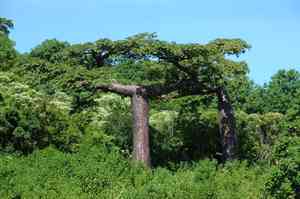
Suarez baobab (Adansonia suarezensis)
Also known as: Suarez baobab, Madagascar baobab
The Suarez baobab is a rare deciduous tree notable for its bulbous, bottle-like trunk, which acts as a reservoir, storing water to endure dry spells. In dry, deciduous forests, this tree sheds its large, finger-like leaves during droughts to minimize water loss. Its unique, night-blooming white flowers attract nocturnal pollinators, aiding in reproduction. These features underscore the Suarez baobab's exceptional ability to adapt and thrive in arid environments, making it a symbol of resilience.
In This Article
Attributes of Suarez baobab
Lifespan
Perennial
Plant Type
Tree
Plant Height
10 to 30 meters
Spread
5 to 10 meters
Leaf Color
Green
Flower Size
Up to 20 cm
Flower Color
White
Images of Suarez baobab
Quickly Identify Suarez baobab
1
Adansonia suarezensis can be identified by its massive, swollen trunk that tapers upwards, small leaves that are compound and palmate, and large white flowers that appear during the dry season.
Scientific Classification of Suarez baobab
Phylum
Vascular plants
Class
Dicotyledons
Order
Mallows, rock-roses, and allies
Family
Mallow
Genus
Baobabs
Species
Suarez baobab
Planting and Growing of Suarez baobab
Care Difficulty
Hard
Watering Schedule
Every day
Sunlight Requirements
Full sun
Sunshine Duration
4-8 hours
Ideal Temperature
68-86℉
Soil Type
Potting Mix, Peat Mix
Soil pH
6.5-7.5
Fertilizer Type
Balanced
Pruning Season
Spring, Summer
Pruning Area
Branches, Leaves
Pruning Frequency
2 times a year
Repotting Season
Spring
Pot Type
Plastic, Ceramic
 How to Water Suarez baobab?
Adansonia suarezensis, commonly known as the Suarez baobab, requires a measured watering approach. Typically, each watering should involve around 500 ml of water, enough to moisten the soil without creating waterlogging. The key is to ensure the soil is thoroughly drenched but has an excellent drainage system to avoid root rot.
What are the symptoms of an underwatered Suarez baobab?
›
What should I do if my Suarez baobab is not getting enough water?
›
What are the symptoms of an overwatered Suarez baobab?
›
How to save an overwatered Suarez baobab?
›
 What Are the Sunlight Requirements for Suarez baobab?
Full sun exposure is ideal, promoting healthy, strong growth. Continuous access to direct sunlight enables the plant to maximize its photosynthetic potential, which is crucial for thriving in its native environment.
Optimal Light Levels
›
Direct Sunlight Solutions
›
Benefits of Ideal Lighting
›
 What Is the Ideal Temperature Range for Suarez baobab?
The ideal temperature range for Adansonia suarezensis is between 68°F and 86°F. This range ensures optimal metabolic and photosynthetic activity, promoting healthy growth and development. Consistent temperatures within this range support natural cycles of growth, flowering, and fruiting, ensuring the plant remains robust.
 What Soil is Best for Suarez baobab?
Adansonia suarezensis thrives in well-drained soil, which prevents root rot by allowing excess water to flow away efficiently. This condition is crucial as it mimics its native habitat, ensuring that the plant gets sufficient oxygen at the roots, promoting healthy growth. This species requires nutrient-rich soil that supports its extensive growth pattern. Such soil provides essential minerals necessary for the development of its massive trunk and canopy, enhancing photosynthesis and overall vitality. While nutrient-rich soil is ideal, Adansonia suarezensis does not demand overly fertile conditions. Moderate fertility is beneficial as it strikes a balance, preventing excessive leaf growth that can detract from the tree's iconic, sturdy form.
 How to Fertilize Suarez baobab?
Adansonia suarezensis typically requires a moderate amount of fertilizer. Use a balanced fertilizer with an N-P-K ratio of 10-10-10 or 20-20-20. Apply liquid fertilizer at a rate of 1 gallon per square foot, ensuring even distribution around the root zone. For slow-release fertilizer, apply approximately 2 pounds per plant, taking care to spread it evenly over the soil surface.
 How to Prune Suarez baobab?
Begin by inspecting the tree to identify dead, diseased, or damaged branches. Use sharp and clean pruning shears to cut these branches close to the trunk. Additionally, thin out any overcrowded areas by selectively removing branches to improve airflow and light. Always make cuts at a slight angle, ideally just above a node or bud to encourage healthy growth.
More About Pruning Techniques→
 How to Propagate Suarez baobab plant?
1
Before planting, soak Adansonia suarezensis seeds in warm water for 24 hours. This process helps to soften their hard seed coat, improving the chances of successful germination.
2
Use a well-draining potting mix that can retain some moisture but also allows excess water to escape. A mix of sand, peat moss, and perlite typically works well, providing the right conditions for the seeds to sprout.
3
Plant the seeds in the growing medium at a depth two times their size. Lightly cover them with soil and water gently. Providing a consistently moist environment is important for the seeds to start germinating.
 How to Repot Suarez baobab plant?
1
It's time to repot Adansonia suarezensis when you notice roots poking out of the drainage holes, the soil is compacted and barely absorbs water anymore, or if the plant seems stunted despite proper care. These signs indicate that the plant needs more space for healthy root growth.
2
Select a pot slightly larger than the current one with adequate drainage holes to prevent waterlogging. The new pot should allow about an inch or two of extra space for the roots to spread. This prevents root rot and ensures optimal growth conditions by accommodating future root expansion.
3
Choose a well-draining cactus mix with a blend of sand, perlite, and organic matter. Such a mix mimics the plant's natural habitat, ensuring proper aeration and moisture management. The well-draining soil prevents root rot and allows room for root expansion and nutrient absorption.
Learn More About Suarez baobab Diseases
Anthracnose
Bacterial Leaf Spot
Bacterial Soft Rot
Bacterial Wilt
Black Spot
Chemical Injury
Crown Gall
Damping-off
Drought Stress
Fusarium Wilt
Gray Mold
Leaf Spot
Mosaic
Nutrient Deficiency
Nutrient Toxicity
Powdery Mildew
Root Rot
Root-knot Nematode
Sooty Mold
Spider Mites
Temperature Stress
Thrips Damage
White Mold



