Manchurian fir(Abies holophylla)

Manchurian fir (Abies holophylla)

Also known as: Manchurian Fir, Needle Fir

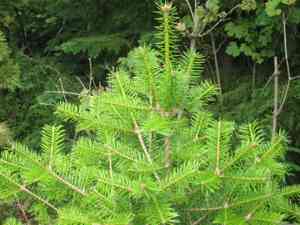
Abies holophylla, also known as needle fir or Manchurian fir, is an evergreen conifer native to the mountainous regions of northern Korea, southern Ussuriland, and northeastern China, specifically in the provinces of Heilongjiang, Jilin, and Liaoning. This species typically reaches heights of up to 30 meters (100 feet) with a trunk diameter of around 1 meter (3 feet), forming a narrowly conical crown with horizontally spreading branches.

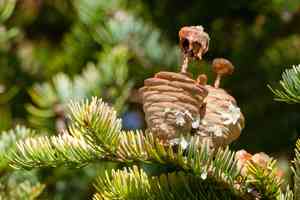
The bark of the needle fir is gray-brown and scaly, featuring resin blisters. Its needles are flattened and measure 2–4 cm (¾–1½ inches) in length and 1.5–2.5 mm (1/16–1/8 inch) in thickness. The needles are arranged at right angles to the shoot and end in a pointed tip, forming a V-shape with the shoot. Unlike the silver fir, the needles of Abies holophylla are sharp and prickly without any indentation at the top. They are bright green on the upper surface and whitish-green on the underside, with two whitish strips created by 7–10 wax-covered stomatal bands.

Young shoots of this species are glabrous and shiny yellow-gray, turning gray-brown as they mature. The seed cones are cylindrical, measuring 12–14 cm (4¾–5½ inches) in length and 4–5 cm (1¾–2 inches) in width, with a yellow-brown color and a bluntly rounded apex. The scale bracts of the cones are hidden under the cone scales. Seeds are 8–9 mm (5/16–3/8 inch) long, with a wing measuring approximately 1.5 cm (5/8 inch) that aids in dispersal when the cones disintegrate in the fall.

While not commonly used, Manchurian fir can serve as an ornamental plant in suitable climates.

Attributes of Manchurian fir

Lifespan
Perennial
Plant Type
Tree
Plant Height
40 m
Spread
5 m
Leaf Color
Green
Flower Size
4 cm to 5 cm
Flower Color
N/A

ForwardPlant - Identify plants with a snap

Identify and diagnose plants, get toxicity alerts, and explore safety guides for all types of fungi.

Try for Free

Images of Manchurian fir

Manchurian fir(Abies holophylla)

Quickly Identify Manchurian fir

1
Abies holophylla can be identified by its straight trunk, conical crown, and needle-like leaves which are stiff and sharp. The bark is gray-black and becomes fissured with age. The cones are cylindrical and brown when mature.

Scientific Classification of Manchurian fir

Phylum
Vascular plants
Class
Conifers
Order
Pines and allies
Family
Pine
Genus
Firs
Species
Manchurian fir

Planting and Growing of Manchurian fir

Care Difficulty
Moderate
Watering Schedule
Every 2 days
Sunlight Requirements
Full sun
Sunshine Duration
4-8 hours
Ideal Temperature
50-70℉
Soil Type
Potting Mix, Peat Mix
Soil pH
4.5-7
Fertilizer Type
Balanced
Pruning Season
Spring, Summer
Pruning Area
Branches, Leaves
Pruning Frequency
2 times a year
Repotting Season
Spring
Pot Type
Plastic, Terracotta

water icon How to Water Manchurian fir?

When watering Abies holophylla, ensure the soil is evenly moist but not waterlogged. Typically, you should supply around 1000 milliliters per watering session to penetrate the soil effectively. The key is to provide enough water to soak through the root zone, allowing for deep root development.
What are the symptoms of an underwatered Manchurian fir?
What should I do if my Manchurian fir is not getting enough water?
What are the symptoms of an overwatered Manchurian fir?
How to save an overwatered Manchurian fir?

sunlight icon What Are the Sunlight Requirements for Manchurian fir?

Sunlight Requirements: Full sun, Partial sun
Duration of light: 6 to 8 hours daily
Abies holophylla thrives best under conditions ranging from full sun to partial sun, providing an ideal setting boosts its growth rate, enhances foliage color, and promotes a sturdy structure.
What is the ideal amount of sunlight for Abies holophylla?
How can Abies holophylla reach its ideal lighting conditions?
What benefits does ideal lighting provide Abies holophylla?

temperature icon What Is the Ideal Temperature Range for Manchurian fir?

Ideal Temperature: 50 ~ 70℉
The ideal temperature range for Abies holophylla, also known as the needle fir, is between 50°F and 70°F. This range ensures optimal growth, allowing the plant to develop robust root systems and vibrant foliage. Maintaining this temperature range supports the plant's natural cycle and enhances its resilience to common pests and diseases. It is important to keep the temperature steady within these limits, as sudden changes could stress the plant.

soil icon What Soil is Best for Manchurian fir?

Soil type: Loam, Sandy loam
Soil PH: 4.5 ~ 7
A well-drained soil is crucial for Abies holophylla to prevent root rot and other fungal diseases. It allows for adequate oxygenation and water passage, which ensures healthy root growth and overall plant vigor. Maintaining consistent moisture without over-watering is key. This balance helps in providing the necessary nutrients to the plant while avoiding waterlogged conditions that could harm root systems. Soil rich in organic matter supports the healthy growth of Abies holophylla by providing essential nutrients. This enriches foliage color and promotes robust development.

fertilize icon How to Fertilize Manchurian fir?

Fertilizer type: Balanced
For Abies holophylla, the quantity of fertilizer is critical for ensuring healthy growth. Use approximately 150 grams of balanced granular fertilizer per tree, evenly distributed around the base. This should be done twice annually to mimic the nutrient availability of their natural habitat in temperate forests. An overdose can lead to root burn, so careful measurement is key.

prune icon How to Prune Manchurian fir?

Pruning Time: Spring
First, prepare by gathering your tools: sharp pruning shears and possibly a small saw for larger branches. Begin by removing any dead or diseased branches, cutting back to healthy wood or the trunk itself. Focus on maintaining the tree’s natural shape, trimming lightly around the edges. Always prune about one-quarter inch above a bud at a 45-degree angle to encourage new growth. Take a step back frequently to ensure you are maintaining an even shape and not over-pruning any section. More About Pruning Techniques

propagate icon How to Propagate Manchurian fir plant?

Propagate Time: Spring,Late spring,Early spring
1
Gather Abies holophylla seeds from matured cones during the early spring season to ensure high viability and optimal germination rates. Store seeds in a cool, dry place until ready to sow.
2
Select healthy, semi-hardwood cuttings from the parent plant in late spring. Ensure each cutting is at least 15 cm long, and remove the lower leaves to minimize moisture loss.
3
Sow seeds in a well-drained medium, lightly covering with soil. Maintain consistent moisture levels and provide indirect sunlight to encourage germination over several weeks.
More About Propagating Techniques

repot icon How to Repot Manchurian fir plant?

Repotting frequency: Every 2-3 years
1
Abies holophylla needs repotting when you notice roots emerging from drainage holes or the plant seems overcrowded in its container. These signals suggest that the roots have filled the pot, limiting the plant's ability to absorb water and nutrients effectively. Spring is the best season, prior to new growth.
2
Choose a pot with good drainage and one size larger than the current pot. A container must have drainage holes to prevent waterlogging, which can lead to root rot. The slightly larger size allows the roots room to grow without being overly spacious, ensuring better plant stability.
3
Opt for a well-draining, acidic soil mix. Such soil provides the ideal pH level for Abies holophylla, ensuring nutrient uptake and preventing water from accumulating. Incorporating elements like peat moss or perlite can further enhance aeration and drainage, adapting to the plant's natural forest floor environment.

ForwardPlant - Identify plants with a snap

Find the best spots for them to optimize their health, simply using your phone.

Try for Free