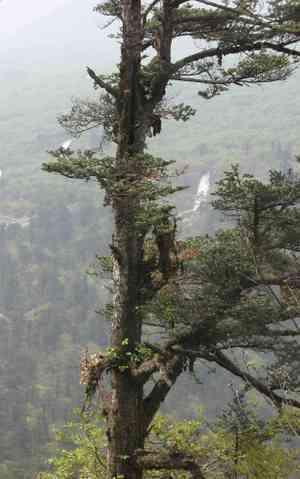
Faber's fir (Abies fabri)
Also known as: Faber's Fir, Faber fir
Faber's fir trees are tall evergreens, reaching heights up to 76 meters. They are easily identifiable by their slender, needle-like leaves, which attach to the branches with a unique, suction cup-like base. Unlike pine cones, the cones of Faber's fir stand upright on the branches and are more elongated. The trees have a distinctive conical shape and dense foliage, with smooth gray bark on younger trees that becomes rough and fissured as they age.
In This Article
Attributes of Faber's fir
Lifespan
Perennial
Plant Height
Mature trees typically reach heights of 15-25 meters.
Spread
The crown diameter of mature trees can reach up to 6-8 meters.
Leaf Color
The leaves are dark green on the upper surface and have two white stomatal bands on the underside.
Flower Size
N/A - Faber’s fir is a conifer and does not produce flowers.
Flower Color
N/A
Quickly Identify Faber's fir
1
Faber's fir can be identified by its needle-like leaves that are dark green on the top and have two white stomatal bands underneath. The cones are cylindrical, standing upright on the branches, turning from green to brown as they mature.
Scientific Classification of Faber's fir
Phylum
Vascular plants
Class
Conifers
Order
Pines and allies
Family
Pine
Genus
Firs
Species
Faber's fir
Planting and Growing of Faber's fir
Care Difficulty
Moderate
Watering Schedule
Every 2 days
Sunlight Requirements
Partial sun
Sunshine Duration
4-8 hours
Ideal Temperature
50-70℉
Soil Type
Potting Mix, Peat Mix
Soil pH
5.5-6.8
Fertilizer Type
Balanced
Pruning Season
Spring, Summer
Pruning Area
Branches, Leaves
Pruning Frequency
2 times a year
Repotting Season
Spring
Pot Type
Plastic, Ceramic
 How to Water Faber's fir?
Abies fabri thrives with soil that remains consistently moist but not waterlogged. It's important to aim for 600 ml of water per session, ensuring the moisture penetrates deeply to reach the root systems while avoiding water pooling at the base.
What are the symptoms of an underwatered Faber's fir?
›
What should I do if my Faber's fir is not getting enough water?
›
What are the symptoms of an overwatered Faber's fir?
›
How to save an overwatered Faber's fir?
›
 What Are the Sunlight Requirements for Faber's fir?
Partial sun exposure is perfect, providing the right balance of light needed. Benefits include more vibrant needle color, sturdy growth, and enhanced natural resistance.
Understanding ideal sunlight exposure
›
Solutions for optimal sunlight
›
Benefits of optimal sunlight
›
 What Is the Ideal Temperature Range for Faber's fir?
The ideal temperature range for Abies fabri, also known as Faber's fir, is between 50°F and 70°F. This range promotes optimal growth and health by ensuring that the physiological processes of the plant can function properly without the stress that extreme temperatures can cause. Abies fabri, native to certain regions in China, is adapted to temperate climate conditions, making this temperature range conducive for growth.
 What Soil is Best for Faber's fir?
Abies fabri thrives in well-drained soil, which prevents waterlogging that could lead to root rot. Proper drainage ensures roots receive enough oxygen, promoting healthy growth. Although well-drained, the soil should retain enough moisture to support Abies fabri's hydration needs, especially during dry spells. This balance aids in maintaining vibrant foliage. Nutrient-rich soil ensures that Abies fabri gets all the essential nutrients for growth and resistance against diseases, making the tree flourish sustainably.
 How to Fertilize Faber's fir?
Abies fabri, commonly known as Faber's Fir, benefits from a balanced approach to fertilization. It's essential to use a complete fertilizer with equal parts of nitrogen, phosphorus, and potassium, typically in a 10-10-10 NPK ratio. The amount should be carefully measured: for young trees, apply approximately 50 grams per square meter of root zone. Mature trees require around 100 grams per square meter, spread evenly around the base. Be cautious not to over-fertilize, as this can lead to nutrient runoff and potential damage to the roots and surrounding ecosystem.
 How to Prune Faber's fir?
Start pruning in late spring or early summer when the tree is actively growing. This timing helps in quick recovery and reduces the chances of introducing diseases through fresh cuts. First, target any dead, diseased, or broken branches. Removing these ensures the tree's energy is directed towards healthy growth and reduces the risk of spreading disease through the plant. When shaping, aim to maintain the natural form of the tree. Make cuts just outside the branch collar, avoiding flush cuts that harm the tree. Regular shaping encourages a stable structure and balanced growth.
More About Pruning Techniques→
 How to Propagate Faber's fir plant?
1
Gather cones from mature Abies fabri trees in early autumn. Once collected, extract the seeds and allow them to dry. Store seeds in a cool, dry place until you are ready to plant them in the early spring.
2
In late spring, select healthy stems for cutting. Use sharp pruning shears to trim a 6-8 inch piece. Remove any lower leaves to reduce water loss and dip the cutting in rooting hormone before planting.
3
Choose a sturdy, healthy rootstock for grafting. In early autumn, select a compatible scion from Abies fabri. Make a clean cut on both the scion and rootstock to ensure good contact and secure with grafting tape.
 How to Repot Faber's fir plant?
1
Repotting Abies fabri is essential when you observe roots emerging from the drainage holes or soil compaction on the surface, signaling restricted root growth. Ideally, repot in early spring or autumn when the plant's growth activity begins or ends. This timing allows the plant to establish roots without the stress of high summer temperatures or winter dormancy.
2
Choose a pot that is 2 inches larger in diameter than the current one. Ensure it has drainage holes to prevent water logging, which can lead to root rot. A slightly larger pot allows roots to expand comfortably, providing ample nutrients and space for water circulation, crucial for Abies fabri's vitality.
3
Opt for a well-draining loam mix enriched with organic matter like compost. This composition retains necessary moisture without becoming waterlogged, simulating the natural forest floor habitat of Abies fabri. Enhanced aeration and balanced nutrients in the soil support robust root and foliar development.



