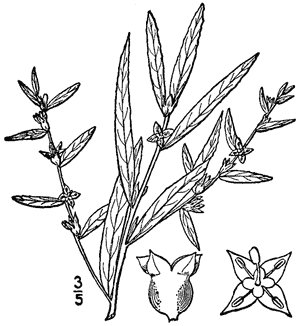
Globefruit primrose-willow (Ludwigia sphaerocarpa)
Also known as: None
The globefruit primrose-willow (Ludwigia alata) thrives in wet, marshy environments through several specialized adaptations. It features small yellow flowers that bloom above the water, supported by buoyant, spongy stems that assist in flotation and oxygen transport. The plant's distinctive, ball-shaped fruits contribute to its name, while its narrow leaves help maintain a streamlined profile. These adaptations enable the globefruit primrose-willow to effectively sustain itself in flood-prone areas by facilitating buoyancy, oxygenation, and efficient nutrient uptake.
In This Article
Attributes of Globefruit primrose-willow
Lifespan
Perennial
Plant Type
Herb
Plant Height
30-100 cm
Spread
30-90 cm
Leaf Color
Green
Flower Size
1-1.5 cm
Flower Color
Yellow Green
Images of Globefruit primrose-willow
Quickly Identify Globefruit primrose-willow
1
To identify Ludwigia sphaerocarpa, look for its distinctive spherical seed capsules, alternating leaves, and its yellow flowers. The plant usually grows in moist or aquatic environments.
Scientific Classification of Globefruit primrose-willow
Phylum
Vascular plants
Class
Dicotyledons
Order
Myrtales
Family
Evening primrose
Genus
Primrose-Willow
Species
Globefruit primrose-willow
Planting and Growing of Globefruit primrose-willow
Care Difficulty
Easy
Watering Schedule
Every 8 days
Sunlight Requirements
Partial sun
Sunshine Duration
4-8 hours
Ideal Temperature
70-85℉
Soil Type
Potting Mix, Peat Mix
Soil pH
6.5-7.5
Fertilizer Type
Balanced
Pruning Season
Spring, Summer
Pruning Area
Branches, Leaves
Pruning Frequency
2 times a year
Repotting Season
Spring
Pot Type
Terracotta, Plastic
 How to Water Globefruit primrose-willow?
Ludwigia sphaerocarpa thrives in consistently moist conditions. Ensure you water until the soil is saturated but not waterlogged. The soil should feel damp to the touch, reaching down at least an inch without pooling on the surface.
What are the symptoms of an underwatered Globefruit primrose-willow?
›
What should I do if my Globefruit primrose-willow is not getting enough water?
›
What are the symptoms of an overwatered Globefruit primrose-willow?
›
How to save an overwatered Globefruit primrose-willow?
›
 What Are the Sunlight Requirements for Globefruit primrose-willow?
Partial to full sun is ideal for Ludwigia sphaerocarpa, allowing it to photosynthesize efficiently and maintain its vivid coloration, essential for optimal growth and health.
Preferred Sunlight Intensity
›
Solutions for Optimal Light
›
Benefits of Optimal Light
›
 What Is the Ideal Temperature Range for Globefruit primrose-willow?
The ideal temperature range for Ludwigia sphaerocarpa is between 70°F and 85°F. This range promotes the best growth and flowering, ensuring that the plant develops strong, healthy leaves and stems. Staying within these temperatures also helps to minimize stress, which can lead to increased disease resistance and a longer lifespan for the plant.
 What Soil is Best for Globefruit primrose-willow?
Ludwigia sphaerocarpa thrives best in well-drained soils which prevent waterlogging. Optimal drainage enhances root oxygenation and reduces the risk of root rot, promoting healthier growth and vibrant blooms. A nutrient-rich soil provides the essential elements for Ludwigia sphaerocarpa's growth. The presence of organic matter boosts fertility, enabling vigorous development and a lush appearance. Maintaining a balance of moisture retention and aeration in the soil is key. This ensures that the plant remains hydrated without suffocating the roots, fostering a thriving environment.
 How to Fertilize Globefruit primrose-willow?
Ludwigia sphaerocarpa thrives with moderate amounts of fertilizer. When using liquid fertilizers, a teaspoon mixed in a gallon of water is sufficient. For slow-release granules, a gentle scattering around the base is adequate. Ensure not to overdose as this can lead to nutrient burn and harm the plant.
 How to Prune Globefruit primrose-willow?
Begin by inspecting the plant for any dead, damaged, or diseased stems and leaves. These parts should be removed first to prevent further health issues and to allow you to see the plant's overall structure more clearly. To maintain a neat and aesthetic appearance, follow the natural shape of the plant. Trim back long, unruly branches and encourage bushier growth by making cuts just above leaf nodes. Be careful not to remove more than one-third of the plant at any one time to prevent stress. To promote flowering, focus on removing faded blooms and weak stem tips. This redirects the plant's energy towards producing new buds. Consistent deadheading and pinching can yield more vibrant blossoms.
 How to Propagate Globefruit primrose-willow plant?
1
Collect seeds from mature fruits when they appear brown and dry. Clean the seeds by removing any remaining pulp to avoid decay during propagation.
2
Select healthy, non-flowering stems to use as cuttings. Cut below the node and ensure each cutting is about 4-6 inches long to promote successful rooting.
3
Carefully dig up the plant and separate the rhizomes, ensuring each has several shoots and roots. This promotes healthy and vigorous new growth when replanted.
 How to Repot Globefruit primrose-willow plant?
1
Repotting Ludwigia sphaerocarpa is crucial when you notice its roots heavily circling inside the pot or poking out of the drainage holes. Spring and early summer provide optimal growth conditions, allowing the plant to recover faster from the shock of repotting.
2
Select a pot that is about 2 inches larger in diameter than the current one, to give roots ample room to expand. Opt for clay pots if overwatering is a concern; their porous nature helps in regulating moisture.
3
Choose a well-draining soil mix high in organic matter. This mix supports the delicate root system and ensures the right balance of moisture and nutrients, which aids in preventing waterlogging and promoting healthy growth.
Learn More About Globefruit primrose-willow Diseases
Anthracnose
Bacterial Leaf Spot
Bacterial Soft Rot
Bacterial Wilt
Crown Gall
Cyst Nematode
Damping-off
Downy Mildew
Drought Stress
Fusarium Wilt
Gray Mold
Leaf Spot
Mosaic
Nutrient Deficiency
Nutrient Toxicity
Powdery Mildew
Root Rot
Root-knot Nematode
Rusts
Sooty Mold
Spider Mites
Temperature Stress
Thrips Damage
White Mold



