American slippery jack

Suillus americanus

A species of Slippery jacks. Also known as Chicken fat mushroom.

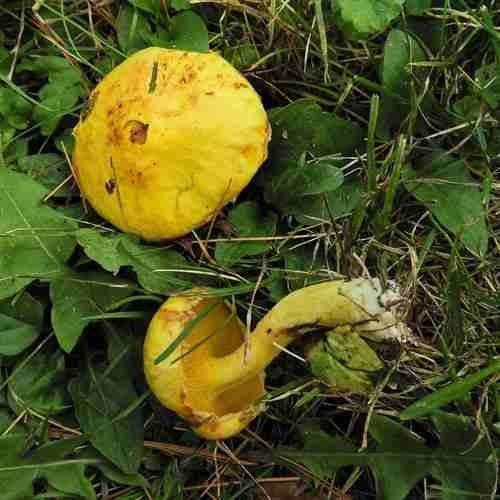
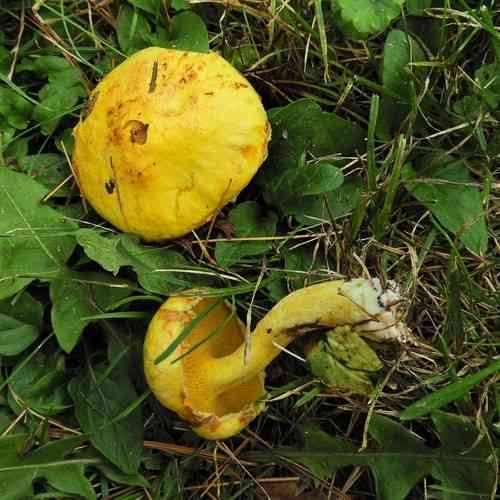
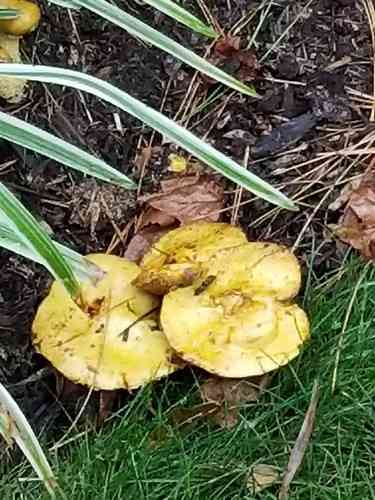
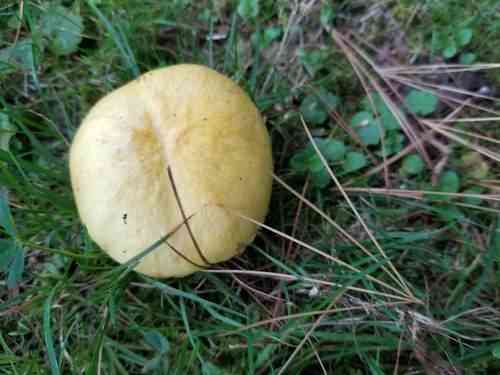
Often spotted beneath white pines during the summer months, the American slippery jack truly embodies its name with a cap that's distinctly slimy, much like the texture of chicken fat. Its muted, yellow-brown shade is also an identical match.

In This Article
Attributes Classification Toxicity

Attributes of American slippery jack

ForwardPlant - ID plants and mushrooms, and learn more about them🌿

Identify and diagnose plants, get toxicity alerts, and explore safety guides for all types of fungi.

Try for Free
Cap Diameter
3 - 10 cm
Height
5 - 11 cm
Cap
Cap 3 - 10 cm; convex to wavy; bright yellow; slimy
Cap Shape
Convex, Flat, Central Bump
Cap Surfaces
Slimy or slightly sticky, Fibrillose-scaly
Stem
Stem 3 - 10 cm long, up to 1 cm thick; frequently crooked; with reddish brown glandular dots
Stem Shapes
Cylindrical
Stem Surfaces
Smooth to slightly fibrous
Flesh
Yellow throughout, staining purplish brown
Ring
With Ring Zone
Spore Print Color
Cinnamon brown
Odor
Mildly mushroomy but not distinctive.
Flesh Bruises
Discolor to pink or red
Growth Form
Scattered, Gregarious
Nutrient Gathering
Mycorrhizal
Substrate
On soil
You can find American slippery jack by these plants
Eastern white pine, Limber pine
Occurence Habitats
Coniferous Woodland
Species Status
Widely distributed
Endangered Species
No

Scientific Classification of American slippery jack

ForwardPlant APP

AI mushroom expert in your pocket

Try for Free
Phylum
Club fungi
Class
Mushroom-forming fungi
Order
Boletes and allies
Family
Suillaceae
Genus
Slippery jacks
⚠️

Toxicity and Edibility of American slippery jack

ForwardPlant: Identify & Forage

Your Essential Guide to Edible vs. Toxic Mushrooms. Forage with Confidence!

Try for Free

Is American slippery jack Toxic?

While not overtly poisonous, this species has been observed to elicit unique and unpredictable responses in some people. Of particular note is the skin irritation that can arise from simple contact with the mushroom. Furthermore, consuming the gelatinous coating on the cap may result in digestive discomfort for certain individuals. This fungus predominantly establishes symbiotic connections with five-needled pine trees and can be found across North America, Europe, and Asia in regions where these pines are present. Due to these potential adverse effects, it is recommended to exercise prudence when interacting with american slippery jack.


Type of poisoning
Allergic
Toxic Severity
Low toxicity
Incubation Period
0.5-24 hours
Poisoning Symptoms
Individual responses to a mushroom allergy can differ widely, with reactions spanning from slight to intense, including skin rashes, itching, swelling in the mouth, stomach upset, and respiratory issues. In severe cases, it can lead to anaphylaxis, which requires immediate medical attention.