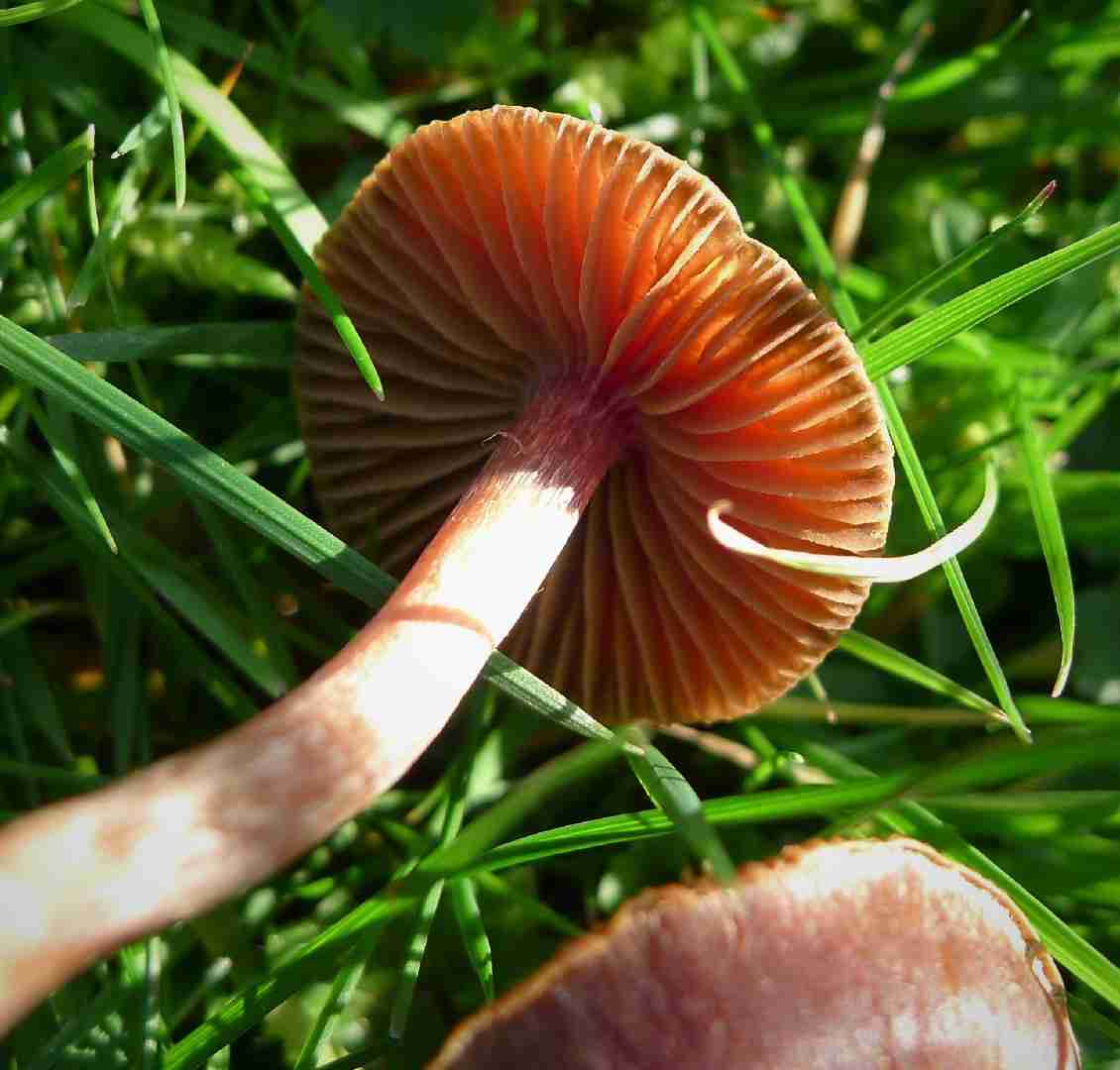
Sepia webcap
Cortinarius decipiens
A species of Cortinar.
The sepia webcap, a common fungus, is characterized by its brownish, often convex or flattened cap. Its gills, located underneath, transition from rusty to brown as the mushroom matures. This species primarily thrives in woodland environments, where it establishes intricate connections with trees and plays a vital role within the forest ecosystem.
In This Article
Attributes of Sepia webcap
Cap Diameter
2 - 5 cm
Height
3 - 8 cm
Cap
Cap 2 - 4.5 cm across; sharply conical to broadly convex; vinaceous buff; with fine radial fibrils
Cap Shape
Bell-shaped, Convex, Central Bump
Cap Surfaces
Fibrillose-scaly
Gills
Adnate; moderately crowded; greyish ochraceous to reddish cinnamon
Gill Attachment
Attached
Stem
Stem 3 - 7 cm long, 2 - 5 mm thick; pale yellowish grey stem; fibrous; with white fibrils
Stem Shapes
Cylindrical
Stem Surfaces
Fibrillose
Ring
With Ring Zone
Spore Print Color
Rust-brown
Odor
Faint radish-like smell.
Body Color
YellowPurple
Flesh Bruises
The flesh or milk does not discolor when bruised or cut.
Growth Form
Scattered, Gregarious
Nutrient Gathering
Mycorrhizal
Substrate
On soil, Mosses
You can find Sepia webcap by these plants
Oaks, Spruces, Pines, Willows
Occurence Habitats
Deciduous Woodland
Species Status
Uncommon but not rare
Endangered Species
No
Scientific Classification of Sepia webcap
Phylum
Club fungi
Class
Mushroom-forming fungi
Order
Gilled fungi
Family
Cortinariaceae
Genus
Cortinar
Toxicity and Edibility of Sepia webcap
Is Sepia webcap Toxic?
Toxicity information is not available for this mushroom. Always consult with an expert before consuming any wild mushrooms.

