How to Propagate Cat greenbrier?
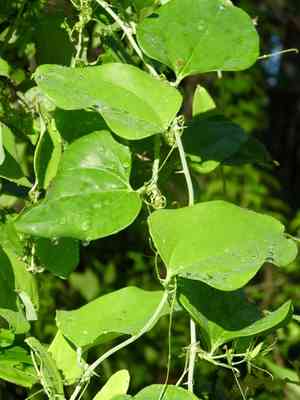
Smilax rotundifolia is most effectively multiplied by separating its root ball during the prime periods of spring and fall. This technique is relatively straightforward, with indicators of success being fresh shoots and healthy foliage. Verify that each separated section possesses a substantial root system to enhance its chances of thriving.
Optimal Time for Cat Greenbrier Propagation
Propagation Method
Division
Propagation Period
Spring,Autumn
Tools for Cat Greenbrier Propagation
Sharp, sterilized pruning shears
These are vital for making clean, safe cuts through the roots and rhizomes of cat greenbrier during division. Sterilization prevents disease transmission, and sharp blades ensure smooth cuts, aiding faster recovery and reducing plant stress.
Soil knife or hori-hori
This instrument helps gently loosen the soil around cat greenbrier without causing significant root damage. Its dual function as a knife and trowel makes it perfect for carefully extracting plant sections during division with minimal disturbance to the root system.
Watering can with a fine rose attachment
Post-division, it's essential to water cat greenbrier gently to help settle the soil and eliminate air pockets around the roots. A fine rose attachment disperses water evenly and delicately, minimizing soil erosion or root exposure.
Rooting hormone powder or gel
This encourages faster root development in newly divided cat greenbrier sections. Applying rooting hormone to cut surfaces can boost root growth and establishment, which is crucial for successful cat greenbrier propagation.
Quality potting mix or garden soil
A well-draining and nutrient-rich medium is essential for newly propagated cat greenbrier sections to flourish. The correct soil mixture provides necessary support, moisture, and nutrients, vital for initial root establishment and growth.
How to Propagate Cat Greenbrier?
Propagation Type
Easy
Caring for Your Newly Propagated Cat Greenbrier
Caring for Your Newly Propagated Cat Greenbrier
After propagation, place cat greenbrier in an environment that mimics its natural habitat, typically partial shade and moist, well-drained soil. Avoid harsh, direct sunlight as it can scorch leaves. Maintain soil moisture, especially in dry conditions, without overwatering, which can lead to root rot. Monitor for common cat greenbrier pests and diseases, treating any infestations promptly to prevent spread. Mulching can help retain soil moisture and suppress competing weeds.
Common Propagation Mistakes for Cat Greenbrier
Overwatering during rooting
Excessive moisture can cause root rot, significantly reducing the success rate of cat greenbrier propagation.
Using overly mature or young stem cuttings
Cuttings that are either too old or too young may not root effectively, leading to poor establishment and growth of cat greenbrier.
Failing to control environmental conditions
Without proper humidity and temperature regulation, cat greenbrier cuttings may fail to establish, as these conditions are vital for successful rooting.
Tips For Propagating Cat Greenbrier
Use semi-hardwood cuttings
Choose semi-hardwood cuttings, which tend to root more effectively and are sturdy enough to support the initial growth phases of cat greenbrier.
Maintain optimal humidity
Ensuring a consistently high humidity environment helps prevent cuttings from drying out, which is crucial for the rooting process of cat greenbrier.
Careful water management
Provide sufficient moisture to keep the soil slightly damp but not waterlogged, to support healthy root development without causing rot.



