How to Propagate Partridge pea?
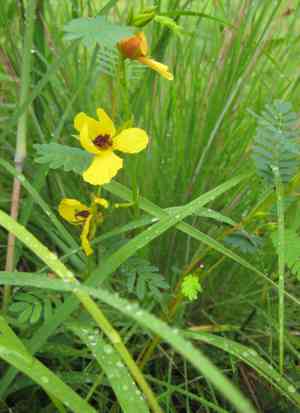
For Chamaecrista fasciculata, the prime period for reproduction is Spring, with planting seeds being the favored technique. Reproduction is quite straightforward, with the appearance of young plants signifying success. Sufficient hydration and illumination are crucial for peak development.
Optimal Time for Partridge Pea Propagation?
Propagation Method
Seeding
Propagation Period
Spring
Essential Tools for Partridge Pea Propagation?
Seed trays
Shallow containers designed for organized seed sowing, providing ample space for each partridge pea seed to prevent crowding. They aid in managing moisture levels, crucial for successful germination.
Sterile potting mix
A clean, disease-free growing medium that supports healthy partridge pea seedling development. It ensures proper air circulation and drainage while retaining adequate moisture for seed sprouting.
Heat mat
Gently warms the soil, accelerating partridge pea seed germination by maintaining a consistent, ideal temperature, especially useful in cooler conditions or climates.
Humidity dome
Covers seed trays to maintain high moisture levels around partridge pea seeds, vital for preventing soil dryness and assisting the germination process.
Fine mist spray bottle
Allows for delicate watering of partridge pea seeds and young plants, minimizing soil disruption and providing appropriate moisture without over-saturation.
Tweezers
Useful for handling small partridge pea seeds, ensuring precise placement in the potting mix without damage, and assisting with thinning seedlings when needed.
Labels and marker
Labeled with a permanent marker, these help identify sown partridge pea seeds and track their progress, ensuring proper care and monitoring throughout the propagation phase.
How to Propagate Partridge Pea?
Propagation Type
Sowing
Difficulty Level
Easy
Caring for Your Newly Propagated Partridge Pea?
Caring for Your Newly Propagated Partridge Pea?
Post-propagation, partridge pea seedlings require ample sunlight and well-draining soil to flourish. They tolerate drought but benefit from occasional watering during extended dry periods. Partridge pea is an annual that readily self-seeds, so minimal care is needed once established. Fertilization is generally unnecessary unless the soil is very poor. Monitor for pests and diseases, though partridge pea is typically quite resilient. Deadheading is not required as partridge pea is often cultivated for its seed pods, which provide sustenance for wildlife.
Common Errors to Avoid When Propagating Partridge Pea
Overwatering
Saturated soil can lead to root rot in partridge pea, as it prefers well-drained conditions. Excessive moisture can reduce oxygen availability to roots, causing suffocation and increasing disease susceptibility.
Planting seeds too deep
Partridge pea seeds need sufficient light for germination. Planting them too deeply may prevent adequate light exposure, hindering sprouting and leading to poor yields or failed propagation.
Ignoring pre-treatment of seeds
Partridge pea possesses a tough seed coat, which can impede water absorption and delay germination. Failing to pre-treat seeds before sowing can significantly lower germination rates.
Crowded planting
Sowing seeds or planting partridge pea too closely can result in competition for light, nutrients, and space. This can lead to weaker plants more vulnerable to diseases and pests.
Neglecting to handle with care
Partridge pea can be sensitive to root disturbance. Rough handling during transplanting can damage roots, stressing the plant and potentially hindering growth or even causing plant death.
Tips For Propagating Partridge Pea
Proper seed depth
Sow partridge pea seeds at a shallow depth, just enough to lightly cover them with soil. This ensures they receive adequate light for germination while remaining anchored.
Scarification of seeds
Scarify the hard seed coat of partridge pea by gently nicking the seeds with a file or soaking them in hot water to improve water uptake and promote more uniform germination.
Adequate spacing
Provide sufficient space between partridge pea seeds or seedlings to ensure good air circulation and reduce the risk of fungal diseases, while allowing each plant ample resources for vigorous growth.
Gentle transplanting
When transplanting partridge pea, carefully support the root ball to minimize disturbance. This encourages rapid establishment and reduces transplant shock in the plants.
Well-drained soil
Ensure that partridge pea is planted in well-drained soil to prevent waterlogging. Good drainage is crucial for the health of partridge pea, fostering strong root development and reducing disease risk.



